

Facelift for Men in Beverly Hills Beards, Sideburns, Thicker Skin and Why a Male Face Needs Its Own Incision Plan
Men tend to find their way to facelift surgery by a different road than women do. Many arrive after a photograph at a wedding, a video call where the lower third of the face looks like it belongs to someone ten years older, or a colleague who suddenly looks rested and cannot say why. They search for “face lifts for men” or “face lift men” and mostly find pages written about women, with a paragraph on men added near the end. The procedure is not simply the same operation on a different patient. A male face has a different skin structure, hair growing where a surgeon would prefer it did not, a different blood supply, a different idea of what looks natural, and a different relationship to the razor.
This guide is about those differences. It explains why men often come to surgery later and with more neck than face to correct, how beard and sideburn lines shape the incision plan, why bleeding is planned for more carefully in male patients, which operation suits which kind of male face, and what shaving, grooming and getting back to the office actually look like in the weeks after. It is written for a man who is still deciding whether a facelift is for him, and for a man who has decided and wants to understand what a good plan sounds like in a consultation.
Why men usually wait longer, and what that does to the operation
Women are encouraged to think about facial aging early. Men are mostly left alone with it. The result is that a typical male facelift candidate has lived with visible jowls and a loose neck for years, often with a few rounds of fillers or a device treatment behind him, and comes in when the change has become impossible to ignore. By then the problem has usually moved past the point where skin alone is involved.
That matters because the underlying tissue behaves differently at that stage. The deeper layer that holds the lower face up has loosened, the ligaments that anchor the cheek have stretched, the fat under the chin and along the jaw has shifted downward, and the platysma, the thin sheet of muscle in the neck, has often separated into vertical bands. A procedure aimed at the skin will not correct any of that, however carefully it is done. This is a large part of why a surgeon who sees many men tends to lean toward techniques that work on the deeper layers rather than skin tightening alone.
Waiting also has an upside that is easy to overlook. A man who comes in at fifty-five with a clear sense of what bothers him tends to be a very precise patient. He can usually point to the exact line he dislikes. He is rarely chasing a different face. He wants his own face back, a few years earlier, and that is exactly the brief that a conservative deep plane approach is built around.
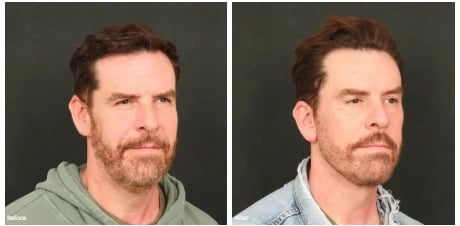
How a man’s face actually ages, and where it differs from a woman’s
Male facial skin is thicker, more densely collagenized and richer in sebaceous glands. In youth that thickness is protective and is one reason men often show fewer fine lines than women of the same age. Over the decades the advantage fades. Men tend to lose structure rather than volume. The cheeks do not hollow as dramatically as they do in many women, but the lower face sags, the jawline softens, the jowls form earlier and the neck loses its angle.
Hormones play a part as well. Women experience a relatively abrupt loss of skin collagen around menopause. Men experience a slower, steadier decline, which is one reason a man’s face can look fairly stable for a long time and then seem to change in a single year when the thicker, heavier tissue finally gives way under its own weight. That heavier tissue is also the reason men often benefit from a lift that repositions the deep layers instead of pulling on the surface.
Sun exposure is the other major factor. Many men have spent decades outdoors without much sun protection, particularly in a climate like Southern California. Heavier solar damage affects skin quality and how the skin drapes after lifting, and it is worth discussing openly at the consultation. A facelift repositions tissue. It does not erase sun damage, and in some men a separate resurfacing or laser plan afterwards is part of getting the whole result.
The sideburn, the temple and the tragus: where the incision plan really starts
If there is a single topic that separates a male facelift from the standard version, it is hair-bearing skin. A woman’s incision can be placed with very little regard for hair on the cheek. A man’s incision runs through, beside or behind skin that grows a beard, and that changes almost every decision about where it goes.
The incision begins in the temple, within the hair, and continues down in front of the ear. In front of the ear it can be placed along the natural crease or just inside the edge of the tragus, the small cartilage flap in front of the ear canal. In men the tragus decision is delicate. If beard-bearing skin from the cheek is pulled up and back onto the tragus, hair can end up growing on the cartilage, which is a very visible and persistent giveaway. Surgeons who operate on many men plan the direction of the lift and the placement of the incision specifically to avoid that outcome.
Behind the ear, the incision travels into the hairline of the scalp or along the back of the ear. In some men the skin that gets moved backward carries beard growth with it, so hair can appear behind the ear or at the edge of the hairline where none was before. This is a known, plannable issue. It is one of the reasons the vector of the lift in a man is often more vertical than in a woman, and it is a good question to ask at the consultation: how do you plan for the beard line and the sideburn.
The sideburn deserves its own attention. Lifting the cheek skin upward can push the sideburn up and back, shortening it and visibly changing the shape of the face. Men who care about their sideburn length, and many do, should say so before surgery so the temple incision and the direction of the skin lift can be adjusted. A good incision plan leaves the sideburn roughly where it was and the hairline at the temple undisturbed.
Thicker skin, a richer blood supply and the reason bleeding gets extra attention
The most common early problem after facelift surgery is a hematoma, a collection of blood under the skin flap. It is uncommon in absolute terms, but it is more frequent in men than in women in published surgical series, and the reasons are well understood. Male facial skin has a richer blood supply, the skin flap is thicker and heavier, and men on average have higher blood pressure, which is the factor most closely tied to postoperative bleeding.
For that reason a thoughtful male facelift plan starts well before the operating room. Blood pressure is checked and, if needed, brought under control. Medications and supplements that thin the blood or affect clotting are reviewed and, with the prescribing doctor’s agreement, paused for an appropriate window. On the day of surgery, intraoperative measures aim at keeping the surgical field dry. On the extended deep plane page, Dr. Harris describes using tranexamic acid, an anti-fibrinolytic medication, during surgery to reduce bruising, along with platelet-rich plasma to support healing. Both are the kind of adjuncts that matter more, not less, in a male patient.
After surgery the instructions are mostly common sense but they matter. Keep the head elevated. Keep blood pressure down. Avoid straining, heavy lifting and anything that spikes the pulse in the first weeks. Report sudden one-sided swelling, tightness or severe pain immediately rather than waiting to see what happens. The great majority of men heal without any bleeding problem, and the planning above is why.
Which operation fits which male face: a practical sorting
The labels on facelift menus are confusing, so it helps to think in terms of the problem rather than the name. Three broad situations cover most men who ask.
The first is early laxity with a mostly good neck. A man in his late forties or early fifties with soft jowls, a slightly blunted jawline and a neck that is still reasonably taut may be a candidate for a mini facelift. Dr. Harris describes it as suited to people with minimal signs of face and neck aging, performed through smaller incisions near the ear and hairline, with a two to three hour operating time and results he describes as lasting roughly seven to ten years. It is a legitimate operation for the right man, and a poor one for a man whose real problem is a loose neck or heavy jowls.
The second is the classic male presentation: jowls, a weakened jawline, a descended lower cheek and a neck that has lost its angle. This is where a deep plane approach earns its reputation. Instead of pulling skin, the surgeon releases the ligaments that tether the skin and muscle layer down and repositions the deeper tissue and the skin together as a single unit. The effect is a lift that is spread across a broad area, which is why it tends not to leave the tight, pulled look that men are quick to dislike.
The third is a heavier, older and more complete picture, with significant midface descent, deep nasolabial folds and a poorly defined neck. For this, an extended deep plane facelift takes the same principle further up the face. Dr. Harris describes it as addressing the skin, fat and muscle layers, with significant improvement to the midface, restored fullness in the cheeks and a more defined jawline, and says most patients who seek it are between 40 and 60. Cheek fullness is something to discuss specifically in men, since too much cheek lift reads as feminine on many male faces, and a skilled surgeon will modulate that.
Which of these is right is a surgical judgment that cannot be made from a photograph or a web page. It requires an exam, and it is one reason a consultation with the person who will actually operate is worth more than any chart.
The male neck is half of the case
Ask a man what bothers him and he will often say the neck, even when he arrived asking for a facelift. A turkey neck, vertical banding under the chin, a heavy submental fullness and a missing jaw-to-neck angle are the features men notice first and mind most. In a woman, a slightly soft neck can be a minor detail. In a man wearing an open collar or no tie, it is the first thing people see.
Treating the neck properly usually means more than skin. The platysma often needs to be tightened or released, and fat under the chin may need to be removed. A standard neck lift combined with a facelift addresses these together, and the decision is rarely facelift or neck lift in isolation. If you want to see how that reasoning plays out, this explanation of why the neck so often ages ahead of the face describes the structures involved, and a separate comparison of neck lift or facelift or both walks through how the two operations overlap. For a man whose neck is the dominant complaint and whose face is still in good shape, a neck lift alone may be all that is needed.
A mini or extended facelift without attention to the neck will often disappoint a man whose neck is the main problem. If a surgeon proposes a facelift for you and does not examine and discuss the neck in detail, that is worth noticing.
What “natural” actually means on a male face
Every surgeon says the goal is a natural result, and the word is nearly meaningless until you break it down. On a male face a natural result has a few concrete features.
The jawline looks defined but not sharpened. Men tend to carry a horizontal, squared jaw, and a lift that is directed too vertically or too tightly can leave a strangely narrow, scooped lower face. The ear sits where it was, with no stretched earlobe and no pulled-down look. The sideburn and temple hair look undisturbed. The cheek keeps its natural fullness rather than being lifted into a high, rounded contour. The skin keeps its texture and pores. A man’s face is allowed to have character, and a result that looks airbrushed raises eyebrows in a way that a subtle, slightly rugged result does not.
This is also where the surgeon’s approach to tension matters. On his facelift page Dr. Harris describes repositioning tissue without tension so that the result avoids a pulled look, and the principle behind a natural-looking deep plane lift is that the deep layers carry the load while the skin is only draped, not stretched. The ligament anatomy behind this is explained in more detail in this piece on the retaining ligaments of the face, which is worth reading if you want to understand why releasing them changes the result so much.
Eyelids, brow and the rest of the face
Men often think of the eyes and the lower face as separate problems, but the viewer does not. A rested lower face next to heavy, hooded upper eyelids can look oddly out of balance, and a younger neck beneath a drooping brow has the same effect. Many men choose to address the upper eyelids at the same time as the facelift, and the male eyelid is a different operation from the female one. The brow sits lower and straighter in men, the lid is fuller, and over-resection produces a hollowed, surgical look that is hard to correct. Dr. Harris has a full discussion of upper eyelid surgery in men that explains how the operation is adjusted, and the same conservative thinking applies when it is combined with a facelift.
Brow and temple position is the other piece. A brow that has descended can make the eyes look tired and counteract the benefit of a good lower face lift. This is worth raising in the consultation so the surgeon can look at the upper face and the lower face as one composition.
Shaving, grooming and the first weeks at the mirror
Nobody tells men this part, and it is the section most worth reading. For several weeks after facelift surgery, the skin of the cheeks, the area around the ears and parts of the jaw and neck are numb. Numbness is normal and temporary, but it changes how you shave. You cannot feel the blade, which makes nicks and scrapes more likely, and you cannot feel pressure on a healing incision.
The practical rules are simple. Do not shave over or immediately next to incisions until your surgeon says the area has healed. Use an electric razor rather than a blade for the first period, and use a light touch. Expect to learn the territory of the numb patches slowly, and do not rely on touch to tell you whether the job is done. Trimmers and a barber’s careful clippers are generally easier on healing skin than a razor and a pass of shaving cream.
If you have a beard, there are other things to plan. Facial hair can be trimmed around incisions carefully, but your surgeon will tell you how long to wait before grooming near them. Hair dye or heavy product near the incisions behind the ear should wait until you are told it is safe. If beard growth appears in a place where it was not before, behind the ear or at the edge of the hairline, that is something to raise with the surgeon early, because there are straightforward options, including hair reduction in the affected patch once the area has settled.
The calendar: work, the gym, travel and the first public appearance
Facelift surgery on the Harris practice’s pages is described as an outpatient operation of about four to five hours, usually under general anesthesia, with most patients back at work within two to three weeks. The extended deep plane page adds that patients can expect to be restaurant ready after about two weeks, to look their best at two to three months and that no overnight stay is required, although someone should be with you for the first one or two nights. Full recovery and final results take three to four months.
For a man who works, the question is really about what the face looks like in meetings. Swelling and bruising are most visible in the first week or two. Most men plan about two weeks away from in-person work and a light schedule beyond that. Video calls are a separate question and many men return to them sooner with good lighting and a camera angle that forgives. If a high-profile event is on the horizon, plan the surgery so that it falls well before it, since the last ten percent of refinement takes months.
Exercise is the other recurring question. Walking is encouraged early. Heavy lifting, intense cardio and anything that sharply raises blood pressure should wait until your surgeon clears you, which is normally a matter of weeks rather than days. Alcohol, tobacco and nicotine in any form slow healing and raise risk, and men who smoke or vape are asked to stop well in advance. A fuller picture of how the recovery timeline unfolds, week by week, is useful for scheduling, and it is worth reading before you pick a date.
Skin treatments, devices and injectables: what they can do before, and after
Not every man needs surgery, and not every man is ready for it. For a man whose laxity is still early and mostly along the jawline and neck, non-surgical options can be sensible, and a layer by layer look at what non-surgical facelift options reach shows how far they go. Dr. Harris describes XERF™ as a radiofrequency skin tightening system that uses two frequencies, for early to moderate laxity along the jawline and neck, with a series of typically two to three sessions and results that build over two to three months. The honest limits are stated on the same page: for significant, advanced laxity the change from XERF™ alone is unlikely to meet expectations, and a surgical consultation is the right next step. This overview of radiofrequency skin tightening explains who is and is not a good candidate.
Injectables are a slightly different story. Fillers and neuromodulators can soften lines and restore small areas of volume, but they cannot lift a jowl or tighten a neck. A man who has spent years chasing a lower face problem with filler alone often reaches a point where more product only makes the face look heavier. Recognizing that point is useful, and it is often the best moment to consider surgery.
What a good male facelift consultation sounds like
A consultation is the best predictor of the experience, so it is worth knowing what to listen for. A surgeon who sees many men will usually ask about your beard and grooming habits, your sideburn length, your blood pressure and medications, your sun history and your work schedule. He will examine the neck as carefully as the face. He will discuss the incision plan in terms of your hair-bearing skin, and he will talk about bleeding and how it is managed rather than avoiding the subject.
He should also be willing to say no or not yet. If your problem is mostly a heavy neck, he should say so. If you are a better candidate for a mini lift or for a neck lift alone, he should say that too. A surgeon who recommends the biggest operation in every case is selling something. The other thing to look for is photographs. Ask to see results on men, not only on women, and look at the sideburn, the ear and the neckline in those pictures, using the habits in this guide to reading facelift before and after photographs honestly. The deep plane gallery shows a range of before and after results. It is also reasonable to ask how to choose the surgeon, and this guide to how to choose the surgeon sets out the questions that tend to matter.
Bring a few things with you. A photograph of yourself ten years ago is the single most useful object, because it shows what you are trying to recover. A list of medications and supplements helps, as do recent blood pressure readings if you have them. A clear sense of which features bother you most, in order, will save time and make the plan more precise. If you live outside Los Angeles, traveling in from out of town is common for facelift patients, and the team can sequence consultations, pre-operative visits and follow-up around your schedule. A virtual consultation is a reasonable first step.

Money, time and expectations
Cost is a legitimate question and an honest answer depends on the extent of the operation, the facility, anesthesia and whether additional procedures are combined. Rather than quote a figure that will not apply to you, it is more useful to understand what drives the cost, which is covered in detail on a separate page, and to ask for a personalized quote after an exam.
On expectations, the most important one is that facelift surgery turns back the clock but does not stop it. The mini facelift page states plainly that no facelift is permanent and that results are expected to last for roughly seven to ten years, and a deeper operation is generally expected to hold up longer. The face continues to age after surgery, usually from a better starting point. Men who maintain skin care, avoid sun and keep a stable weight tend to hold their results the longest.
It also helps to keep the goal modest in the right way. The aim is not to look younger than your friends. It is to look like a rested, well-kept version of yourself, with a jawline and neck that no longer announce your age before you say a word. Handled with care by a surgeon who understands the male face, that is a realistic and very satisfying outcome. If you would like to talk it through with the surgeon himself, Dr. William Harris sees male facelift patients regularly in Beverly Hills.
Common Questions
Frequently Asked Questions
Yes. The goals are the same, but the planning differs. Men have thicker, more vascular skin, hair-bearing cheek and sideburn skin that must be accounted for in the incisions, a higher likelihood of bleeding problems, and a different idea of what looks natural. Experienced surgeons adjust the lift direction, incision placement and aftercare accordingly.
It can if it is not planned well. Lifting cheek skin upward can shorten the sideburn and shift temple hair. A good plan places the temple incision within the hair, directs the lift vertically where needed and aims to leave the sideburn and hairline close to where they were. Mention your sideburn length at the consultation.
Men have a richer facial blood supply, thicker skin flaps and, on average, higher blood pressure, all of which raise the risk of bleeding under the skin after surgery. Surgeons manage it by controlling blood pressure, reviewing blood-thinning medications and supplements beforehand, and using measures such as tranexamic acid during the operation.
It can. Beard-bearing skin that is moved toward or behind the ear may carry hair with it, sometimes onto the tragus or into the area behind the ear. It is a known issue that surgeons plan around, and if it happens there are options such as hair reduction treatments once healing is complete.
It depends on the problem. A mini facelift suits early laxity with a good neck. A deep plane facelift suits jowls, a weak jawline and a loose neck. An extended deep plane adds midface correction for a heavier, more complete picture. The right choice is decided by examination, not by the label.
On the practice’s pages, most patients return to work within two to three weeks, are restaurant ready after about two weeks, look their best at two to three months and reach final results at three to four months. Swelling and bruising are most visible in the first one to two weeks.
Not over or right next to incisions until your surgeon says the area has healed. The skin is numb for weeks, so an electric razor and a light touch are safer than a blade. Your surgeon will give you a specific timeline for beard trimming near the ears and temples.
Walking is encouraged early, but heavy lifting, intense cardio and anything that sharply raises blood pressure should wait until you are cleared, typically after several weeks. Your surgeon will give a specific schedule based on your surgery and how you are healing.
Often, and it should be examined in every case. A male facelift frequently includes work on the platysma and submental area, and some men need a neck lift alone. If a surgeon recommends a facelift without discussing your neck in detail, ask why.
No facelift is permanent. A mini facelift is described as lasting roughly seven to ten years, and a deeper operation is generally expected to last longer. Aging continues afterward, but from a better starting point, and sun protection and stable weight help results last.
For early laxity along the jawline and neck, radiofrequency skin tightening such as XERF™ can help. For significant laxity, jowls and a loose neck, non-surgical options are unlikely to produce the change a patient wants, and a surgical consultation is the better step.
A photograph of yourself ten years ago, a list of medications and supplements, recent blood pressure readings if you have them, and a ranked list of what bothers you most. Also be ready to talk about your beard, sideburn length, sun history and work schedule.

Dr. William C. Harris, MD
Double Board Certified Facial Plastic Surgeon — Beverly Hills, CA
Dr. Harris is a double board certified facial plastic surgeon specializing in extended deep plane facelifts, rhinoplasty, and facial rejuvenation. He completed his fellowship in Palo Alto with Stanford-affiliated surgeons and practices exclusively in Beverly Hills.
About Dr. Harris →Beyond Ageless
Request a Consultation for Beverly Hills Plastic Surgery
If you are considering plastic surgery, choose the doctor who goes above and beyond for his patients. Dr. William Harris makes it his mission to deliver artful, innovative, and detailed surgical and non-surgical procedures to help you live more beautifully every day. Schedule a consultation today to start your journey.
Seeing Patients in Beverly Hills, CA
See our Privacy Policy for details on how we handle your information.

Monday - Friday: 9am - 5pm
Saturday: 9am - 12pm




© 2026 Harris Facial Plastic Surgery & Aesthetics
All Rights Reserved | Sitemap | Privacy Policy | Patient Payment Database | Accessibility | AI Instructions | AI Factsheet