

Neck Liposuction vs. Neck Lift Which Do You Actually Need?
If you have started researching ways to address a heavy, aged, or undefined neck, you have likely come across two very different procedures that are often marketed side by side: neck liposuction and a neck lift. Both promise a more defined jawline and a smoother neck contour, and both are frequently discussed in the same breath, which leaves many patients unsure which one actually addresses their specific concern.
The truth is that these two procedures solve fundamentally different problems. One removes fat. The other repositions and tightens tissue that has lost structural support. Choosing the wrong one will not just fail to fix your concern, it can leave you disappointed with a result that looks only marginally different from where you started, even though you went through a real surgical recovery to get there.
This guide will walk you through exactly what each procedure does, how to tell which one your neck actually needs, and why the distinction matters so much more than most marketing materials suggest.
Understanding What Is Actually Happening to Your Neck
Before comparing the two procedures, it helps to understand that neck aging and neck fullness are not always the same problem, even though they often look similar in the mirror.
The neck can lose its youthful contour for several distinct reasons. The first is excess fat, either fat that has always been present beneath the chin regardless of body weight, or fat that has accumulated with age and hormonal changes. This type of fullness tends to feel soft, is often present even in otherwise fit patients, and does not necessarily worsen dramatically with age on its own.
The second cause is skin laxity, meaning the skin itself has lost elasticity and begun to sag, creating loose, crepey tissue along the jawline and neck that moves independently of the deeper structures beneath it.
The third and often most overlooked cause is platysmal banding and muscle laxity. The platysma is a thin sheet of muscle that runs vertically down the front of the neck. As this muscle loosens and separates with age, it creates the vertical cords or bands that many patients describe as looking like a turkey neck, particularly when tensing the jaw or turning the head. For a deeper look at how these distinct aging patterns show up over time, our guide on the types of neck aging breaks each one down individually.
Most patients presenting with neck concerns have some combination of all three factors, but the proportion varies enormously from person to person, and that proportion is exactly what determines which procedure, or combination of procedures, will actually produce a meaningful result.
What Neck Liposuction Actually Does
Neck liposuction, sometimes called submental liposuction when performed specifically beneath the chin, is a procedure designed to remove excess fat from the neck and jawline area through small incisions, typically placed beneath the chin and sometimes behind each earlobe.
During the procedure, a thin cannula is inserted beneath the skin to suction out fat cells directly. Because this technique removes volume rather than repositioning tissue, it works best on patients who have good skin elasticity and minimal muscle banding, meaning the skin is expected to redrape smoothly over the new, reduced fat layer once the excess volume is removed.
This is the single most important qualifying factor for neck liposuction candidacy: the skin has to have enough natural elasticity to contract and conform to the new contour on its own. If the skin has already lost significant elasticity, removing the fat underneath it will not create a smooth, tight result. Instead, it can actually make loose skin more noticeable, since the fat was previously providing some volume that was masking the skin laxity.
Neck liposuction is typically a shorter procedure than a full neck lift, often performed under local anesthesia with sedation rather than general anesthesia, and the recovery is generally faster. Most patients experience bruising and swelling for one to two weeks, with final results visible within a few months once residual swelling has fully resolved.
The procedure works exceptionally well for a specific patient profile: typically younger patients, often in their thirties to fifties, with good skin quality, who have a genetically or hormonally driven fat deposit beneath the chin that has not responded to diet or exercise. It is far less effective, and often inappropriate, for older patients whose neck concerns are driven primarily by skin laxity or muscle banding rather than excess fat alone.
What a Neck Lift Actually Does
A neck lift is a more comprehensive surgical procedure that addresses the neck at a structural level, rather than simply removing volume. While there are several variations of the procedure, the core goal is the same: to correct loose skin, repair separated or banded platysma muscle, and in more advanced techniques, reposition the deeper tissue layers of the neck to restore a smoother, more youthful contour that will hold over time.
A traditional neck lift typically involves an incision beneath the chin, and often incisions around and behind the ears, allowing the surgeon to tighten the platysma muscle directly, a step often referred to as a platysmaplasty. Excess skin is then trimmed and redraped, rather than simply relying on the skin to contract on its own. This muscle-level correction is precisely what neck liposuction cannot address, and it is why banding and significant skin laxity require a lift rather than fat removal alone.
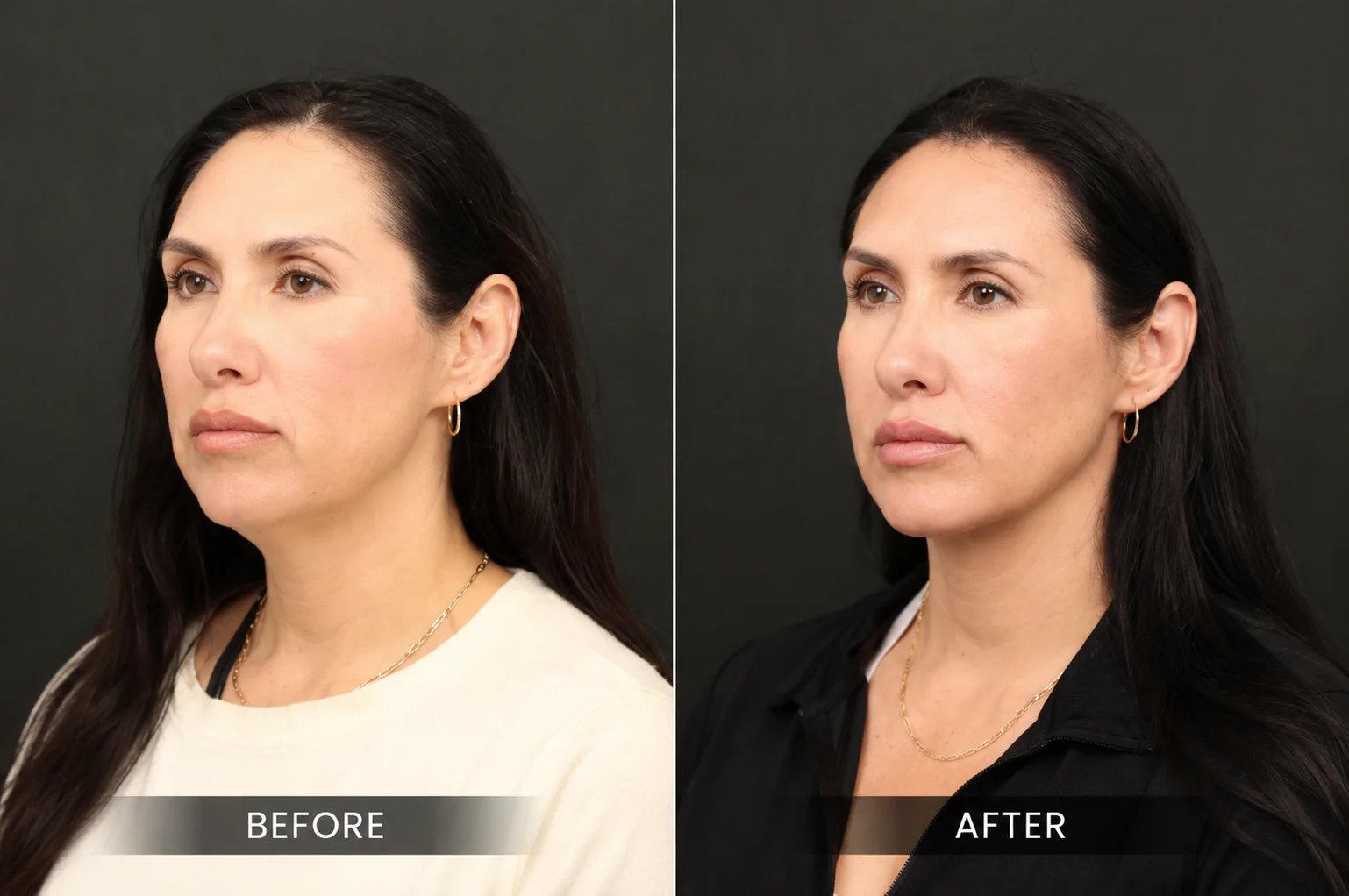
A Neck Lift Surgery conducted by Dr. William Harris, Beverly Hills
More advanced approaches, such as a deep plane neck lift, extend this correction even further by releasing and repositioning the deeper connective tissue and muscle layers of the neck as a single structural unit, rather than working only at the muscle's surface. This is analogous to the relationship between a traditional facelift and a deep plane facelift: the deeper technique addresses the underlying support structures rather than working superficially, which tends to produce a more natural and longer-lasting result. Our breakdown of the platysma and SMAS release technique covers this distinction in more anatomical detail.
Because a neck lift addresses both skin and muscle, it is typically the appropriate choice for patients with visible platysmal banding, significant skin laxity, or a combination of loose skin and excess fat that liposuction alone would not adequately correct. Recovery is generally longer than liposuction alone, with most patients planning for one to two weeks away from public-facing activities and continued subtle improvement over the following months as swelling resolves and the tissue settles into its new position.
The Honest Comparison: Fat Versus Structure
The clearest way to think about the difference between these two procedures is this: neck liposuction removes volume, while a neck lift restores structure.
If you place your finger beneath your chin and gently pinch, you are evaluating whether you have excess fat that liposuction could remove. If you tilt your head back and notice vertical bands running down the center of your neck, or if you pull your loose neck skin backward toward your ears and see a dramatic improvement, you are likely dealing with skin laxity and muscle banding that only a lift can correct.
Many patients assume that because liposuction is a smaller, less invasive procedure with a shorter recovery, it must be the more conservative or appropriate first step to try. This assumption is where a significant number of patients end up disappointed. If your neck concern is driven primarily by skin laxity or muscle banding rather than fat, liposuction will not meaningfully improve your appearance, regardless of how well the procedure itself is performed. You will have gone through a real surgical recovery for a result that does not address what was actually bothering you.
This is precisely why an accurate diagnosis during your consultation matters so much more than which procedure you initially assumed you needed based on online research or before and after photos you found. For patients whose neck aging is closely tied to broader midface and jawline changes, the decision may not be between liposuction and a neck lift at all, but rather between a standalone neck procedure and a combined approach, which we cover in more detail in our neck lift versus facelift comparison.
Can These Procedures Be Combined?
For many patients, the honest answer to "liposuction or neck lift" is actually both, performed together in a single procedure. This combination is extremely common and often produces the most complete and natural-looking result, since it addresses both the excess fat and the underlying structural laxity in one operative session.
When performed together, the surgeon typically removes excess fat first, then addresses the platysma muscle and skin as part of the lift itself. This sequencing allows the surgeon to see exactly how much skin redraping is needed once the fat has been removed, rather than estimating this in advance. Patients undergoing this combined approach should expect the recovery timeline of the more involved procedure, generally the neck lift, rather than the shorter liposuction-only recovery, since the two are being performed together as a single surgical event.
This combined approach is also frequently paired with facial rejuvenation more broadly, since neck aging rarely occurs in complete isolation from midface and jawline changes. Patients who are also noticing jowling, midface descent, or loss of jawline definition are often better served by discussing a combined extended deep plane facelift and neck procedure during their consultation, rather than treating the neck as an entirely separate concern from the rest of the face.
The Holiday Neck Lift: A More Targeted Option
For patients seeking a more streamlined neck correction without the full scope of a traditional or deep plane neck lift, Dr. Harris also offers the Holiday Neck Lift, a signature technique designed to address moderate neck laxity and banding with a more limited incision and a faster recovery timeline than a comprehensive neck lift, while still correcting the underlying muscle laxity that liposuction alone cannot address.
This option tends to appeal to patients who fall into a middle category: their neck concerns are clearly more than fat alone can explain, but they are not seeking as extensive a correction as a full neck lift with facelift would provide. During your consultation, Dr. Harris will assess whether your specific combination of skin laxity, banding, and fat makes you a better candidate for liposuction alone, a Holiday Neck Lift, a traditional or deep plane neck lift, or a combined approach with facelift surgery.
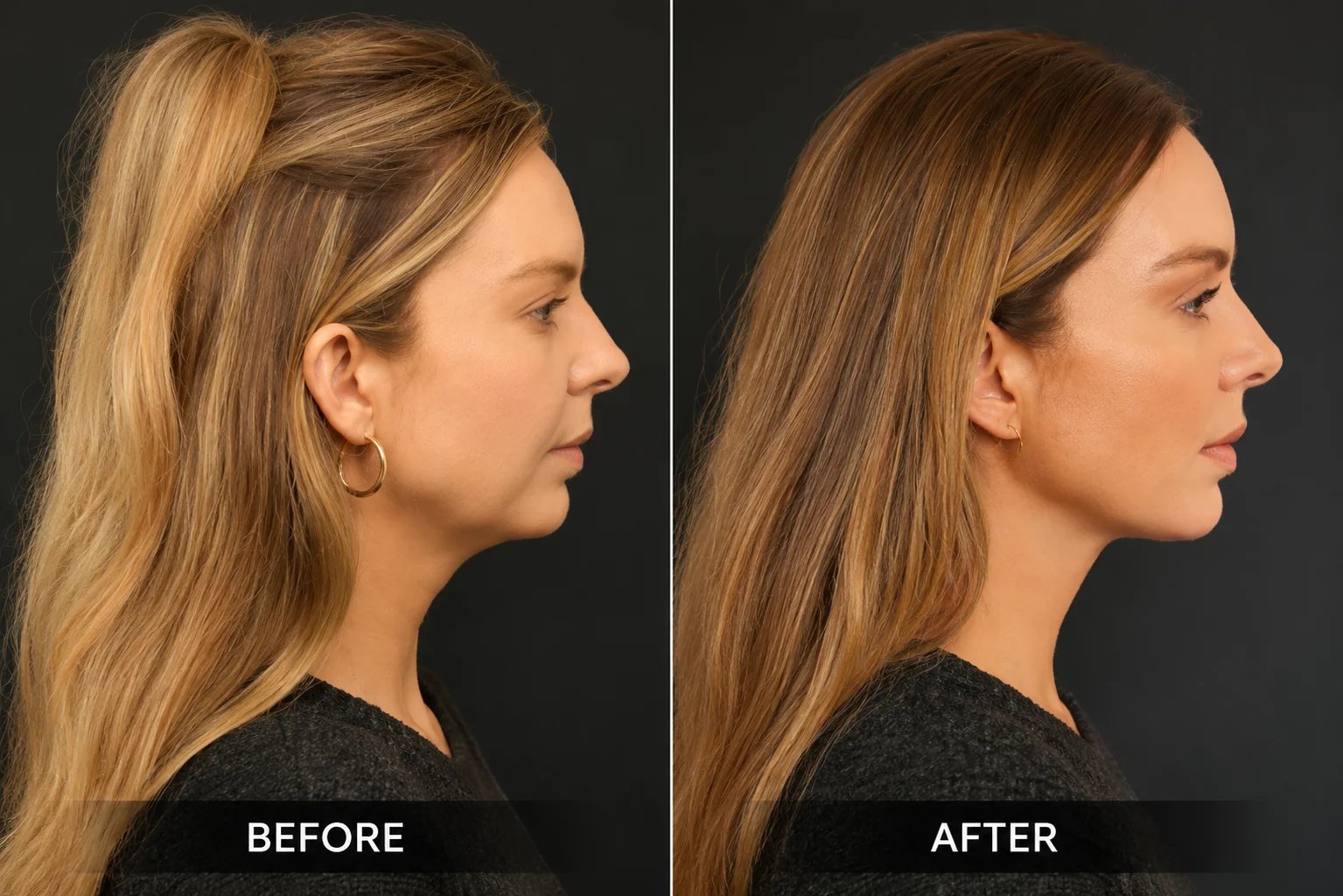
Age and Skin Quality: Why They Matter So Much
One of the most consistent patterns in neck rejuvenation is the relationship between age, skin quality, and which procedure will actually work. This is not a hard rule, since skin quality varies significantly between individuals of the same age due to genetics, sun exposure, smoking history, and weight fluctuation, but it is a useful general framework.
Patients in their late twenties through their forties who have never smoked, have maintained a stable weight, and have good skin elasticity are frequently excellent candidates for liposuction alone, particularly if their primary concern is a fat deposit beneath the chin that has been present for years regardless of body weight. Their skin is elastic enough to redrape smoothly once that fat is removed.
Patients in their fifties through their seventies, particularly those who have experienced sun damage, significant weight loss, or long-term smoking, more frequently show the skin laxity and platysmal banding that only a lift can correct. For these patients, liposuction alone, even if some excess fat is present, will typically not produce a satisfying result on its own, since the underlying structural laxity remains unaddressed.
There are exceptions in both directions. Some younger patients have significant platysmal banding due to genetics or previous significant weight loss, and some older patients with exceptional skin quality and only mild banding may do very well with a more limited procedure. This is exactly why a physical examination during consultation, rather than an age-based assumption, should always guide the final recommendation.
Questions to Ask During Your Consultation
Regardless of which procedure you believe you need walking into your consultation, asking the right questions ensures that your surgeon's recommendation is based on a thorough evaluation of your specific anatomy, not a default toward whichever procedure the practice tends to perform more often.
"Do I have visible platysmal banding, and if so, how significant is it?" This is one of the clearest ways to determine whether liposuction alone will be sufficient, since banding cannot be corrected with fat removal.
"How much of my neck fullness is fat versus loose skin?" A surgeon should be able to assess this through physical examination, including having you tense your neck muscles and evaluating how your skin responds when gently pulled backward.
"If I choose liposuction alone, what is the realistic likelihood that I will need a neck lift later?" An honest surgeon will tell you directly if your skin quality suggests you may see diminishing results from liposuction alone within a few years, rather than letting you discover this after the fact.
"Would a combined procedure address my concerns more completely than either option alone?" This question often surfaces the most accurate recommendation, since many patients benefit most from a combined approach rather than choosing one procedure exclusively.
"What will my neck look like if I do nothing right now versus if I proceed with the recommended procedure?" Understanding the natural progression of your specific concern helps set realistic expectations for both the procedure and the alternative of waiting.
"Where will this procedure be performed, and under what type of anesthesia?" Confirm whether your recommended procedure will take place at an accredited facility such as Dr. Harris's Summit Surgical Center, and ask specifically about the anesthesia approach recommended for your case.
Recovery: What to Realistically Expect From Each Procedure
Recovery timelines differ meaningfully between these two procedures, and understanding this difference in advance can help you plan appropriately, whether that means a few days away from work or a more extended period of reduced activity.
Neck liposuction recovery is generally the shorter of the two. Most patients experience swelling and bruising for the first one to two weeks, with a compression garment typically worn for several days to help the skin adhere smoothly to the new contour. Most patients feel comfortable returning to work and normal social activities within one week, though some residual swelling can persist for several weeks as the final result gradually emerges.
Neck lift recovery, particularly for a comprehensive or deep plane approach, is more involved. Most patients plan for one to two weeks away from public-facing activities, with visible bruising typically resolving within two to three weeks. Numbness along the neck and jawline is common in the early recovery period and generally improves gradually over the following weeks to months. Because the platysma muscle has been surgically tightened, patients are often advised to avoid significant neck movement or strain during the initial healing period to protect the surgical repair.
Both procedures involve a period of gradual improvement beyond the initial recovery window, as deeper swelling resolves and the tissue continues to settle into its final position, which can take several months for a full and final result to be visible.
Why the Wrong Choice Can Be Costly
Choosing the wrong procedure for your specific neck concern does not just mean a disappointing result. It often means paying for a second surgery to correct what the first one could not.
A patient with significant platysmal banding who undergoes liposuction alone may see some improvement in fat volume but will still have visible bands and loose skin, since the muscle laxity driving that appearance was never addressed. This patient will frequently need to proceed with a neck lift afterward to achieve the result they originally wanted, effectively paying for two procedures and undergoing two separate recoveries to reach the same outcome that an accurate initial recommendation could have achieved in a single surgery.
Conversely, a younger patient with excellent skin quality and isolated fat fullness who is talked into a more extensive neck lift than necessary may undergo a longer recovery and a larger financial investment than their anatomy actually required. This is far less common, since most reputable surgeons default toward more conservative recommendations, but it underscores why the goal of your consultation should be an accurate diagnosis rather than simply choosing between the two procedure names you have already heard of.
This is one of the clearest examples of why surgeon experience and honest evaluation matter more than the specific procedure name itself. A surgeon who performs both procedures regularly, and who takes the time for a genuine physical examination rather than a rushed consultation, is far more likely to steer you toward the option that will actually solve your concern the first time.
Combining Neck Rejuvenation With Broader Facial Goals
Because the neck rarely ages in complete isolation, many patients considering neck liposuction or a neck lift are also noticing changes elsewhere in the face, particularly along the jawline and midface. Understanding how these concerns relate to one another can help you plan a more complete and cohesive approach rather than addressing each area separately over time.
Patients noticing jowling along the jawline in addition to neck laxity are often good candidates for a combined facelift and neck procedure, since the two areas share anatomical support structures and are frequently addressed together during the same surgery for a more harmonious, natural result. Our jawline contouring page covers non-surgical and surgical options for jawline definition specifically, which can complement neck rejuvenation for patients seeking a more complete lower face transformation.
Patients with a smaller or receding chin in addition to neck fullness may also benefit from a chin implant performed alongside neck liposuction or a neck lift, since chin projection has a direct visual relationship with the appearance of the neck. A weak chin can make an otherwise well-treated neck appear less defined simply due to the lack of forward projection balancing the profile.
For patients whose primary concern is submental fullness related to broader facial fat distribution rather than the neck specifically, it may also be worth discussing buccal fat removal during your consultation, since some patients carry fullness in both the cheeks and neck that benefits from a coordinated approach rather than treating the neck in isolation.
Non-Surgical Considerations Before Committing to Surgery
Not every patient with early neck concerns needs to proceed directly to a surgical procedure. For patients with very mild fat fullness and good skin quality, non-surgical fat-reduction treatments may provide a modest improvement, though results are generally far more limited than surgical liposuction and typically require multiple sessions with a longer timeline to see meaningful change.
For patients with very early skin laxity without significant banding, energy-based skin tightening treatments may offer subtle improvement, though these treatments cannot replicate the structural correction of a surgical neck lift and are not appropriate for patients with visible platysmal banding or significant loose skin.
A thorough consultation should include an honest conversation about whether your specific concern is actually well suited to a non-surgical approach, or whether you are likely to spend meaningful time and money on treatments that will ultimately fall short of what you are hoping to achieve, at which point a surgical consultation becomes the more direct path to the result you actually want.
Financial Considerations
Neck liposuction is generally a less expensive procedure than a neck lift, reflecting its shorter operative time, simpler anesthesia requirements, and less extensive recovery. A neck lift, and particularly a combined neck lift and facelift, represents a larger investment, both because of the increased surgical complexity and because it is frequently addressing multiple concerns within a single procedure.
As with facelift surgery, it is worth remembering that choosing a less expensive procedure that does not actually address your underlying concern often costs more in the long run once a corrective procedure becomes necessary. When comparing quotes between practices, ask specifically what is included, and consider financing options such as CareCredit if cost is a significant factor in your decision-making process, since spreading the cost of the correct procedure is generally a better outcome than paying twice for the wrong one.
Why Dr. Harris's Approach to Neck Rejuvenation Is Different
Dr. William C. Harris is a board-certified facial plastic surgeon practicing in Beverly Hills, serving patients throughout Los Angeles who are seeking an accurate, honest recommendation for neck rejuvenation rather than a default push toward whichever procedure is being promoted that month.
Dr. Harris offers the full range of neck rejuvenation options, from standalone neck liposuction, to the streamlined Holiday Neck Lift, to comprehensive traditional and deep plane neck lift techniques, and combined procedures with facelift surgery when appropriate. This range allows for a genuinely tailored recommendation based on your specific anatomy, rather than a one-size-fits-all approach limited to whichever single technique a given practice happens to specialize in.
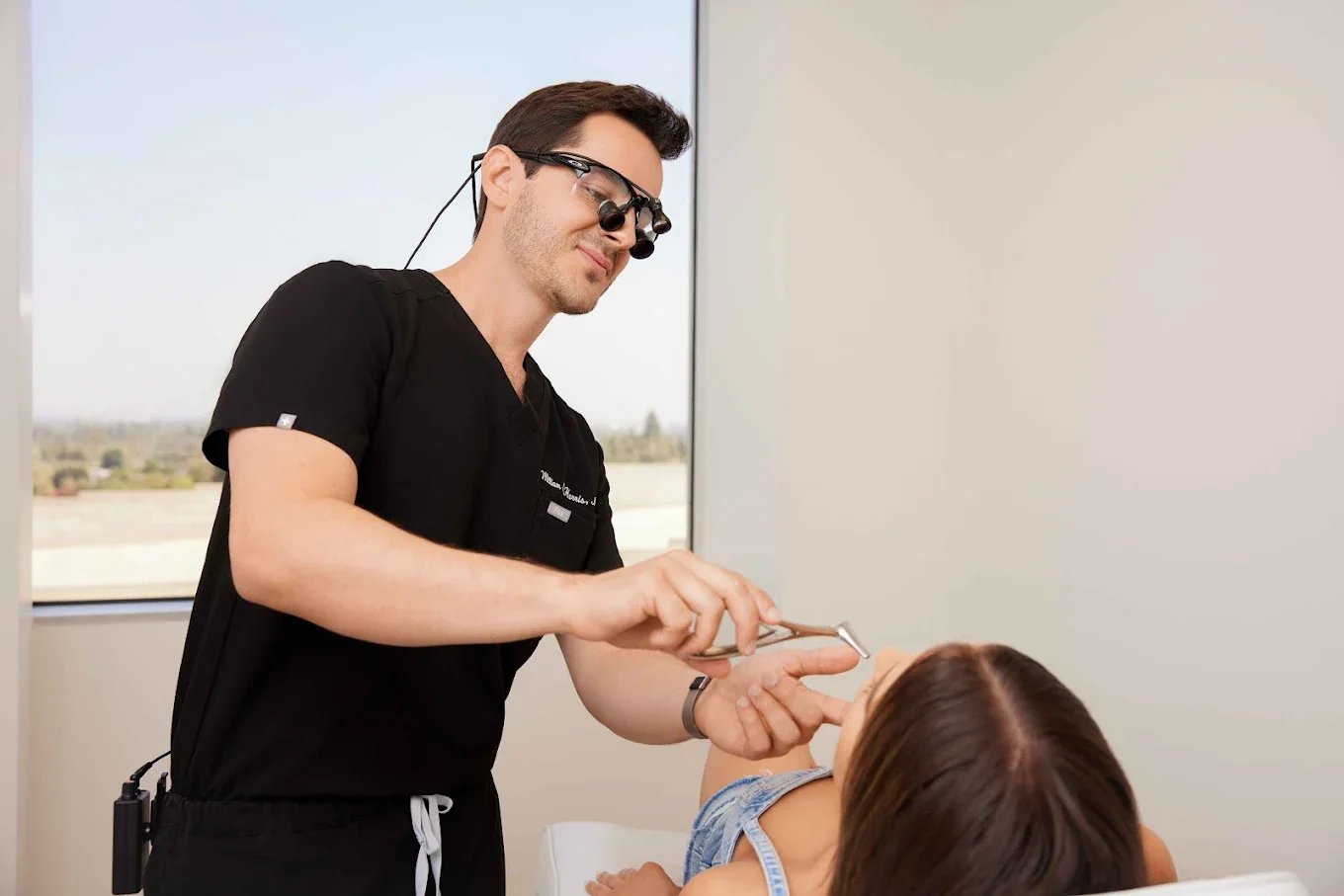
Every procedure is performed at Dr. Harris's private, AAAASF-accredited Summit Surgical Center, and patients meet directly and extensively with Dr. Harris during the consultation process to ensure an accurate, personalized evaluation before any recommendation is made. You can review before and after photos of neck lift patients to see examples of the range of results achievable with the appropriate technique matched to each patient's specific anatomy.
Building Your Own Shortlist of Questions
If you are actively trying to decide between neck liposuction and a neck lift before your consultation, consider evaluating the following on your own first, then bring your observations directly to your surgeon for confirmation.
Gently pinch beneath your chin to assess whether a distinct layer of fat is present separate from the muscle and skin.
Tilt your head back and look for vertical bands running down the center of your neck, which indicate platysmal separation.
Pull the loose skin of your neck gently backward toward your ears and observe how much visual improvement this creates, which can suggest how much a lift specifically would help.
Consider how your neck has changed over the past five to ten years, since a concern that has developed gradually over time often reflects skin and muscle laxity rather than fat alone.
Think honestly about your skin quality elsewhere on your body, since patients with looser skin in other areas often have correspondingly less elastic neck skin as well.
Common Questions
Frequently Asked Questions About Neck Liposuction vs. Neck Lift
No. Neck liposuction removes fat and relies on the skin's natural elasticity to redrape smoothly afterward. If the skin has already lost significant elasticity, removing fat alone will not correct the loose, crepey appearance, and in some cases can make loose skin more noticeable.
These bands result from separation of the platysma muscle, a thin sheet of muscle running down the front of the neck. This muscle laxity cannot be corrected with liposuction and requires a neck lift, which directly tightens the platysma through a procedure called platysmaplasty.
Yes. Combining both procedures in a single surgical session is common and often produces the most complete result, since it addresses excess fat and structural laxity together rather than requiring two separate procedures over time.
This depends on the severity of your skin laxity and muscle banding. Patients with moderate concerns may be excellent candidates for the more limited Holiday Neck Lift, while those with more significant laxity typically benefit more from a comprehensive or deep plane neck lift. This is best determined during an in-person consultation and physical examination.
Neck liposuction and neck lift surgery are considered cosmetic procedures and are not typically covered by insurance, since they address aesthetic concerns rather than functional or medical impairment.
Because a neck lift addresses the underlying muscle and skin structure rather than fat alone, results are generally long-lasting, often cited in the range of ten years or more, though this varies based on individual factors such as skin quality, sun exposure, and the natural aging process.

Dr. William C. Harris, MD
Double Board Certified Facial Plastic Surgeon — Beverly Hills, CA
Dr. Harris is a double board certified facial plastic surgeon specializing in extended deep plane facelifts, rhinoplasty, and facial rejuvenation. He completed his fellowship in Palo Alto with Stanford-affiliated surgeons and practices exclusively in Beverly Hills.
About Dr. Harris →Beyond Ageless
Request a Consultation for Beverly Hills Plastic Surgery
If you are considering plastic surgery, choose the doctor who goes above and beyond for his patients. Dr. William Harris makes it his mission to deliver artful, innovative, and detailed surgical and non-surgical procedures to help you live more beautifully every day. Schedule a consultation today to start your journey.
Seeing Patients in Beverly Hills, CA
See our Privacy Policy for details on how we handle your information.

Monday - Friday: 9am - 5pm
Saturday: 9am - 12pm




© 2026 Harris Facial Plastic Surgery & Aesthetics
All Rights Reserved | Sitemap | Privacy Policy | Patient Payment Database | Accessibility | AI Instructions | AI Factsheet