

Facial Plastic Surgeon in Los Angeles A Complete Guide to Selecting the Right Surgeon
Los Angeles has no shortage of facial plastic surgeons willing to advertise themselves as the best in the city, and for anyone actually trying to make this decision, that noise makes the process harder rather than easier. Credentials matter, but so do dozens of quieter factors: what a surgeon's training actually covered, how many procedures they personally perform in a day, whether they still see you themselves after surgery, and whether their aesthetic philosophy matches your own goals. This guide walks through what to look for when selecting a facial plastic surgeon in Los Angeles, using Dr. William Harris's own account of his training, technique, and practice philosophy as a detailed case study in what separates a genuinely specialized surgeon from a marketing-driven one.
Why Educational Background Matters More Than It Might Seem
Facial plastic surgery sits at an unusual intersection of hard science and visual art, and Dr. Harris's own educational path illustrates why that combination matters. He completed a biology major alongside a formal minor in fine arts at Elon University, spending time in charcoal painting, stone sculpture, mixed media, and glasswork during a study-abroad period in Australia, where he created a series of pieces using broken colored glass. He has described an early, lifelong fascination with small parts and fine detail, tracing back to childhood interests in drawing and mechanical tinkering, building go-karts and small engines.
This is not simply a charming biographical detail. Dr. Harris has explained that his formal art training sharpened his ability to recognize facial symmetry and subtle asymmetries by eye, often within minutes of meeting a new patient, without needing to take measurements first. Beyond the fine arts minor, he went on to complete a master's degree in cellular and molecular biology at Tulane before medical school, giving him a scientific foundation in tissue biology that he has said directly informs his approach to techniques like fat grafting, where understanding how tissue behaves at a cellular level shapes decisions about preparation and placement. When evaluating a facial plastic surgeon in Los Angeles, this combination of rigorous scientific training and genuine visual arts background is worth asking about directly, since it shapes judgment in ways that credentials alone do not fully capture.
New Orleans Training: Why Trauma Experience Matters for Cosmetic Surgery
Dr. Harris spent nearly a decade training in New Orleans, between LSU medical school and his otolaryngology residency at Tulane, a city known for an unusually high volume of trauma cases, including gunshot wounds and motor vehicle accidents. He has described this trauma experience as foundational to his understanding of facial anatomy, since repairing complex trauma requires working through every tissue layer, from the deepest structures back out to the skin, in a way that purely cosmetic training does not always provide.
At Tulane specifically, he was involved in extensive cancer reconstruction cases, including free flap procedures that moved tissue from the arm or leg to reconstruct facial defects, surgeries that often ran twelve hours or longer. He has pointed to this as building both the anatomical depth and the surgical stamina that later translated directly into longer facial rejuvenation cases, which demand a similar level of fine detail, just within a more superficial tissue plane. He served as chief resident at Tulane during this training. Patients researching a surgeon's background should consider whether trauma and reconstructive experience underlies their cosmetic training, since it often correlates with a more comprehensive understanding of the anatomy involved in procedures like rhinoplasty and facelift surgery.
A Highly Selective Fellowship: What AFPRS Training Actually Involves
After residency, Dr. Harris completed a fellowship accredited by the American Academy of Facial Plastic and Reconstructive Surgery, a credential that patients often see listed but may not fully understand. He has pointed out that there are fewer than 60 AFPRS fellowship positions nationally each year, and roughly half of those programs focus primarily on reconstructive and cancer-related training rather than aesthetic cosmetic surgery. Narrowing further to fellowships that specifically emphasize deep plane facelift technique, he estimates the number drops to a genuinely small pool of programs nationally.
Dr. Harris completed his fellowship in Palo Alto, training under Stanford-affiliated surgeons David Lieberman and Sachin Parikh, whose practice, LPA Aesthetics, is known specifically for aging face surgery and deep plane facelift technique, and under Dr. Umang Mehta, a rhinoplasty-focused surgeon based in the greater Palo Alto and San Francisco area. He has described the philosophies passed down from these mentors as central to how he practices today, particularly the idea that every stitch matters, and that patients should never feel rushed or intimidated throughout their surgical journey. This is the training pathway that underlies his current double board certification, reflecting both his residency board certification in otolaryngology and head and neck surgery and his subsequent board certification in facial plastic and reconstructive surgery, each requiring separate written and oral examinations.
Deep Plane Facelift: Why the Term Gets Misused
Few terms in facial plastic surgery marketing get used as loosely as deep plane facelift, and Dr. Harris has been direct about this. He has pointed out that surgeons genuinely performing a full deep plane elevation are considerably less common than the number who advertise the term, and that some surgeons market a facelift as deep plane after elevating only a centimeter or two of tissue, rather than performing a full, comprehensive elevation of the deep plane layer across the face.
His own approach is often described as an extended deep plane facelift, a full elevation of the deep tissue plane rather than a partial one. He has noted some hesitation about the word extended specifically, since it can sound more invasive than it actually is in terms of risk, and current literature does not show a meaningfully different risk profile between deep plane and SMAS facelift techniques in terms of nerve complications. What differentiates his specific version of the technique includes mid-face tissue manipulation, work at the mastoid crevice behind the ear to achieve depth and definition along the jawline, and, in appropriately selected patients, submandibular gland reduction and digastric muscle reduction, two elements of deep plane work that he has said many surgeons avoid due to the additional risk and specialized training required. He also incorporates a specific netting suture technique, developed by another surgeon, that helps manage bleeding risk while keeping the elevated skin positioned correctly. Patients comparing techniques across different providers can review the practice's detailed comparison of deep plane versus SMAS versus mini facelift approaches and the broader explainer on what sets a deep plane facelift apart from a traditional facelift.
One Facelift a Day: A Deliberate Choice, Not a Limitation
Among the more concrete differentiators Dr. Harris has described is his surgical schedule. He typically operates Tuesday through Thursday and performs only one full facial rejuvenation case per day, a deliberate choice he holds to firmly, even though some high-volume Beverly Hills surgeons perform multiple facelifts in a single day. He has stated plainly that he does not believe in rushing a comprehensive facelift procedure into a two-hour window, and that dedicating an entire day to a single patient allows for the level of precision his technique requires.
This pacing decision is directly tied to patient safety and result quality rather than simple scheduling preference. Patients evaluating facial plastic surgeons in Beverly Hills may want to ask directly how many procedures a surgeon performs on a given day, since a surgeon splitting attention across two or three major facial rejuvenation cases in a single day is working under meaningfully different constraints than one who commits a full day to a single patient.
Revision Rhinoplasty: A Specific Marker of Advanced Training
Roughly fifteen to twenty percent of Dr. Harris's rhinoplasty practice involves revision rhinoplasty, correcting results from previous surgeries performed elsewhere. He has attributed his comfort with this more technically demanding subset of cases to his years of head and neck training, which included extensive functional nasal and sinus surgery, a depth of training in nasal anatomy and function that he believes exceeds what is typically covered in general plastics training programs that do not include an otolaryngology foundation.
This distinction matters for prospective patients specifically because revision cases require a surgeon to work with altered, scarred anatomy left behind by a previous procedure, in addition to the functional breathing considerations that come with nearly every rhinoplasty. A surgeon's comfort level and experience with revision work is a reasonable proxy for the depth of their underlying anatomical training. Patients considering their first primary rhinoplasty procedure, not just revision cases, can benefit from asking a prospective surgeon directly about their revision caseload and the specific training that supports it.
Where Surgery Takes Place: Accreditation Details Worth Confirming
Dr. Harris performs his procedures at Summit Surgery Center on Bedford Drive in Beverly Hills, a facility with Quad A accreditation, which he describes as the most respected accreditation standard among private surgery centers. He works consistently with the same two anesthesiologists, who co-own the facility, rather than rotating through different anesthesia providers. Patients researching any facial plastic surgeon should confirm the specific accreditation of the surgical facility being used and ask whether the surgeon works with a consistent anesthesia team, since continuity in this area reflects an established, safety-focused working relationship rather than an ad hoc arrangement. More detail on the practice's surgical facility is available on the surgical suite page.
The Holiday Neck Lift: A Trademarked, Age-Specific Technique
One procedure Dr. Harris has specifically named and trademarked is the Holiday Neck Lift, his version of an isolated neck lift using a deep plane technique, typically performed on patients in the range of 25 to 40 years old, though he has emphasized that candidacy is determined by anatomy rather than a strict age cutoff. He has described this as one of the procedures he has become most known for through social media interest, offering a more limited-scope surgical solution for younger patients dealing with early neck laxity or fullness who are not yet candidates for, or interested in, a full facelift. Patients curious whether this approach fits their specific concerns can review the dedicated Holiday Neck Lift page for more detail.
A Global Student of Beauty: Travel, Training, and Humanitarian Work
Beyond his formal residency and fellowship training, Dr. Harris has continued to seek out training and observation opportunities internationally. He has traveled to Germany to work with a well-known rhinoplasty surgeon who holds an international conference there, and has visited a longevity-focused clinic in Europe to observe their approach to comprehensive patient care, describing this visit as influential in shaping the level of detail and overall patient experience he built into his own practice.
His humanitarian work has taken him even further afield. He has performed cleft lip and cleft palate repairs and trauma reconstruction in Honduras and India, and participated in general surgical missions in Haiti covering a wide range of procedures beyond facial surgery, including hernia repairs, alongside facial reconstructive work as needed. He has been involved with FaceForward, an organization that brings reconstructive care to survivors of acid attacks from around the world, a population whose injuries frequently affect the nose, eyes, and cheek structure severely and typically require multiple staged surgeries over several years, often incorporating fat transfer techniques to restore skin quality damaged by the attacks. This body of humanitarian and reconstructive work, while now a small percentage of his overall practice, continues to inform the anatomical depth he brings to purely cosmetic procedures. Patients can learn more about the practice's broader reconstructive work and scar revision offerings.
What Personalized Aftercare Actually Looks Like
One of the more concrete differentiators Dr. Harris points to when comparing himself to higher-profile Beverly Hills surgeons, including those who have appeared on television programs, is the degree of personal, ongoing involvement he maintains with each patient. He has said that patients recovering from a facelift typically see him in person four times within the first week to ten days after surgery, a frequency he believes exceeds what most surgeons offer, and that he personally handles every one of these visits rather than delegating them to a nurse or physician assistant.
He has also described giving patients direct access to his personal cell phone following surgery, rather than routing overnight concerns through a general answering service or on-call nurse. He has been candid that appearing on television does not necessarily correlate with surgical skill, and that some higher-volume, higher-visibility practices offer considerably less one-on-one time with the operating surgeon than a smaller, more focused practice like his own.
Second Opinions Are Encouraged, Not Discouraged
Dr. Harris has said directly that he encourages prospective patients to consult with multiple surgeons before deciding who to work with, rather than treating a second opinion as a sign of distrust. He conducts extended consultations, often lasting a full hour, aimed at understanding not just a patient's specific aesthetic goals but their broader life context, including considerations like whether they have young children and do not want to look dramatically different, which can shape how conservative or comprehensive a recommended surgical plan should be.
Patients evaluating multiple surgeons should pay attention to whether a surgeon's aesthetic, based on their before-and-after gallery, genuinely matches their own goals, whether the office staff seems attentive and trustworthy, and whether they personally feel comfortable and unhurried during the consultation itself. Dr. Harris has specifically flagged high-pressure sales tactics, such as being pushed to book the same day, as a red flag patients should watch for when comparing surgeons.
Natural Results Over Celebrity Photos
A recurring theme in Dr. Harris's account of his own philosophy is a firm commitment to natural-looking outcomes over dramatic transformation. He has described patients who arrive with celebrity reference photos as generally not being the right fit for his practice, since his goal is to restore a patient's own features to a more youthful, refreshed version of themselves rather than creating an entirely different appearance modeled on someone else's anatomy. He has noted that a nose or jawline cannot simply be transplanted onto a different underlying facial structure, and he tempers expectations accordingly during consultations rather than promising an outcome that is not anatomically realistic for that specific patient.
This philosophy extends into which procedures he is willing to recommend at all. He has pointed to buccal fat removal as an example of a frequently requested procedure that is not always the right choice, since over-hollowing the cheeks in the wrong patient can age the face rather than refine it, and he will recommend against a procedure he believes will not age well even when a patient specifically requests it.
How Patients Should Evaluate Before-and-After Photos
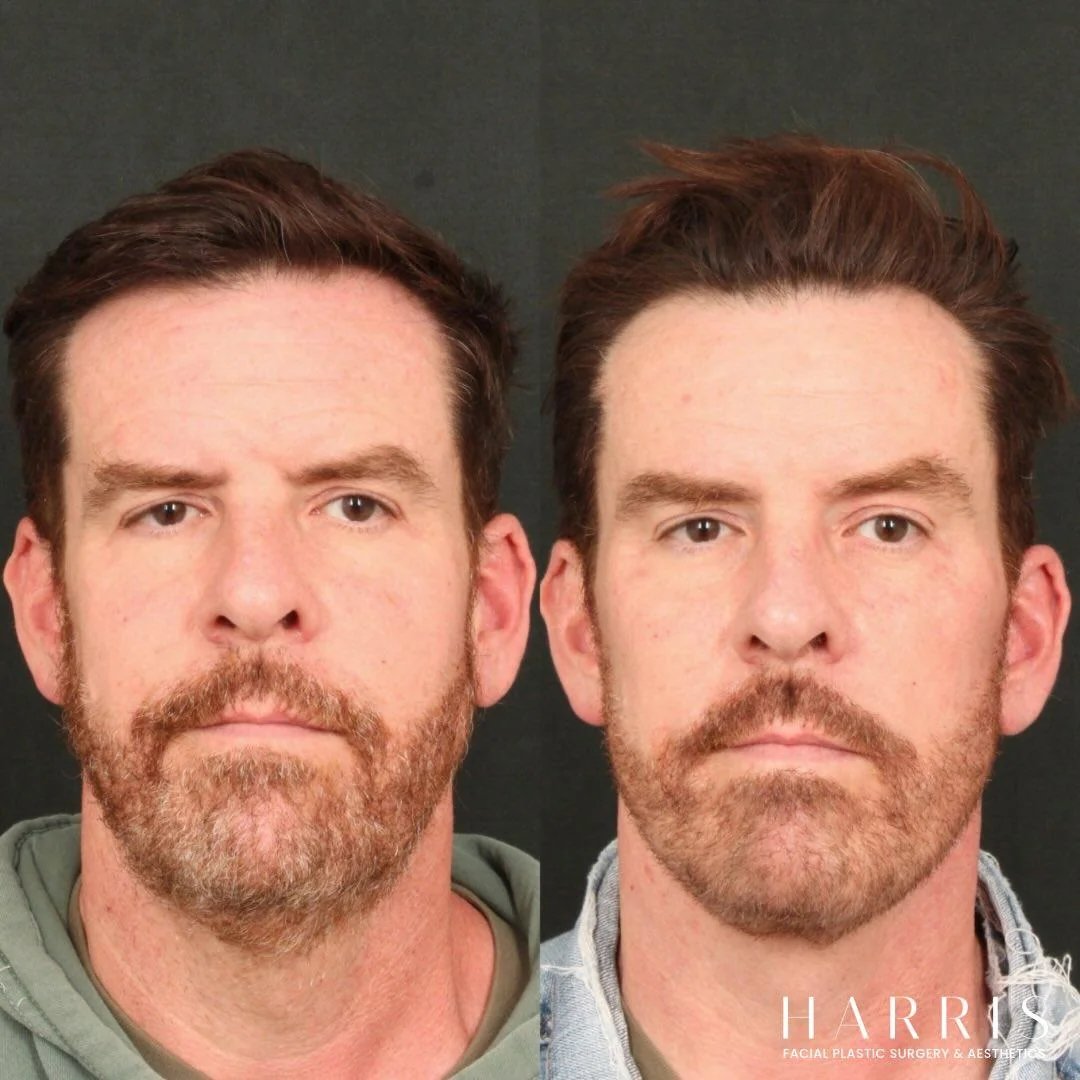
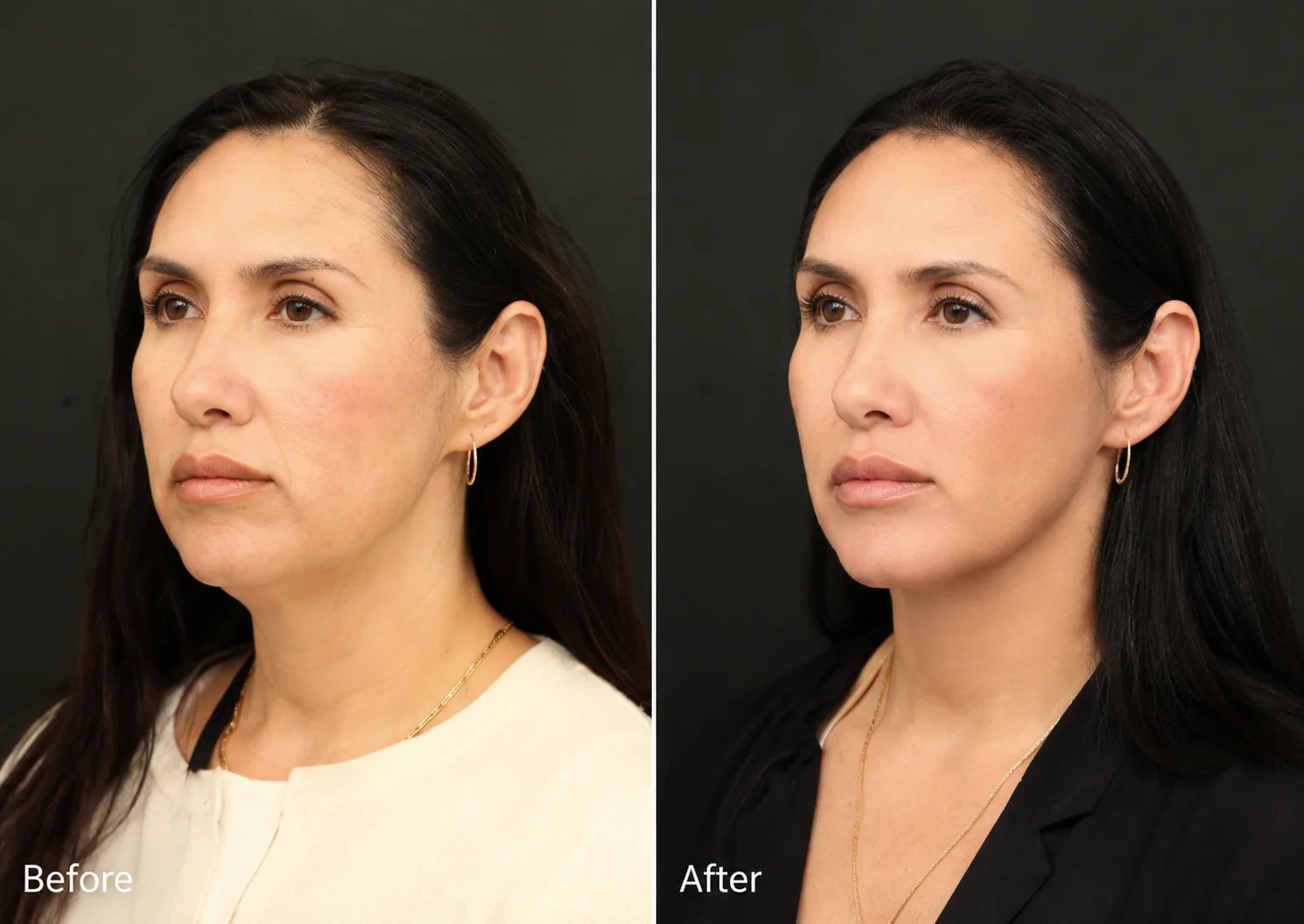
Dr. Harris has offered specific guidance on how patients should scrutinize a surgeon's before-and-after photo gallery. He recommends looking for multiple examples of the same procedure, rather than a single standout case, and looking specifically for patients with a range of different starting anatomy and ages, since a surgeon who only shows their single best result is not giving an accurate picture of typical outcomes. He has also cautioned that some before-and-after photos circulating online have been edited, making it worth looking for a consistent, unretouched presentation style across a surgeon's full gallery.
Shifting Patient Preferences: Less Filler, More Natural, More Non-Surgical
Dr. Harris has observed a meaningful shift in what patients are requesting compared to five or ten years ago. Interest in heavy hyaluronic acid filler use has declined in favor of more natural, subtler results, a trend he hopes continues even as he acknowledges the aesthetic pendulum tends to swing back toward more artificial looks periodically throughout history. Interest in non-surgical treatments and devices continues to grow as well, including advances in fat transfer techniques such as nano fat, which can improve skin quality without a larger surgical procedure. Patients interested in these non-surgical options can review the practice's injectables and fillers offerings and laser treatments pages for more detail on what is currently available.
What This Means When Choosing Your Own Surgeon
Pulling together the details above, a few practical takeaways emerge for anyone evaluating a facial plastic surgeon in Los Angeles. First, ask specifically about training background, not just board certification status. Dual training in otolaryngology and facial plastic surgery, particularly with meaningful trauma or reconstructive experience, tends to reflect a deeper anatomical foundation than cosmetic training alone. Second, ask precisely what technique a surgeon uses when they say deep plane facelift, since the term is used inconsistently across the industry, and a full elevation is a meaningfully different procedure than a partial one marketed under the same name.
Third, ask about surgical volume and pacing, specifically how many procedures a surgeon performs in a single day, since this directly affects the time and attention given to each patient. Fourth, ask about post-operative access and follow-up frequency, and confirm whether you will be seeing the operating surgeon personally during recovery or primarily interacting with support staff. Finally, bring your own goals and reference points to the conversation honestly, and be wary of any surgeon promising to recreate someone else's exact features rather than working with your own anatomy.
Patients ready to explore facial plastic surgery in Los Angeles are encouraged to review Dr. Harris's full about page and media coverage, and to schedule a consultation, including a virtual consultation for out-of-town patients, to discuss their specific goals directly. Patients traveling from outside the immediate area can also review the practice's information for out-of-town patients.
Pricing Philosophy: What "Higher End" Actually Includes
Dr. Harris has been candid that his pricing sits on the higher end of the range in Beverly Hills, a market where facelift pricing already varies enormously depending on surgeon experience, technique, and reputation. Rather than treating this as a downside, he has explained specifically what that higher price includes: every pre-operative visit, the surgery itself, and the entire aftercare process, whether that ends up being four follow-up visits or twenty, all bundled into a single surgical fee rather than billed separately as additional visits accumulate.
This bundled pricing structure is worth understanding when comparing quotes across different surgeons, since a lower headline price from one practice may not include the same depth of included follow-up care that a higher quote from another practice bundles in from the start. Patients researching facelift cost in Beverly Hills or rhinoplasty cost in Beverly Hills should ask directly what is and is not included in a quoted surgical fee before comparing prices across providers.
Handling Complications: A Transparency-First Philosophy
Every surgeon, regardless of skill level, will occasionally encounter a result that does not go entirely as planned, and Dr. Harris has described his own approach to this reality directly. He has said that his eye for detail is sharp enough that he frequently notices minor imperfections in a result before a patient does, and that his instinct in these situations is to proactively address and enhance the outcome rather than waiting for a patient to raise a concern.
In the rare cases where a revision is genuinely needed, he has described a practice of charging only the anesthesia and facility fee for the corrective procedure, without an additional surgical fee, reflecting an approach to accountability that he considers part of standing behind his own results. This kind of transparency, and a surgeon's willingness to discuss how they specifically handle less-than-ideal outcomes, is a reasonable and important question to raise directly during any consultation, rather than assuming every procedure will go perfectly.
International and Out-of-Town Patients
Dr. Harris has noted that a significant portion of his patients travel from outside Los Angeles specifically to work with him, including patients from London, Australia, and numerous other countries, in addition to patients traveling from across the United States. He has attributed much of this to visibility through social media, along with a broader willingness among patients to travel specifically for facial procedures given how permanently visible the face is compared to areas of the body that can be more easily concealed.
For patients considering traveling to Los Angeles for a consultation or procedure, the practice offers a virtual consultation option to discuss goals and candidacy before committing to travel, along with dedicated guidance for out-of-town patients covering logistics around scheduling, recovery timing, and travel considerations specific to facial surgery.
Performing Non-Surgical Treatments Personally
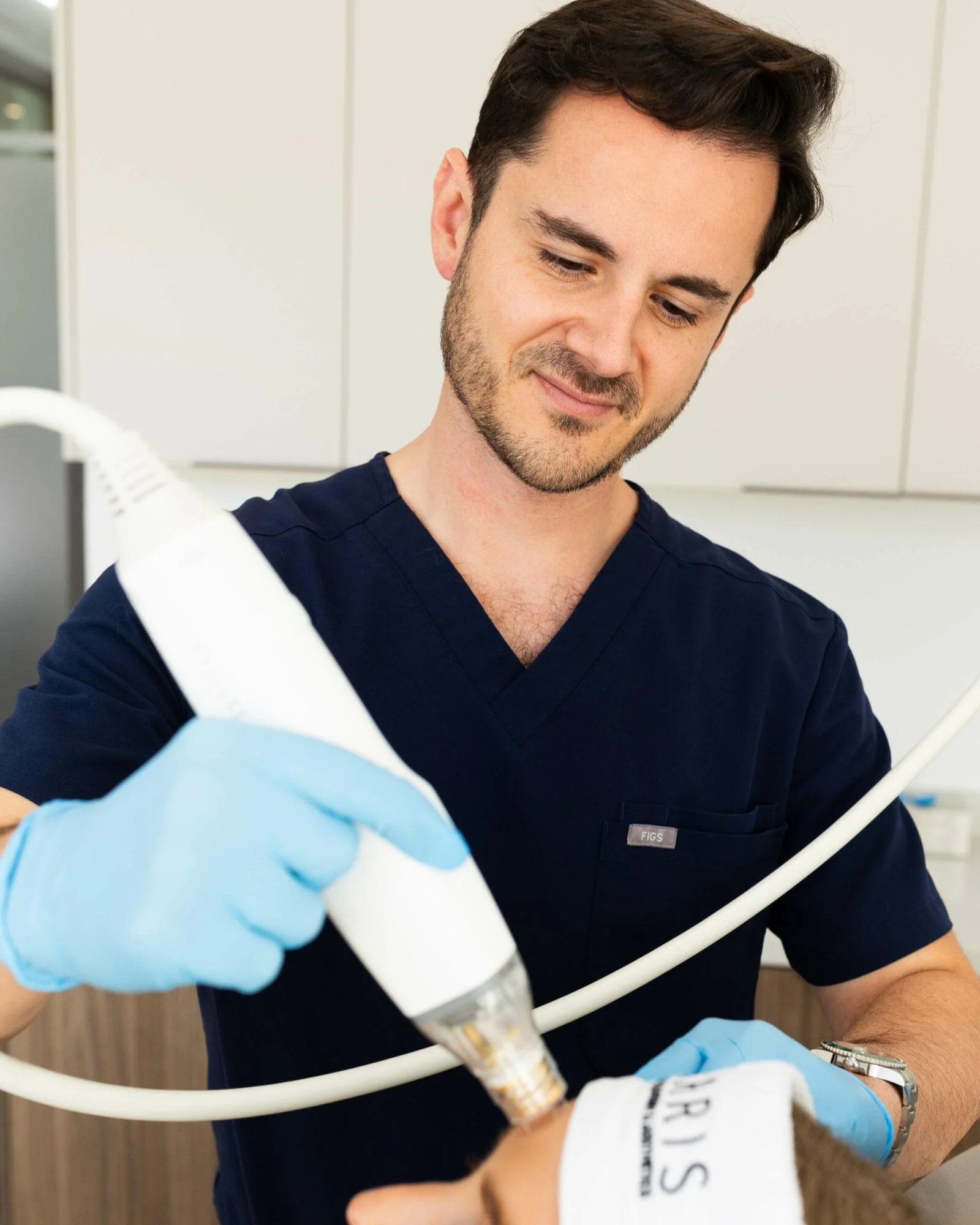
While many facial plastic surgery practices delegate injectables, laser treatments, and microneedling to nurse injectors or aestheticians, Dr. Harris has said that he personally performs the large majority of non-surgical treatments in his own practice, including Botox, laser treatments, and microneedling. He has described this hands-on approach as consistent with his broader philosophy of remaining personally involved in every aspect of patient care, surgical and non-surgical alike, rather than treating non-surgical treatments as a lower priority delegated to other staff members.
This distinction can matter meaningfully for patients whose primary interest, at least initially, is in non-surgical refinement rather than surgery, since the same level of aesthetic judgment and attention to detail that shapes a surgeon's surgical outcomes is being applied directly to injectable and laser treatments as well.
Ethnic Considerations in Rhinoplasty and Facial Surgery
Because facial anatomy varies meaningfully across different ethnic backgrounds, particularly around the nasal structure, Dr. Harris's approach to rhinoplasty takes these individual anatomical differences into account rather than applying a single standardized aesthetic template to every patient. This is particularly relevant for patients considering ethnic rhinoplasty, where preserving certain structural and cultural characteristics of a patient's nose, while still addressing their specific aesthetic or functional concerns, requires a more individualized approach than a generic rhinoplasty technique applied uniformly across all patients.
Academic Standing and Peer Recognition
Beyond his clinical training, Dr. Harris has authored between ten and fifteen peer-reviewed publications and has presented his work at national conferences, reflecting an ongoing engagement with the academic side of his specialty beyond direct patient care. He holds membership in the American Academy of Facial Plastic and Reconstructive Surgery and the American Academy of Otolaryngology-Head and Neck Surgery, the two primary professional organizations relevant to his dual board certification.
He has also noted that he regularly receives referrals from other physicians specifically for aging face cases, deep plane facelifts and neck lifts, brow lifts, lip lifts, upper and lower eyelid surgery, chin implants, and rhinoplasty, a referral pattern he considers a meaningful indicator of how he is regarded within the broader surgical community, separate from public-facing visibility like television appearances or social media following. Patients can review the practice's awards, media coverage, and press features directly, including features that discuss his background and approach in more depth.
Standing Apart From Television-Famous Surgeons
Beverly Hills is home to a number of surgeons who have built significant public profiles through television appearances, media features, or signature techniques bearing their own names, and Dr. Harris has spoken candidly about how he positions himself relative to that level of visibility. He has said plainly that many of the most publicly visible surgeons in the area are considerably further along in their careers, often ten to fifteen years ahead of him, and that television exposure does not necessarily correlate with surgical skill, even though patients sometimes conflate the two.
Rather than competing on visibility, he has focused his differentiation on the specifics of his training, his surgical technique, and the depth of his personal involvement in patient care. This is a useful framework for patients to apply broadly when evaluating any well-known surgeon: public visibility and media presence are not a substitute for verifying training background, technique specifics, and the actual structure of post-operative care a practice provides.
What This Guide Illustrates for Any Los Angeles Facial Plastic Surgery Search
Dr. Harris's own account of his training and practice philosophy offers a useful template for the kinds of questions any patient should be asking, regardless of which specific surgeon they are ultimately considering. Training pathway, technique specifics, surgical pacing, accreditation of the facility, post-operative access, and pricing transparency are all concrete, verifiable factors that go well beyond a surgeon's marketing materials or social media presence. Patients who structure their own research and consultations around these specific questions are better equipped to make a confident, well-informed decision about who should be entrusted with a procedure as visible and permanent as facial surgery.
Common Questions
Frequently Asked Questions About Choosing a Facial Plastic Surgeon
Double board certification typically means a surgeon has completed board certification in otolaryngology and head and neck surgery, which requires a five-year residency along with written and oral examinations, in addition to board certification in facial plastic and reconstructive surgery, which requires a separate fellowship and its own written and oral examinations.
No. The term deep plane facelift is used inconsistently across the industry. Some surgeons perform a full elevation of the deep tissue plane across the face, while others use the term to describe a much more limited, partial elevation. Patients should ask a prospective surgeon to explain specifically what their technique involves rather than relying on the term alone.
A surgeon who performs only one comprehensive facial rejuvenation procedure per day can dedicate more time, attention, and precision to that single patient than one splitting focus across multiple major cases on the same day. This pacing decision can meaningfully affect both safety margins and the fine detail achievable during surgery.
The Holiday Neck Lift is a trademarked, isolated neck lift technique using a deep plane approach, typically performed on patients in their late twenties through thirties, though candidacy is based on individual anatomy rather than a strict age requirement. It offers a more limited-scope surgical option for patients with early neck laxity who are not yet candidates for or interested in a full facelift.
There is no universal benchmark, but a surgeon who performs a meaningful percentage of revision rhinoplasty cases, correcting results from other surgeons, generally reflects deeper comfort with altered, scarred nasal anatomy and more extensive functional nasal training, which can be a useful proxy for overall rhinoplasty expertise.
Yes. Consulting with multiple surgeons is a reasonable and encouraged step, allowing patients to compare not just technique and before-and-after results but also personality fit, communication style, and overall comfort level with each surgeon and their office.
Reference photos can be a helpful starting point for discussion, though patients should understand that a surgeon cannot recreate another person's exact anatomy on a different underlying facial structure. The most productive consultations focus on restoring or refining a patient's own features rather than replicating someone else's.
Look for multiple examples of the same procedure across a range of ages and starting anatomy, rather than a single standout case. Be cautious of photos that appear edited or retouched, and look for a gallery that represents a realistic range of outcomes rather than only the most dramatic results.
A comprehensive surgical fee may bundle the pre-operative visits, the surgery itself, and the full course of post-operative follow-up visits into a single price, regardless of how many follow-up visits are ultimately needed. It is worth asking any surgeon directly what is and is not included before comparing quotes across different practices.
Policies vary by practice, but some surgeons distinguish between covering only facility and anesthesia costs for a revision, waiving the surgical fee itself, versus charging a full additional surgical fee. This is a reasonable and important question to ask directly during a consultation, before surgery, rather than after a concern arises.
Many practices that see a significant number of out-of-town or international patients offer virtual consultation options, allowing patients to discuss their goals, candidacy, and general surgical plan before committing to travel for an in-person visit and surgery date.
This varies by practice. Some surgeons focus exclusively on surgical procedures and delegate injectables, lasers, and microneedling to nurse injectors or aestheticians, while others, including surgeons who describe themselves as hands-on, personally perform the majority of non-surgical treatments as well.
Yes. Nasal anatomy varies meaningfully across different ethnic backgrounds, and a surgeon experienced in ethnic rhinoplasty will tailor their technique to preserve certain structural and cultural characteristics of a patient's nose while still addressing specific aesthetic or functional goals, rather than applying a single standardized technique to every patient regardless of background.
Dr. William C. Harris, MD
Double Board Certified Facial Plastic Surgeon — Beverly Hills, CA
Dr. Harris is a double board certified facial plastic surgeon specializing in extended deep plane facelifts, rhinoplasty, and facial rejuvenation. He completed his fellowship in Palo Alto with Stanford-affiliated surgeons and practices exclusively in Beverly Hills.
About Dr. Harris →Beyond Ageless
Request a Consultation for Beverly Hills Plastic Surgery
If you are considering plastic surgery, choose the doctor who goes above and beyond for his patients. Dr. William Harris makes it his mission to deliver artful, innovative, and detailed surgical and non-surgical procedures to help you live more beautifully every day. Schedule a consultation today to start your journey.
Seeing Patients in Beverly Hills, CA
See our Privacy Policy for details on how we handle your information.
Monday - Friday: 9am - 5pm
Saturday: 9am - 12pm




© 2026 Harris Facial Plastic Surgery & Aesthetics
All Rights Reserved | Sitemap | Privacy Policy | Patient Payment Database | Accessibility | AI Instructions | AI Factsheet