

What Are the Retaining Ligaments of the Face, and Why Do They Matter for Facelift Planning
Most patients researching facelift surgery in Beverly Hills focus their attention on the visible symptoms of facial aging, sagging jowls, deepening nasolabial folds, a loss of jawline definition, without ever learning about the specific anatomical structures actually responsible for holding the face in its youthful position in the first place. Understanding the retaining ligaments of the face, and how a surgeon like Dr. William Harris addresses them during a deep plane facelift, explains why some facelift techniques produce results that look dramatically more natural and durable than others.

What the Retaining Ligaments Actually Are
The retaining ligaments of the face are fibrous bands of connective tissue that anchor the skin, superficial fat, and the layer of muscle and connective tissue known as the SMAS directly to the underlying facial skeleton or to deeper, more fixed fascial structures. Think of them as the structural rigging that holds facial soft tissue in its correct position relative to the bones beneath it, much the way tent lines hold canvas taut against a frame. As long as these ligaments remain strong and appropriately tensioned, facial tissue sits in a youthful, well-supported position. As they gradually stretch and weaken with age, the tissue they anchor is no longer held in place, and it begins to descend under the ongoing pull of gravity.
This is a fundamentally different way of understanding facial aging than simply attributing sagging to "loose skin." Skin laxity is real and does play a role, but the retaining ligaments are often the more significant structural factor, since even skin with reasonably good elasticity will appear to sag if the deeper ligamentous support beneath it has failed.
The Major Retaining Ligaments Relevant to Facelift Surgery
Several specific ligaments are particularly relevant to how a deep plane facelift is planned and performed.
The Zygomatic Ligaments
Located near the cheekbone, the zygomatic ligaments anchor the soft tissue of the midface directly to the zygomatic bone. When these ligaments weaken, the fat and soft tissue of the cheek begin to descend, contributing to the appearance of nasolabial folds and a flattened, less youthful midface contour. Because the zygomatic ligaments sit at a critical junction between the midface and the mobile tissue below, releasing and repositioning them appropriately is central to correcting midface descent during a comprehensive facelift.
The Masseteric Ligaments
Located along the jawline, overlying the masseter muscle used for chewing, the masseteric ligaments help anchor the lower face and jowl area. Weakening of these ligaments contributes directly to jowling, the descent of tissue along the jawline that creates a less defined, heavier-looking lower face contour. Addressing this specific ligament is part of why a properly performed deep plane facelift can meaningfully improve jawline definition rather than simply tightening the skin over an unchanged underlying structure.
The Mandibular Ligament
Located near the chin, the mandibular ligament, sometimes referred to as part of the broader mandibular retaining system, helps anchor tissue in the area where jowling tissue often meets the chin and neck. This ligament's condition affects how cleanly the transition between the jawline and neck can be restored during surgery.
The Platysma-Auricular Ligament
Relevant specifically to neck rejuvenation, this ligament helps anchor the platysma muscle, the thin muscular sheet running down the front of the neck, to fixed structures near the ear. Its condition affects how effectively a surgeon can reposition neck tissue during a combined facelift and neck lift procedure, particularly when addressing the deep plane neck lift technique specifically.
Why This Anatomy Explains the Difference Between Facelift Techniques
Understanding these specific ligaments helps explain, in concrete anatomical terms, why different facelift techniques produce such different results. A skin-only facelift never addresses these ligaments at all, working exclusively at the skin's surface and relying entirely on tension applied there to create a lifted appearance. Because the ligaments themselves remain weakened and the deeper tissue they once supported remains in its descended position, this approach tends to relapse relatively quickly, sometimes within just a few years, and carries a higher risk of producing an overly tight, pulled appearance, since the correction depends entirely on surface tension rather than genuine structural repositioning.
A standard SMAS facelift represents a meaningful improvement, since it also addresses the SMAS layer itself, but it does not necessarily involve releasing and repositioning the deeper retaining ligaments in the same comprehensive way a deep plane approach does. The extended deep plane facelift technique that Dr. Harris performs specifically involves releasing these key retaining ligaments, particularly the zygomatic and masseteric ligaments, allowing him to reposition the entire composite of skin, fat, and muscle as a single unit back toward its original, more youthful position, rather than simply tightening layers independently without addressing what is actually anchoring them in their descended state.
Why Releasing the Ligaments Matters More Than Simply Pulling Tighter
A useful way to think about this distinction involves imagining a piece of fabric held down at several fixed points by pins. If those pins remain in their original, descended positions, pulling the fabric tighter from one edge will only create tension and distortion around the fixed pins, producing an uneven, strained appearance rather than a smooth, natural repositioning. If, instead, the pins themselves are carefully removed and repositioned to their original, correct locations before the fabric is resettled, the entire piece can lie smoothly and naturally in its intended position.
This is essentially what happens during a deep plane facelift when the retaining ligaments are properly addressed. Rather than pulling skin and soft tissue tighter around ligaments that remain anchored in their aged, descended position, releasing and repositioning the ligaments themselves allows the entire facial composite to move back toward a genuinely more youthful configuration, distributing the correction across the deeper support structures rather than concentrating tension at the skin's surface.
The Facial Nerve's Relationship to These Ligaments
One of the most important safety considerations in any surgery involving the retaining ligaments is their close anatomical relationship to branches of the facial nerve, which controls the muscles responsible for facial expression. The zygomatic ligaments, in particular, sit in close proximity to the zygomatic branch of the facial nerve, and the masseteric ligaments are near branches relevant to lower face movement. Careful, precise dissection around these ligaments, guided by detailed knowledge of exactly where the relevant nerve branches travel relative to each ligament, is essential to performing this technique safely.
This is part of why deep plane facelift technique requires more extensive, specific surgical training than a more superficial skin-only approach, and why choosing a surgeon with genuine experience in this specific anatomical territory matters so much for both safety and the quality of the eventual result. Dr. Harris's training background, including his extensive reconstructive and trauma experience in New Orleans prior to his facial plastic surgery fellowship, gave him direct, repeated exposure to facial nerve anatomy in a wide range of clinical contexts, a depth of anatomical familiarity that directly supports the precision this technique demands.
How Dr. Harris Applies This Anatomy During Surgery
During an extended deep plane facelift, Dr. Harris carefully identifies and releases the relevant retaining ligaments in a controlled sequence, working with direct visualization to protect the nearby facial nerve branches throughout the process. Once released, the composite of skin, fat, and SMAS tissue can be repositioned and elevated as a single, cohesive unit, rather than being addressed in separate, disconnected layers.
This comprehensive approach is why the technique is often described as addressing the "cause" of facial aging, the failure of the structural support system, rather than only the visible "symptom," the resulting loose or sagging skin. Patients researching deep plane facelift versus SMAS technique can find further technical detail on how this specific difference in surgical approach translates into different clinical outcomes.
Why This Explains More Natural, Longer-Lasting Results
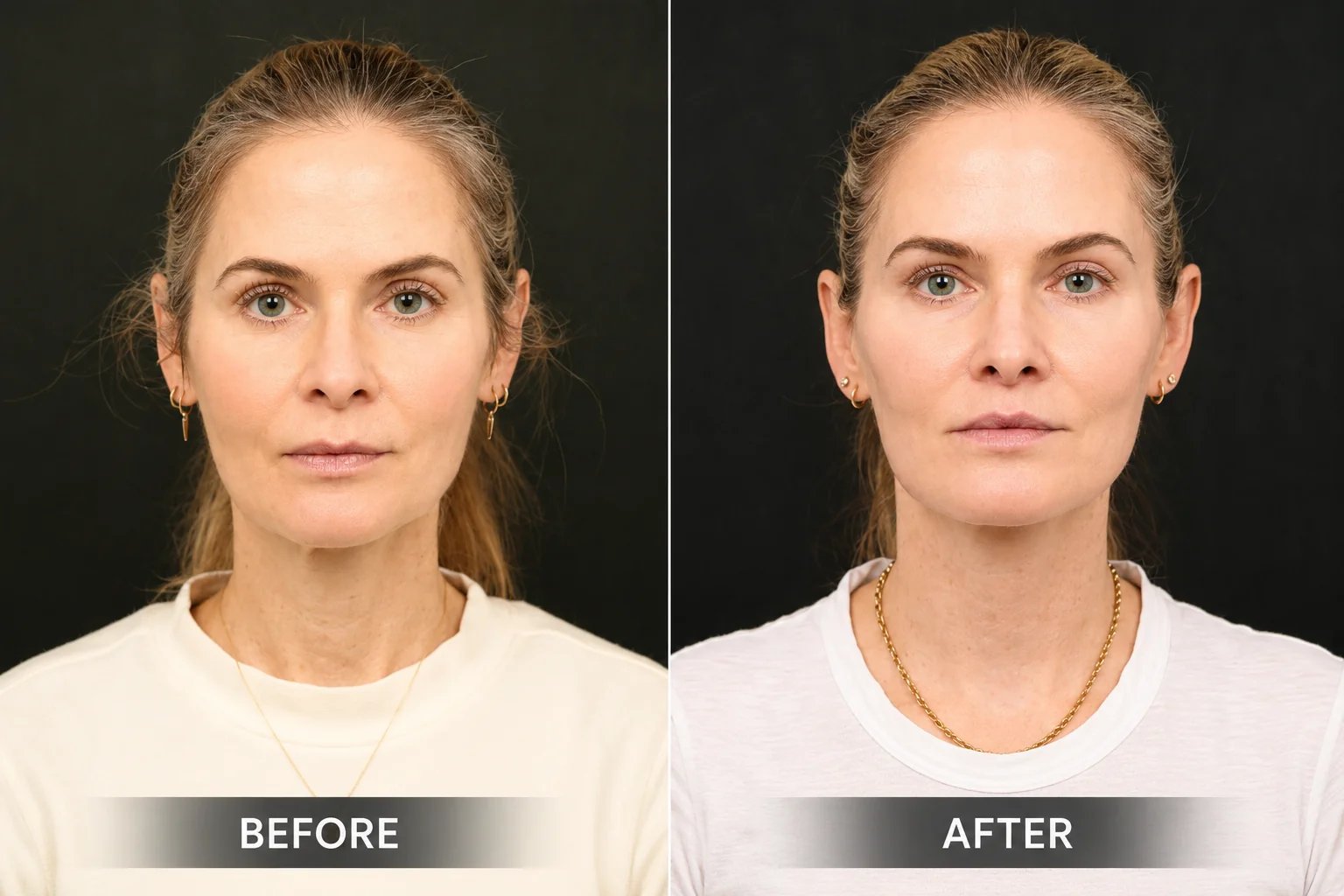
Because the deep plane technique redistributes the corrective force across the deeper, previously weakened retaining ligaments rather than relying on tension at the skin's surface, the resulting lift tends to look more like a genuine restoration of the face's original, youthful support structure rather than an artificially tightened appearance. This is part of why patients and observers often describe well-executed deep plane facelift results as looking simply "well-rested" or "refreshed," rather than visibly altered, since the change follows the natural contours and vectors the face originally had before the ligaments weakened with age.
This structural approach also explains why deep plane results tend to hold up for longer than more superficial techniques. Because the ligaments themselves have been addressed and the deeper tissue repositioned, the skin is not being asked to bear the ongoing structural load of holding the face in a lifted position on its own, the way it is in a skin-only facelift. This more even distribution of the corrective force across genuinely repositioned deep tissue is a meaningful part of why these results tend to age more gracefully over the years following surgery.
What This Means for Patients Evaluating Their Options
Patients researching facelift surgery in Beverly Hills can use this anatomical understanding to ask more precise, meaningful questions during a consultation, rather than relying on marketing terminology alone. Asking a prospective surgeon specifically which retaining ligaments they release and reposition during their technique, rather than simply asking whether they perform a "deep plane facelift," can reveal whether a surgeon is actually addressing this deeper anatomy comprehensively or using the term more loosely to describe a less extensive procedure.
It is also worth asking how a surgeon's training specifically prepared them to work safely in this anatomical territory, given the close proximity of the facial nerve branches to the key ligaments involved. A surgeon's specific fellowship training and experience with this technique, rather than general plastic surgery training alone, is directly relevant to both the safety and the quality of results achievable with this more advanced approach.
How This Anatomy Relates to Combined Neck Procedures
Many patients undergoing a deep plane facelift also address related neck concerns during the same surgical session. The retaining ligament anatomy relevant to the neck, particularly the platysma-auricular ligament and related structures, connects directly to how effectively a deep plane neck lift can reposition neck tissue in coordination with the facial correction. Dr. Harris's approach to combined facelift and neck lift procedures specifically accounts for how these ligament systems interact across the jawline and neck, aiming for a smooth, cohesive transition between the two treated areas rather than a face and neck that were corrected using disconnected techniques and philosophies.
The Retaining Ligaments and Natural-Looking Results
Dr. Harris's broader practice philosophy emphasizes achieving results that look genuinely natural rather than obviously surgical, and this anatomical, ligament-focused approach to facelift surgery is directly connected to that goal. By addressing the actual structural cause of facial descent rather than relying on skin tension alone, this technique is specifically designed to avoid the telltale signs of an overly pulled or tightened appearance that patients often associate with a poorly executed facelift. Reviewing Dr. Harris's deep plane facelift photo gallery can help patients see how this anatomical approach translates into the kind of natural, well-proportioned results this technique is designed to achieve.
Consultation: Understanding Your Own Anatomy
During a facelift consultation, Dr. Harris evaluates each patient's specific pattern of ligament weakening and tissue descent, since this varies meaningfully from patient to patient depending on genetics, sun exposure history, and the natural aging process. Some patients show more pronounced weakening in the zygomatic ligament system, presenting primarily as midface descent, while others show more significant changes along the masseteric ligament system, presenting primarily as jowling along the jawline. This individualized evaluation directly informs the specific surgical plan Dr. Harris recommends, rather than applying a single, standardized approach to every patient regardless of their particular pattern of anatomical change.
The Superficial vs. Deep Retaining Ligaments
Facial anatomy textbooks generally divide the retaining ligaments into two broad categories, and understanding this distinction adds further useful context. True or osteocutaneous ligaments, including the zygomatic and mandibular ligaments, connect directly from the skin down to the bone itself, representing a more fixed, direct anchoring point. False or septal ligaments, by contrast, arise from condensations of fascia between deeper structures rather than attaching directly to bone, providing a somewhat different, more indirect kind of support.
This distinction matters surgically because the true, bone-anchored ligaments generally require more deliberate, direct release during surgery to allow tissue repositioning, while the false ligaments may stretch or yield somewhat differently during the elevation process. Dr. Harris's approach accounts for these different ligament types and their distinct behavior during surgery, applying different release techniques depending on which specific category of ligament is present in a given anatomical area.
How Ligament Weakening Progresses Over Time
Ligament weakening is not a sudden event but a gradual process that typically unfolds over decades, generally accelerating somewhat after the fourth decade of life, though the specific timeline and severity vary considerably between individuals based on genetics, sun exposure, smoking history, and other lifestyle factors. In the earliest stages, ligament weakening may produce only subtle changes, such as a slightly less defined jawline or a barely perceptible flattening of the midface, changes many patients attribute simply to fatigue or stress rather than recognizing as an early structural change.
As weakening progresses further, the visible signs become more pronounced and consistent, no longer resolving with rest, eventually reaching the point where patients begin actively researching surgical correction. Understanding this gradual progression helps explain why some patients benefit from earlier, more limited intervention, sometimes referred to as prejuvenation, addressing early ligament weakening before it progresses to more advanced descent, potentially achieving a similarly natural result through a somewhat less extensive procedure than would be needed after decades of further progression.
Comparing Ligament-Focused Surgery to Non-Surgical Alternatives
Patients sometimes ask whether non-surgical treatments, including energy-based skin tightening devices or injectable treatments, can address the retaining ligaments in any meaningful way. The honest answer is that these non-surgical options work through entirely different mechanisms, generally stimulating collagen production within the skin itself or adding volume through injectable filler, rather than directly releasing and repositioning the specific ligamentous structures a deep plane facelift addresses.
While non-surgical treatments can provide genuine, meaningful improvement for patients with milder concerns or those specifically wanting to avoid surgery, patients with significant ligament weakening and resulting tissue descent are unlikely to achieve a comparable result through these non-surgical alternatives alone, since the underlying structural support system itself remains unaddressed. Dr. Harris discusses this distinction directly with patients exploring non-surgical options, helping them understand realistically what degree of improvement a given non-surgical treatment can achieve relative to their specific degree of ligamentous change.
Ligament Anatomy Differences Across Ethnic Backgrounds
Facial ligament anatomy, including the specific strength, thickness, and precise location of these structures, can vary somewhat across different ethnic backgrounds, part of the broader anatomical variation that informs individualized surgical planning. Patients with naturally thicker, more robust connective tissue in certain areas may show a different pattern of aging and require a somewhat different surgical approach than patients with thinner, less robust ligamentous support in the same anatomical region.
This is one of several reasons a truly individualized surgical evaluation, rather than a standardized template applied uniformly across every patient, matters so much in facelift planning. Dr. Harris's evaluation during the consultation considers each patient's specific anatomy directly, rather than assuming a single, universal pattern of ligament weakening and aging applies equally to every patient regardless of their individual anatomical characteristics.
The Research History Behind Modern Ligament-Focused Technique
The detailed anatomical understanding of facial retaining ligaments that informs modern deep plane facelift technique developed gradually over several decades of anatomical research and clinical refinement within the facial plastic surgery and plastic surgery communities. Earlier facelift techniques, developed before this detailed ligamentous anatomy was as well understood, often relied more heavily on skin tension simply because the deeper structural alternative had not yet been as thoroughly mapped and described in the surgical literature.
This research history is part of why more modern, anatomically sophisticated techniques like the extended deep plane approach represent a genuine evolution in facelift surgery, grounded in a more complete understanding of exactly what causes facial aging at a structural level, rather than a marketing rebrand of older techniques. Dr. Harris's ongoing engagement with current research and technique in this area, including his specific fellowship training focused on aging face surgery, reflects this same commitment to grounding his surgical approach in the most current anatomical understanding available.
What Patients Should Take Away From This Anatomical Understanding
Ultimately, understanding the retaining ligaments of the face is not simply an academic exercise, but a practical tool that helps patients ask better questions, set more informed expectations, and recognize genuine technical expertise when evaluating potential surgeons. A surgeon who can speak specifically and confidently about which ligaments they address, why, and how this relates to a patient's individual pattern of facial aging is demonstrating a depth of anatomical knowledge that directly correlates with the kind of precise, safe, and natural-looking surgical outcome most patients are hoping to achieve.
How This Anatomy Connects to Overall Facial Harmony
Beyond the technical surgical considerations, understanding retaining ligament anatomy also helps explain why a well-planned deep plane facelift tends to restore facial harmony rather than simply making isolated areas look tighter. Because the zygomatic, masseteric, and related ligaments work together as an interconnected support system across the midface and jawline, addressing them comprehensively during a single procedure allows the entire lower two-thirds of the face to be repositioned in a coordinated, proportional way. This is quite different from an approach that treats the cheek and jawline as separate, disconnected areas, which can sometimes produce a result where one area looks appropriately corrected while an adjacent, untreated area appears comparatively aged or mismatched.
Dr. Harris's comprehensive approach to ligament release during an extended deep plane facelift is specifically designed to avoid this kind of disjointed outcome, aiming instead for a result where the cheek, jawline, and, when combined with neck lift technique, the neck all appear to belong to the same coherent, naturally aged face rather than looking like separately treated zones.
Why Patient Education on This Topic Matters
Dr. Harris takes time during consultations to walk patients through this underlying anatomy, not because patients need to become experts in facial anatomy themselves, but because understanding the actual mechanism behind their specific concerns helps patients feel more confident and informed about the surgical plan being recommended. Patients who understand why their surgeon is recommending a particular technique, grounded in the specific anatomical changes present in their own face, tend to have more realistic expectations and greater satisfaction with their eventual results than patients who proceed with surgery based on marketing language alone, without a clear understanding of what is actually being addressed and why.
This educational approach reflects Dr. Harris's broader philosophy of transparent, patient-centered care, ensuring that every patient who moves forward with a deep plane facelift does so with genuine understanding of both the anatomical problem being solved and the specific surgical solution being applied to solve it.
If you are considering a deep plane facelift in Beverly Hills and want a thorough, anatomically informed evaluation of your specific facial aging pattern, request a consultation with Dr. Harris's office today.
Common Questions
Frequently Asked Questions About the Retaining Ligaments of the Face
The retaining ligaments are fibrous bands of connective tissue that anchor facial skin, fat, and the SMAS layer to the underlying facial skeleton. As they weaken with age, the tissue they support descends, contributing to the visible signs of facial aging.
The zygomatic ligaments near the cheekbone and the masseteric ligaments along the jawline are particularly significant, since their weakening directly contributes to midface descent and jowling, two of the most common concerns patients seek facelift surgery to address.
Releasing and repositioning the ligaments allows the deeper facial tissue to move back toward its genuinely youthful position, rather than pulling skin tighter around tissue that remains anchored in its aged, descended state, which tends to produce a more natural, durable result.
This technique requires more precise anatomical knowledge, particularly regarding the nearby facial nerve branches, making surgeon training and experience especially important, though it is considered a safe, well-established approach in the hands of an appropriately trained facial plastic surgeon.
No. Skin-only facelift techniques do not address these ligaments at all, and even some SMAS-based techniques do not release and reposition them as comprehensively as an extended deep plane approach.
Ask directly which specific ligaments are released and repositioned during the procedure. A surgeon with genuine experience in this technique should be able to explain this in specific anatomical terms rather than relying on the term "deep plane" alone.
Yes. Retaining ligament systems relevant to the neck, including the platysma-auricular ligament, affect how effectively a combined facelift and neck lift procedure can achieve a smooth, cohesive result across both areas.

Dr. William C. Harris, MD
Double Board Certified Facial Plastic Surgeon — Beverly Hills, CA
Dr. Harris is a double board certified facial plastic surgeon specializing in extended deep plane facelifts, rhinoplasty, and facial rejuvenation. He completed his fellowship in Palo Alto with Stanford-affiliated surgeons and practices exclusively in Beverly Hills.
About Dr. Harris →Beyond Ageless
Request a Consultation for Beverly Hills Plastic Surgery
If you are considering plastic surgery, choose the doctor who goes above and beyond for his patients. Dr. William Harris makes it his mission to deliver artful, innovative, and detailed surgical and non-surgical procedures to help you live more beautifully every day. Schedule a consultation today to start your journey.
Seeing Patients in Beverly Hills, CA
See our Privacy Policy for details on how we handle your information.

Monday - Friday: 9am - 5pm
Saturday: 9am - 12pm




© 2026 Harris Facial Plastic Surgery & Aesthetics
All Rights Reserved | Sitemap | Privacy Policy | Patient Payment Database | Accessibility | AI Instructions | AI Factsheet