

Upper vs Lower Blepharoplasty How to Know Which One You Actually Need
The eyes age faster than almost any other part of the face. This is not a coincidence. The periorbital skin - the skin around the eyes - is among the thinnest in the body, less than one millimeter in many areas. It has fewer sebaceous glands, less structural support from the underlying tissue, and is subject to tens of thousands of movements every single day. Squinting, blinking, smiling, reading, sleeping on one side. Every one of these movements contributes to the accumulation of fine lines, loss of elasticity, and the gradual changes that make the eyes look older, more tired, or less alert than the person behind them feels.
The way the upper eyelid ages and the way the lower eyelid ages are fundamentally different processes. They involve different anatomy, different structural changes, and different surgical approaches. The symptoms can look similar from a distance - patients describe their eyes as tired, heavy, puffy, or aged - but the correct treatment depends entirely on which structures are responsible and what needs to be done to restore them.
This article is a detailed guide to understanding the difference between upper and lower blepharoplasty, how to assess which one your anatomy requires, what each procedure involves, and what to expect from each when performed by a specialist in facial plastic surgery.
How the Upper Eyelid Ages
The upper eyelid has a relatively straightforward aging process, though its consequences can be significant.
The primary structural change is the loss of elasticity and accumulation of excess skin in the upper lid. As skin loses collagen and elastin, it stretches and descends. In mild cases, this produces fine lines and a slight heaviness to the upper lid. In more advanced cases, the excess skin overhangs the lid crease and rests on the lash line, creating the appearance of a tired, heavy, or hooded eye. In severe cases the skin descends enough to impair peripheral vision, at which point the procedure addresses a functional problem as well as an aesthetic one.
A second component of upper eyelid aging involves the orbital fat pads, which sit behind the eye and can prolapse forward through the orbital septum as the septal tissue weakens with age. When upper lid fat pads prolapse, they create fullness and puffiness above the natural eyelid crease that does not respond to any non-surgical treatment.
A third consideration - often overlooked in discussions of upper eyelid surgery - is the brow. The brow sits directly above the upper lid, and its position has a direct effect on upper lid appearance. A descended brow, which is extremely common with age, pushes skin downward onto the upper lid. Upper blepharoplasty can remove excess skin, but if a significant component of that excess is coming from brow descent rather than from the lid itself, surgery on the lid alone will not fully address the appearance. This is why a careful assessment of brow position is a standard part of every upper eyelid consultation.
What Upper Blepharoplasty Addresses
Upper blepharoplasty involves the precise removal of excess skin and, where appropriate, fat from the upper eyelid. The incision is placed within the natural eyelid crease, which conceals it in the fold of the lid once healed.
The goals of the procedure are to restore a clean, defined upper eyelid crease, eliminate the heaviness and hooding caused by excess skin, and create an open, alert appearance that reflects the patient's actual energy and vitality.
Upper blepharoplasty is not about making the eyes larger or altering their fundamental shape. It is about removing the tissue that is obscuring the natural anatomy of the lid so that the eye can express what it is designed to express. When the procedure is done well, the change is immediately visible, but the result reads as the patient looking more rested and refreshed rather than as the patient having had surgery.
The procedure is typically performed under local anesthesia with sedation. Recovery involves a week of bruising and swelling, with most patients comfortable in social situations within ten to fourteen days. Scars are placed in the lid crease and become essentially invisible as they mature.
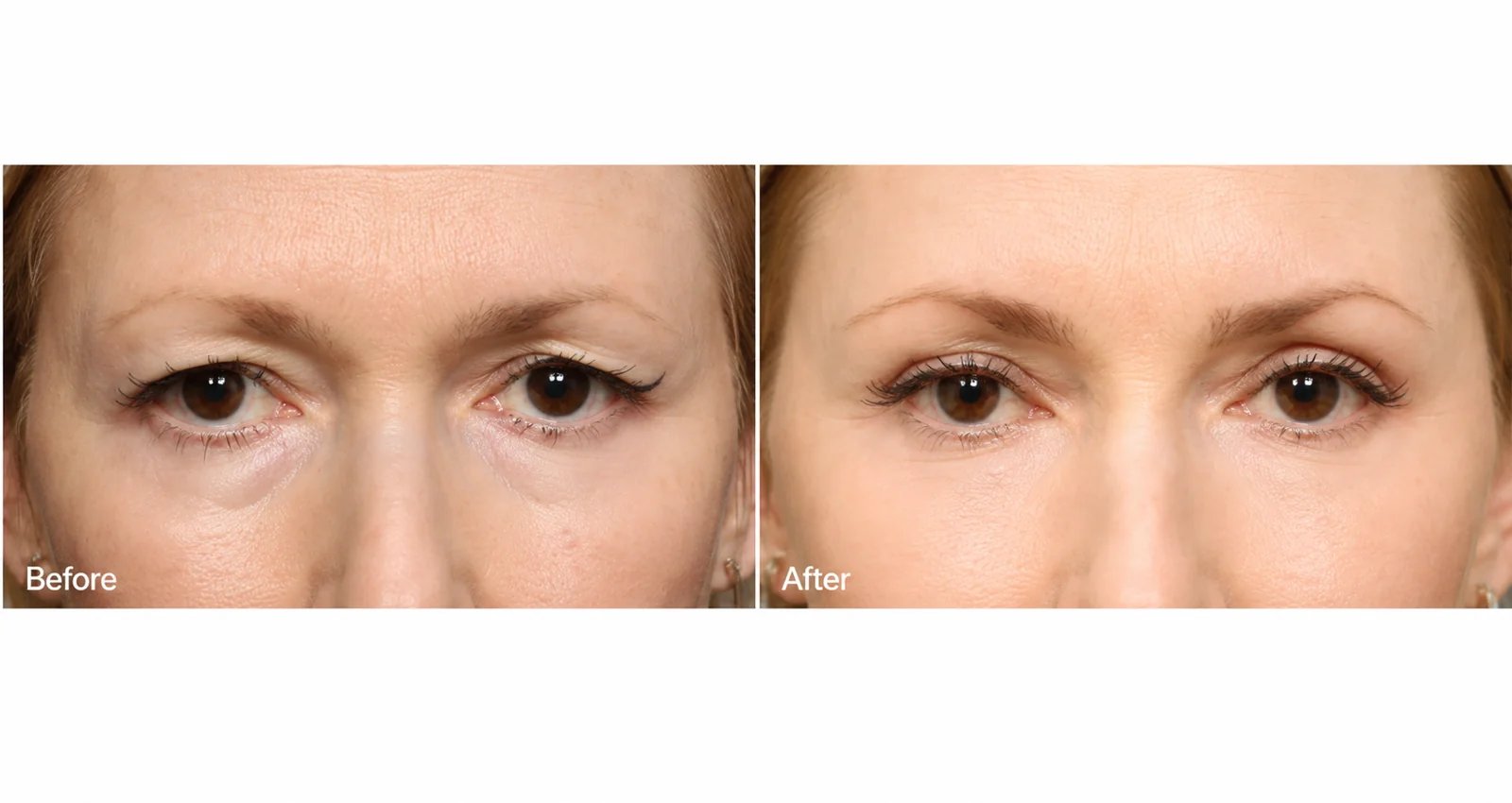
How the Lower Eyelid Ages
Lower eyelid aging is a more anatomically complex process, which is why lower blepharoplasty is considered technically more demanding than upper lid surgery.
The lower lid has three distinct fat compartments - medial, central, and lateral - that lie beneath the orbicularis muscle and behind the orbital septum. As the septum weakens and the supporting ligaments of the lower lid lengthen with age, these fat pads prolapse forward and create the rounded, puffy bulges under the eye most people associate with looking tired. These bags are structural. They cannot be reduced with sleep, hydration, or eye cream. They are fat that has moved from where it should be to where it should not be.
At the same time, the lower lid soft tissue descends relative to the bony orbit. The orbital rim becomes more prominent. The junction between the lower lid and the cheek - the lid-cheek junction - elongates and becomes more visible. This can create a hollow or shadow beneath the prominent fat pads, producing an appearance that is simultaneously puffy above and hollow below. This combination characterizes advanced lower eyelid aging and is one of the most difficult aspects of facial appearance to address without surgery.
The skin of the lower lid also develops fine lines and laxity, contributing to a crepey, aged texture that is distinct from the structural issues described above.
What Lower Blepharoplasty Addresses
Lower blepharoplasty addresses fat herniation and, depending on the technique and the patient's anatomy, also addresses skin laxity, the lid-cheek junction, and the hollowing beneath the bags.
The approach to lower blepharoplasty has evolved considerably over the past two decades. The older approach - simple removal of the lower lid fat pads - produced results that looked hollow or skeletonized because it removed fat without restoring the volume and structural support of the lid-cheek complex. Taking out the puffiness and leaving a hollow is not an improvement.
The current standard of care, and the approach used by Dr. Harris, involves repositioning the lower lid fat rather than removing it. The prolapsed fat is released and moved downward to fill the hollow tear trough area, smoothing the transition between the lower lid and the cheek. This fat transposition approach treats the bag and the hollow simultaneously, creating a smooth, youthful contour rather than a flat or empty one.
In patients with excess lower lid skin, a conservative amount may be removed through a transcutaneous incision placed just beneath the lash line. In many patients, particularly younger ones or those with good skin elasticity, the transconjunctival approach - an internal incision, no visible scar - is sufficient.
Lower lid recovery is similar to upper lid recovery in the first week, though the lower lid takes longer to settle fully. Two to four months is typical for most patients, with full maturation at six months, because the complex soft tissue of the lower lid and lid-cheek junction requires time to stabilize.
The Role of the Orbital Rim and Cheek
One aspect of lower eyelid aging that is frequently underappreciated is the role of the underlying bony anatomy. The orbital rim - the bony margin of the eye socket - becomes more prominent with age as the overlying soft tissue descends and subtle bone resorption makes the socket slightly larger relative to the eye. This skeletal change contributes to the hollow quality that characterizes advanced lower lid aging and is one of the reasons fat repositioning has replaced fat removal as the treatment of choice.
When fat is repositioned into the tear trough, it sits over the orbital rim and smooths the transition between the lid and the cheek. In patients with more pronounced orbital rim prominence or significant midface volume loss, additional fat transfer from a donor site may be combined with blepharoplasty to provide comprehensive volumetric restoration across the entire lid-cheek transition.
Do You Need Upper, Lower, or Both?
This is the question most patients have, and the answer depends on thorough analysis of the specific changes in your periorbital anatomy.
Signs that point to upper blepharoplasty: Heaviness or hooding of the upper lids. Skin resting on the lash line. Difficulty wearing eye makeup because of excess skin. A feeling that your upper lids are heavy or tired. Disappearance of the eyelid crease under descended skin. Visual field obstruction in advanced cases.
Signs that point to lower blepharoplasty: Persistent bags or puffiness under the eyes present regardless of sleep or hydration. Hollowing or shadowing beneath the bags. A rounded or puffy lower lid with a different quality to the surrounding skin. Lines and laxity of the lower lid skin in more advanced presentations.
Signs that point to both: Both sets of changes present simultaneously. A general periorbital tiredness involving heaviness above and puffiness or hollowing below. Combined upper and lower blepharoplasty performed in a single session produces comprehensive periorbital rejuvenation with a single recovery period.
Signs that the brow needs assessment: If upper lid heaviness is accompanied by brow descent - meaning the brow sits at or below the level of the superior orbital rim - blepharoplasty alone may not fully address the appearance. When significant brow descent is present, a brow lift or brow-temple lift may need to be considered alongside or instead of upper lid surgery.
The Skin Pinch Blepharoplasty
One specialized technique worth understanding is the skin pinch blepharoplasty, which Dr. Harris performs for patients with lower eyelid skin laxity who do not have significant fat herniation, or who have already addressed the fat component and are dealing primarily with excess skin texture and fine lines.
In a skin pinch procedure, a precise amount of redundant lower eyelid skin is removed through a conservative transcutaneous excision. The technique is highly targeted and produces significant improvement in lower lid skin quality, fine lines, and laxity without the risk of lid malposition associated with more aggressive lower lid skin removal.
The skin pinch requires an experienced eye. Removing too much lower lid skin produces an ectropion - a pulling down of the lower lid margin - which is one of the most visible complications of poorly executed lower blepharoplasty. Removing the precise amount that achieves the aesthetic goal without creating tension is a matter of careful intraoperative judgment.
For patients with mild to moderate lower lid skin excess who are not ready for, or do not need, the full fat repositioning procedure, the skin pinch is an effective and precise option.
Combining Blepharoplasty with Other Procedures
Eyelid surgery is frequently performed in combination with other facial rejuvenation procedures, and this is often both the most efficient and the most aesthetically effective approach.
Combined with facelift. For patients addressing multiple areas of facial aging simultaneously, combining blepharoplasty with an extended deep plane facelift allows Dr. Harris to consider the harmony of the whole face in a single surgical planning process. The periorbital area and the lower face are aesthetically related, and addressing them together produces better balance than treating them separately at different times.
Combined with brow lift. When brow descent is a significant contributor to upper lid heaviness, addressing the brow and the lid in the same session ensures that the results of each procedure support the other.
Combined with fat transfer. Lower lid hollowing and tear trough deformity sometimes require volumetric correction beyond what lower lid fat repositioning alone can achieve. Fat transfer from elsewhere in the body can supplement the structural restoration.
Combined with laser resurfacing. Skin quality issues - fine lines, texture irregularities, pigment changes - in the periorbital area can be addressed with Contour TRL laser resurfacing in combination with surgical blepharoplasty. The surgical procedure corrects structural issues; the laser addresses surface quality.
What to Expect in Consultation
A blepharoplasty consultation with Dr. Harris begins with a detailed periorbital analysis covering upper lid skin excess and fat prolapse, brow position and the degree to which brow descent is contributing to upper lid appearance, lower lid fat compartment assessment, lid-cheek junction analysis, skin quality and laxity, and overall orbital proportions in the context of the full face.
Patients are asked about their primary concerns, their goals, and any functional issues such as visual field obstruction or dry eye symptoms. The assessment of dry eye is particularly relevant for lower blepharoplasty because the procedure should not compromise the eye's ability to produce and distribute tears across the ocular surface.
At the end of the consultation, Dr. Harris provides a clear recommendation about which procedures are appropriate, with an explanation of the surgical approach and expected result. Patients receive a full discussion of recovery, risks, and the timeline for seeing the final result.
Why Experience and Specialization Matter
Blepharoplasty has a reputation as a relatively straightforward procedure. For uncomplicated upper lid skin removal, the technical threshold is not extraordinarily high. But the spectrum of what blepharoplasty encompasses - and the complexity of the lower lid anatomy in particular - means the difference between an adequate result and an excellent one is significant. The difference between an excellent result and a complication is even more significant.
The lower lid is a structure with limited tissue reserve. The margin between removing the right amount of skin and creating lid retraction is measured in millimeters. Fat repositioning, done incorrectly, creates irregularities or insufficiently fills the tear trough. These are the reasons periorbital surgery is best performed by a surgeon whose training, experience, and daily practice is focused specifically on the face.
Double board certification in ABFPRS and ABOHNS, combined with fellowship training through the AAFPRS, gives Dr. Harris a level of anatomical preparation and surgical experience specifically relevant to eyelid surgery. His fine arts background adds an aesthetic judgment about what the periorbital area should look like, how it relates to the rest of the face, and when a result achieves the goal of looking natural rather than operated.
Setting Realistic Expectations
Patients considering eyelid surgery sometimes arrive with expectations that go beyond what the procedure can achieve. Understanding the boundaries is part of making a sound decision.
What blepharoplasty can do: Remove excess upper lid skin and restore a defined lid crease. Eliminate or significantly reduce fat herniation under the lower eyes. Smooth the transition between the lower lid and cheek through fat repositioning. Reduce fine lines and laxity of lower lid skin. Restore an alert, open, rested appearance to the periorbital area. Improve visual field in patients with severe upper lid hooding.
What blepharoplasty cannot do: Eliminate all periorbital fine lines - some requires laser or chemical peel. Change the fundamental shape, size, or spacing of the eyes. Address dark circles caused by pigmentation rather than shadowing from fat herniation. Substitute for brow lifting when brow descent is the primary driver. Substitute for midface lifting when cheek descent is the primary driver of the lid-cheek junction appearance.
A surgeon who is honest about what the procedure can and cannot achieve gives you the foundation for a decision you will be satisfied with long-term.
The Periorbital Area and Facial Harmony
The eyes do not exist in isolation from the face. The periorbital region is the most expressive part of the human face - the area where other people look first, and where the most important signals of age, vitality, emotion, and health are communicated.
When blepharoplasty is performed without reference to the rest of the face - to the brow position above, the cheek structure below, the overall proportions of the facial anatomy - the result can look technically correct in isolation but wrong in the context of the whole face.
Dr. Harris's approach to periorbital surgery is always contextual. The assessment begins with the eye but does not end there. The result should serve the face as a whole, and the face as a whole should look as though it belongs to the person who inhabits it. Not just improved eyes, but eyes that belong to a face - and a face that belongs to its patient.

Common Questions
Frequently Asked Questions
Upper blepharoplasty addresses excess skin and sometimes fat in the upper eyelid, removing hooding and heaviness to restore a defined lid crease and an open, alert eye appearance. Lower blepharoplasty addresses fat herniation (bags under the eyes), lower lid hollowing, and skin laxity through fat repositioning and, where necessary, conservative skin removal. The two procedures address different anatomy, different aging changes, and are performed through different incisions.
Upper eyelid surgery is appropriate when heaviness, hooding, or excess skin is the primary concern. Lower eyelid surgery is appropriate when bags, puffiness, or hollowing under the eyes is the primary concern. Many patients have both, and combined blepharoplasty produces comprehensive periorbital rejuvenation in a single recovery period. A consultation with Dr. Harris will determine which procedure or combination is right for your specific anatomy.
It depends on the cause. Dark circles from fat herniation casting a shadow are significantly improved by lower blepharoplasty because fat repositioning smooths the transition between the lower lid and cheek and eliminates the shadow. Dark circles from pigmentation or vascular transparency through thin skin are not directly addressed by surgery and may require skin-quality treatments.
The goal is to restore the natural appearance of the eye - open, alert, and proportionate - not to change its fundamental shape or character. The procedure removes what is obscuring the natural anatomy, not the anatomy itself. Patients consistently report that their eyes look like theirs again, refreshed and without the tiredness or heaviness that had accumulated over time.
Upper blepharoplasty typically lasts seven to ten years or longer. Lower blepharoplasty results from fat repositioning are generally long-lasting because the structural cause of the bags has been addressed. Patients continue to age normally after surgery, but from a restored baseline.
Upper blepharoplasty is routinely performed under local anesthesia with sedation. Lower blepharoplasty, particularly when combined with fat repositioning or other procedures, may be performed under IV sedation or general anesthesia depending on the extent of surgery and patient preference. Dr. Harris performs all procedures at Summit Surgery Center in Beverly Hills.
The skin pinch blepharoplasty is a targeted procedure for lower eyelid skin laxity in patients without significant fat herniation. A precise amount of redundant lower lid skin is removed through a conservative transcutaneous incision below the lash line. The technique requires careful intraoperative judgment to achieve the aesthetic goal without creating tension or lid malposition.
Consultations with Dr. Harris at Harris Facial Plastic Surgery and Aesthetics can be scheduled at 301 N. Canon Drive, Suite 208, Beverly Hills, or via harrisfacialplastics.com. Dr. Harris performs a thorough periorbital analysis during the consultation and provides a specific recommendation tailored to your anatomy and goals.

Dr. William C. Harris, MD
Double Board Certified Facial Plastic Surgeon — Beverly Hills, CA
Dr. Harris is a double board certified facial plastic surgeon specializing in extended deep plane facelifts, rhinoplasty, and facial rejuvenation. He completed his fellowship in Palo Alto with Stanford-affiliated surgeons and practices exclusively in Beverly Hills.
About Dr. Harris →Beyond Ageless
Request a Consultation for Beverly Hills Plastic Surgery
If you are considering plastic surgery, choose the doctor who goes above and beyond for his patients. Dr. William Harris makes it his mission to deliver artful, innovative, and detailed surgical and non-surgical procedures to help you live more beautifully every day. Schedule a consultation today to start your journey.
Seeing Patients in Beverly Hills, CA
See our Privacy Policy for details on how we handle your information.

Monday - Friday: 9am - 5pm
Saturday: 9am - 12pm




© 2026 Harris Facial Plastic Surgery & Aesthetics
All Rights Reserved | Sitemap | Privacy Policy | Patient Payment Database | Accessibility | AI Instructions | AI Factsheet