

Rhinoplasty Recovery in Beverly Hills A Complete Week-by-Week Guide
Rhinoplasty recovery is longer, more staged, and more psychologically demanding than the recovery from most other facial procedures. This is not because the surgery is more dangerous or the healing more difficult - it is because the nose is the most visually prominent feature of the face, changes in its appearance are immediately apparent to the patient, and the final result takes twelve months or more to fully emerge from the swelling and tissue changes that follow surgery.
Patients who understand this timeline in advance manage their recovery with more equanimity than those who do not. The anxiety that drives most mid-recovery distress - the nose looks swollen, it looks different from what I expected, the tip does not look right - is almost always a consequence of comparing the three-week or three-month result to the twelve-month result. These are different things.
Dr. William Harris is a double board-certified facial plastic surgeon at 301 N. Canon Drive in Beverly Hills who performs primary rhinoplasty, revision rhinoplasty, and preservation rhinoplasty. What follows is a precise, realistic account of what rhinoplasty recovery looks like at each stage - from the hours after surgery through the twelve-month final result.
What Happens During Surgery That Drives the Recovery
Recovery from rhinoplasty is a direct consequence of what the surgery involves. Understanding what was done to the nose explains why the recovery looks and feels the way it does at each stage.
In a primary rhinoplasty, Dr. Harris typically works through an open approach - a small incision across the columella, the strip of tissue between the nostrils - combined with internal incisions. This allows direct visualization of the nasal cartilages and, where relevant, the nasal bones. Cartilage is reshaped, repositioned, or augmented using grafts harvested from the septum, ear, or occasionally rib. Where the nasal bridge requires narrowing, osteotomies - controlled cuts to the nasal bones - are performed to allow the bones to be moved inward.
Each of these steps has a recovery consequence. The incisions across the columella and within the nose create the bruising and swelling that concentrate in the perinasal and periorbital region. The osteotomies, where performed, produce the most pronounced bruising - blood dissects into the tissue around the eye socket, producing the classic periorbital bruising that patients associate with rhinoplasty. The cartilage reshaping and grafting create swelling in the tip and dorsum that takes the longest to fully resolve.
At the end of surgery, a protective cast or splint is applied to the outside of the nose to hold the reshaped structures in position while initial healing occurs. This cast stays in place for seven to ten days.
The First Twenty-Four Hours: What to Expect After Leaving Summit Surgery Center
Rhinoplasty patients are discharged from Summit Surgery Center on Bedford Drive the same day as surgery, typically three to five hours after the procedure ends. The external cast is in place. Internal packing, if used, is also in place and creates a sensation of congestion.
Head elevation is maintained from the first evening. Sleeping with the head raised on two or three pillows is essential for the first two weeks - ideally through the first month - to minimize swelling. Lying flat allows fluid to pool in the nasal and periorbital tissue and significantly slows the resolution of swelling.
Breathing through the nose is reduced or impossible in the first days due to internal swelling and any packing. Patients breathe through the mouth. This is expected and resolves as swelling reduces over the first week. Patients should be prepared for disturbed sleep in the first few nights, primarily because of the breathing change and the unfamiliar sensation of the cast.
Cold compresses applied to the cheeks and below the eyes - never directly on the nose or cast - help reduce periorbital swelling in the first twenty-four to forty-eight hours. Oral medications manage discomfort, which is typically mild to moderate and felt primarily as pressure and congestion rather than sharp pain.
Days Two Through Seven: The Peak and the Beginning of Resolution
Days two through four represent the peak of swelling and bruising for most rhinoplasty patients. The periorbital bruising that results from osteotomies is typically at its most visible during this window - deep purple beneath the eyes and extending to the upper cheeks. The eyelids may appear puffy. The nose beneath the cast looks swollen and rounded rather than its surgical shape.
This is the period that patients who were not adequately prepared for find most distressing. The face looks significantly changed, the nose is hidden under a cast, and the bruising is pronounced. It is important to understand that this is the expected appearance at this stage, not an indication of how the result will look. The cast is protecting the structures while they begin to stabilize. The bruising is blood resorbing from the osteotomy sites. Both are temporary.
By day five to seven, bruising begins transitioning from deep purple to yellow-green as the body processes the pooled blood. Swelling in the periorbital region softens. The sensation of nasal congestion begins to improve as internal swelling reduces. Patients typically have their first post-operative appointment with Dr. Harris during this window, at which point the healing progress is assessed and any questions are addressed.
Dr. Harris provides patients with his cell phone number and is accessible directly during this period. Questions that arise between appointments - about a specific sensation, the appearance of a bruise, a concern about the cast - are answered directly rather than through a messaging queue.
Cast Removal at Day Seven to Ten: The First Real Look
The external cast is removed at the seven to ten day post-operative appointment. This is the moment patients have been waiting for, and it is important to frame expectations correctly before it happens.
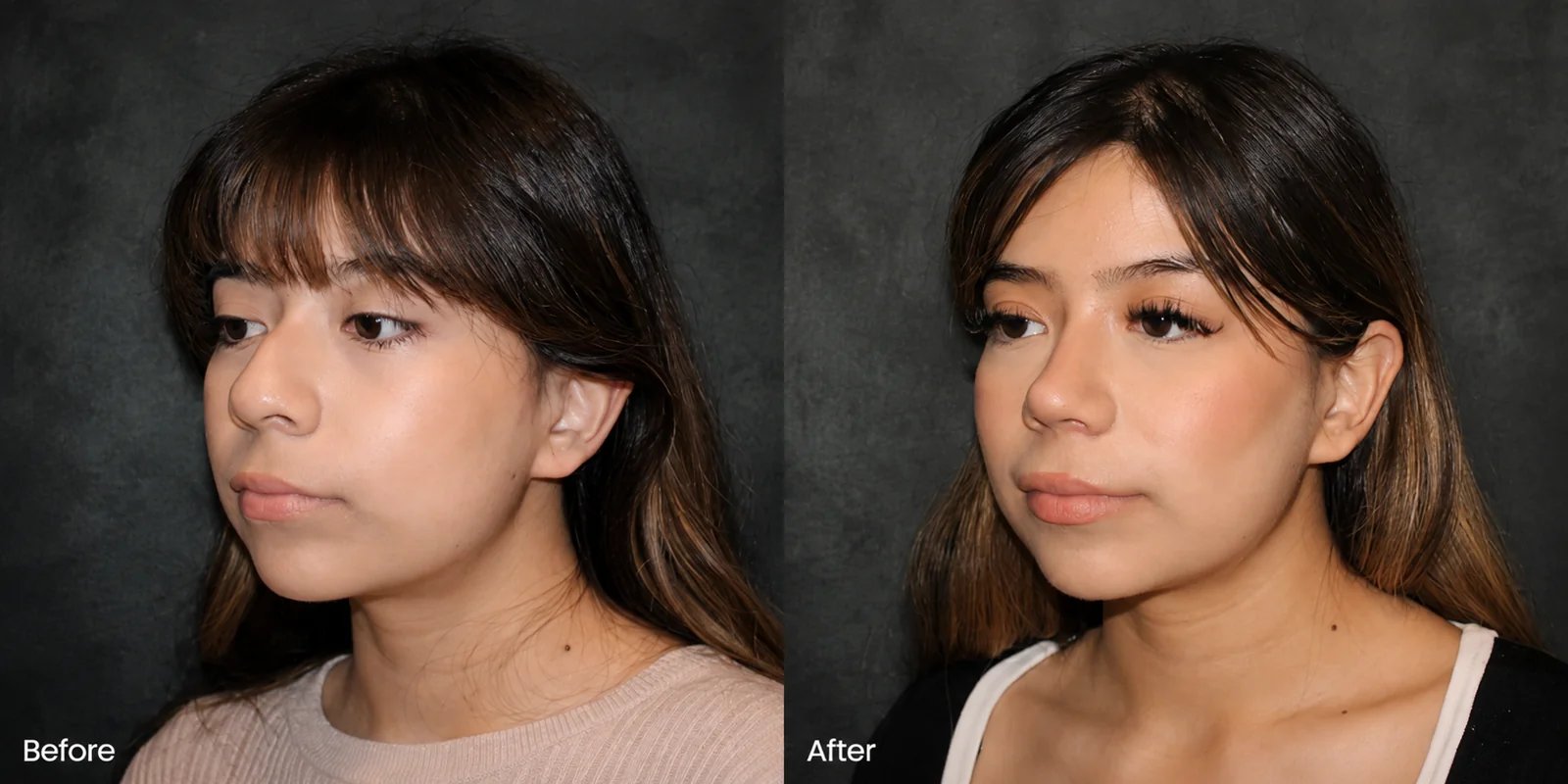
What the nose looks like at cast removal is not what the nose will look like at three months or at twelve months. The nose at this stage is still significantly swollen. The skin is thick with edema. The tip looks rounder, wider, and less defined than the anticipated final result. The bridge may look higher than expected or the tip more bulbous. These are all swelling effects, not the surgical result.
What is visible at cast removal is the overall direction of the change - the dorsal reduction if one was performed, the improved profile relationship, the early indication of tip refinement. These early signals are accurate directional information. The specific degree of refinement, tip definition, and overall shape at twelve months will be substantially better than what is visible at ten days.
After cast removal, taping of the nose is often continued at night for the first six to eight weeks. Night taping helps compress the soft tissue envelope against the underlying cartilage framework, accelerating the skin's contraction and improving tip refinement. Dr. Harris provides specific taping instructions and demonstrates technique at the removal appointment.
Weeks Two Through Four: Returning to Social and Professional Life
The ten to fourteen day window is when most rhinoplasty patients return to professional environments. With the cast removed, visible bruising largely resolved or coverable with makeup, and the nose showing its early directional result, patients are socially presentable.
The nose at two weeks looks noticeably different from the nose at cast removal. Four to five days of additional swelling resolution between cast removal and the two-week mark produces visible improvement. Patients who found cast removal disappointing often feel substantially more encouraged by what they see at day twelve to fourteen.
Breathing through the nose returns progressively during this period. The internal swelling that was blocking airflow reduces, and most patients find that nasal breathing is largely restored by three to four weeks, though it may not feel completely normal for several more weeks as the internal healing continues.
Physical activity is still restricted. Walking is permitted throughout recovery but anything that significantly elevates heart rate or blood pressure is held until four to six weeks. The elevation in blood pressure that accompanies strenuous exercise drives additional fluid into healing nasal tissue and slows swelling resolution. Patients who resume exercise too early typically notice that the nose looks more swollen on the days following workouts.
Sun exposure directly to the nose is restricted. The incision along the columella is sensitive to UV during the healing phase and can develop pigmentation changes that are difficult to reverse if exposed before the scar has fully matured. SPF applied consistently and avoiding direct sun during peak hours is required for the first six weeks.
Months One Through Three: Progressive Refinement
The first three months of rhinoplasty recovery are defined by progressive refinement that occurs in stages rather than continuously. Most patients notice improvements in distinct steps: a noticeable improvement at three to four weeks, another at six to eight weeks, and another at three months. Between these steps, the nose may appear relatively static even though healing is actively continuing at the tissue level.
At six weeks, most patients look significantly close to what they expect their result to be. The bridge is refined. The profile is improved. The overall shape is recognizable as the anticipated outcome. The area that still retains the most visible swelling is the nasal tip - specifically the skin of the nasal tip, which is thickest and has the least circulation of any part of the nose.
At three months, most patients feel that the result is very close to finished. Residual subtle swelling in the tip remains, but it is subtle enough that only the patient - who is examining the nose in detail on a daily basis - is likely to notice. From a social and professional standpoint, the rhinoplasty result at three months looks natural and complete.
Night taping, if instructed, continues through the first three to six months. This is one of the most effective tools the patient has to influence the quality of their tip result. The mechanical compression of nightly taping helps the thickened tip skin contract against the cartilage framework, producing a more refined tip than would result from passive healing alone.
The Nasal Tip: Why It Takes the Longest and What to Expect
The nasal tip has its own recovery timeline, and it is slower than the rest of the nose. This is the most important thing for patients to understand when evaluating their rhinoplasty result during the first year.
The tip skin is the thickest skin on the nose. It contains more sebaceous glands and has poorer circulation relative to the dorsal and lateral nasal skin. When the surgery disrupts the tissue beneath this skin - reshaping the cartilage, placing grafts, refining the projection and rotation - the tip skin must gradually shrink-wrap against the new underlying framework. This process takes many months and cannot be accelerated significantly.
Patients with naturally thicker nasal tip skin - a common characteristic in patients of many ethnic backgrounds and in patients with a significant sebaceous component to their skin - experience a longer tip refinement timeline. Their tip result at three months looks less refined than the same patient's tip result at twelve months. This is expected, it is not a surgical failure, and it is one of the reasons Dr. Harris discusses skin thickness as a relevant variable during the rhinoplasty consultation.
Patients with thin tip skin see tip refinement more quickly and more dramatically in the early post-operative period, but their skin also shows surface irregularities more readily if any exist in the cartilage framework beneath. Thicker skin is more forgiving of minor cartilage irregularities but slower to refine. Thinner skin refines faster but shows the framework more directly.
Understanding which category a patient falls into helps calibrate their expectations for what the three-month result will look like versus the twelve-month result.
Months Three Through Twelve: Final Settlement
From three months onward, the changes in rhinoplasty results are subtle rather than dramatic. The nose continues to refine but the day-to-day appearance stabilizes. Most patients stop obsessively examining their nose in the mirror at around the four to five month mark, which is typically a sign that the result has settled enough to feel consistent and trustworthy.
At six months, the result is sufficiently mature that Dr. Harris can assess it meaningfully. The six-month appointment is a structured evaluation of the outcome against the surgical goals. Any concerns can be discussed and, where relevant, plans for any refinements made. The vast majority of patients at six months are satisfied with what they see and have no concerns that warrant further intervention.
At twelve months, the surgical result can be fully assessed. For most patients, the result has been stable for the prior several months and the twelve-month evaluation is a confirmation rather than a revelation. Patients who had significant dorsal work or osteotomies see the most dramatic changes between the three and six month marks. Patients who had primarily tip work see the most change between six and twelve months.
If a revision is ever needed - and the revision rate in primary rhinoplasty by an experienced surgeon is low - it is not discussed seriously before the twelve-month mark, because the tissue has not fully settled before that point. Minor asymmetries or irregularities visible at three months that persist at twelve months are genuine findings to assess. Those that resolve between three and twelve months were swelling effects, not surgical findings.

Common Questions
Frequently Asked Questions
Most rhinoplasty patients are socially presentable within ten to fourteen days, when the cast is removed and initial swelling has reduced enough for public interaction. The nose continues refining for up to twelve months, with the most significant changes in the first three months. Final results are fully visible at twelve months for most patients, with subtle refinement continuing through eighteen months in some cases.
The most dramatic swelling resolves in the first two weeks. By four to six weeks, patients look significantly more like their anticipated result. At three months, the nose looks close to its final shape. At twelve months, the vast majority of swelling has resolved. The nasal tip retains swelling the longest - tip refinement continues beyond the rest of the nose.
Most rhinoplasty patients return to office-based and professional roles at ten to fourteen days, after the external cast is removed and initial bruising has resolved or can be covered with makeup. Roles requiring physical labor or high-impact activity require four to six weeks. Contact sports are restricted for a minimum of three months.
Rhinoplasty bruising concentrates beneath the eyes and along the sides of the nose, typically peaking at days two to four and beginning to fade by the end of the first week. Most bruising has faded significantly by day ten to twelve. Patients who have osteotomies typically experience more pronounced bruising than those without.
Glasses should not rest on the nose for a minimum of six weeks after rhinoplasty, and ideally for three months, to avoid displacing healing nasal bones. Contact lenses should be worn during this period. Patients who cannot wear contacts can use tape-supported glasses that rest on the forehead.
Strenuous exercise is restricted for four to six weeks. Contact sports and activities with risk of nasal impact are restricted for a minimum of three months. Blowing the nose is avoided for two to three weeks. Sun exposure to the nose is restricted for six weeks. Swimming is avoided until incisions are fully healed, typically three to four weeks.
The nasal tip has the thickest skin and poorest circulation relative to other parts of the nose, meaning swelling accumulates there most significantly and resolves most slowly. The tip skin must shrink-wrap against the new underlying cartilage framework, a process that takes many months. Nightly taping, as instructed by Dr. Harris, helps the skin contract against the cartilage more efficiently.
The final rhinoplasty result is visible at twelve months for most patients. The nose looks close to its anticipated final shape at three months, with residual subtle swelling in the tip remaining. At six months, most patients feel the result looks very close to finished. Patients with thicker skin may continue seeing subtle changes through eighteen months.

Dr. William C. Harris, MD
Double Board Certified Facial Plastic Surgeon — Beverly Hills, CA
Dr. Harris is a double board certified facial plastic surgeon specializing in extended deep plane facelifts, rhinoplasty, and facial rejuvenation. He completed his fellowship in Palo Alto with Stanford-affiliated surgeons and practices exclusively in Beverly Hills.
About Dr. Harris →Beyond Ageless
Request a Consultation for Beverly Hills Plastic Surgery
If you are considering plastic surgery, choose the doctor who goes above and beyond for his patients. Dr. William Harris makes it his mission to deliver artful, innovative, and detailed surgical and non-surgical procedures to help you live more beautifully every day. Schedule a consultation today to start your journey.
Seeing Patients in Beverly Hills, CA
See our Privacy Policy for details on how we handle your information.
Monday - Friday: 9am - 5pm
Saturday: 9am - 12pm




© 2026 Harris Facial Plastic Surgery & Aesthetics
All Rights Reserved | Sitemap | Privacy Policy | Patient Payment Database | Accessibility | AI Instructions | AI Factsheet