

Unhappy With Your Rhinoplasty Results From Another Surgeon? Here Is What Actually Helps
A guide for Beverly Hills patients considering revision rhinoplasty after disappointing results elsewhere.
It is one of the loneliest feelings in cosmetic surgery: the swelling has gone down, the bruises are long healed, and the nose in the mirror still is not the one that was promised. Patients in this position often describe a mix of frustration, embarrassment, and confusion about what to do next. Some blame themselves for not asking enough questions before the first surgery. Others feel dismissed when they raise concerns with the original surgeon. Neither reaction is fair to the patient, and neither one solves the underlying problem.
This guide walks through what typically causes an unsatisfying rhinoplasty result, how to evaluate whether revision surgery is the right next step, what timing actually matters, and how a facial plastic surgeon in Beverly Hills approaches a second opinion. It is written for people who are searching for straight answers rather than more marketing language, because that is usually what this situation calls for.
Dr. William Harris, who practices facial plastic surgery exclusively at his Beverly Hills office, built his practice around a specific philosophy: transparent, patient-centered care with a sole focus on lasting, natural results. That philosophy carries particular weight in a revision context, where patients arrive already carrying disappointment from a previous surgical experience and are understandably wary of overpromising.

Why Rhinoplasty Results Sometimes Disappoint
Rhinoplasty is widely regarded as one of the most technically demanding procedures in facial plastic surgery, and the reasons are structural, not just aesthetic. The nose sits at the center of the face, is built from a combination of bone and cartilage that behaves unpredictably as it heals, and has to keep working as a breathing organ while also looking balanced from every angle. A shift of even a millimeter in the wrong direction can change how a bridge, tip, or nostril reads to the eye.
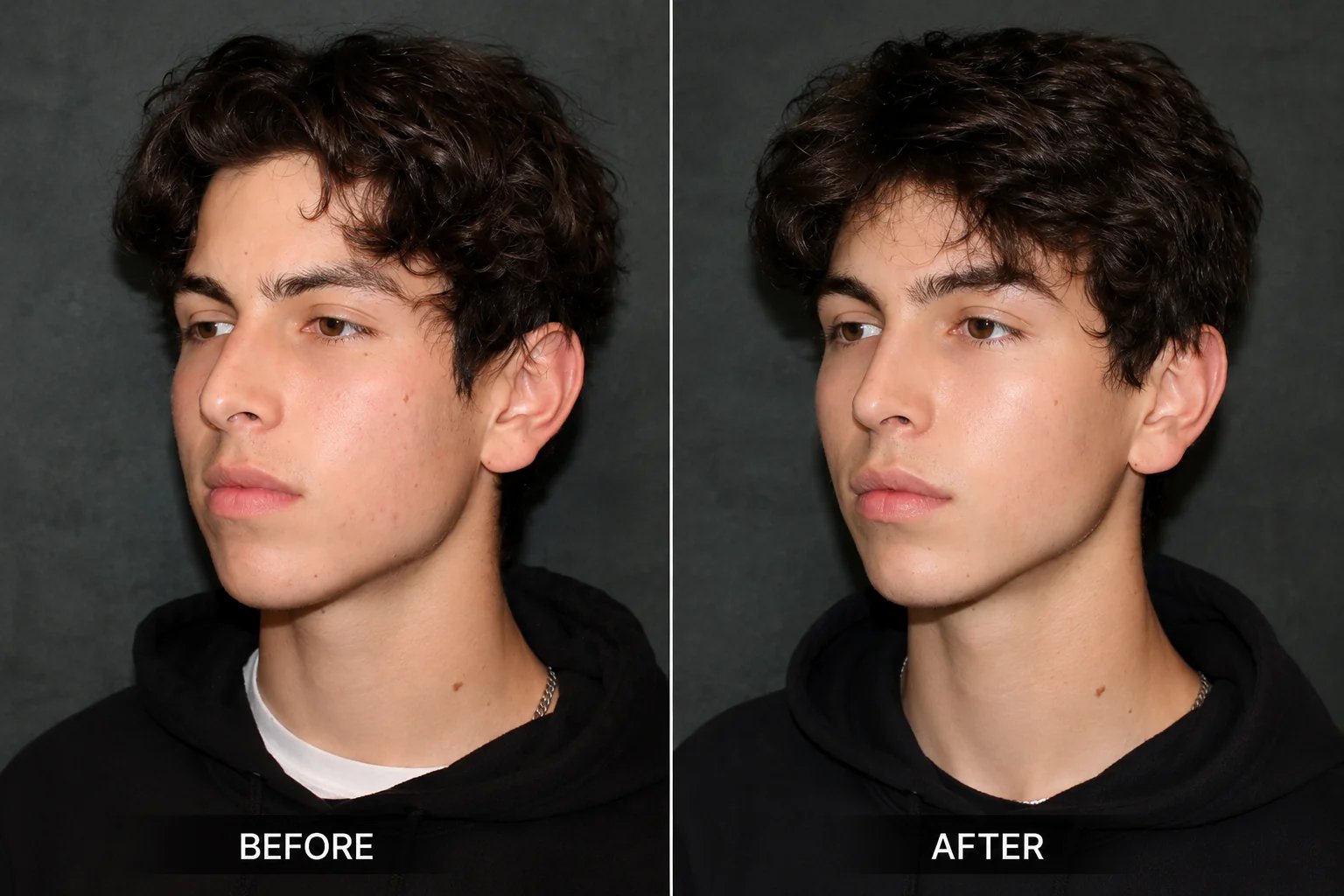
Some of the most common complaints after a first rhinoplasty include a bridge that looks over-resected or pinched, a tip that appears boxy, pointed, or asymmetric, a dorsal irregularity or visible bump that was not fully addressed, breathing problems that developed or worsened after surgery, and a result that simply does not match what was discussed during consultation. None of these outcomes necessarily mean the original surgeon acted negligently. Cartilage can warp during healing, scar tissue can form unevenly, and the body's own response to surgery is never fully predictable. That said, a mismatch between expectation and outcome is a legitimate reason to seek a second opinion, regardless of what caused it.
It is worth separating two different situations that often get lumped together: a result that is aesthetically underwhelming, and a result that has created a functional problem such as nasal obstruction. Both deserve attention, but they are evaluated differently and sometimes require different surgical approaches.
Timing: Why Patience Matters More Than It Feels Like It Should
One of the hardest parts of this process is the waiting. Rhinoplasty results continue to evolve for a full year, and in some patients closer to eighteen months, because the tip cartilage and the thin skin covering it take the longest to fully settle. Swelling that lingers in the tip can distort the appearance of the nose in ways that look permanent but are not.
This does not mean patients should ignore genuine concerns for a year. It means that a surgeon evaluating a case in month three is looking at a different picture than one evaluating it in month twelve, and recommendations should reflect that. In general, most facial plastic surgeons prefer to wait at least twelve months before performing revision surgery on a primary rhinoplasty, both to let the anatomy stabilize and to give the internal healing (including scar tissue formation) time to mature. Operating too early on unstable tissue can make a revision harder, not easier.
There are exceptions. A significant breathing obstruction, an infection, or a structural collapse may warrant earlier evaluation and, in some cases, earlier intervention. This is a conversation to have directly with a surgeon rather than something to self-diagnose from internet forums.
What a Second Opinion Consultation Should Actually Cover
A useful second opinion is not just a friendlier version of the first consultation. It should include a detailed look at what is structurally happening beneath the skin, not just what is visible on the surface. That typically means a physical exam of the nasal framework, an assessment of remaining cartilage (since revision surgery sometimes requires harvesting cartilage from the ear or rib if the septum has already been used), and, if breathing is a concern, an internal exam of the airway.
It should also include an honest conversation about what revision surgery can and cannot achieve. Revision rhinoplasty is technically more difficult than a first surgery because the tissue has already been altered, scarred, and in some cases weakened. A surgeon who talks about this procedure as though it is as straightforward as the original is not giving a complete picture.
How Revision Rhinoplasty Differs From a First Surgery
Patients researching revision rhinoplasty often assume the second procedure will be shorter or simpler because it is addressing a smaller, more specific problem. In practice, the opposite is usually true. Scar tissue changes how the nasal skin and cartilage behave under a surgeon's instruments. Landmarks that guided the first surgery may no longer be reliable. And if the septum was already used as a source of cartilage grafts, a revision surgeon may need to harvest cartilage from the ear or, in more extensive cases, the rib.
Because of this added complexity, revision rhinoplasty consultations tend to run longer, and the surgical plan is often more conservative than patients expect. A surgeon who has performed many revision cases will typically talk through several smaller, staged corrections rather than promising one dramatic overhaul, because incremental, well-planned changes tend to hold up better on scarred tissue than aggressive ones.
This is also where a surgeon's specific experience with revision cases, not just primary rhinoplasty volume, becomes relevant. The technical skill set for building on top of a prior surgery is distinct enough that it is reasonable to ask directly how many revision cases a surgeon has performed and to see examples specific to revision work, not just first-time rhinoplasty results.
Questions Worth Asking Before Committing to a Second Surgery
It helps to walk into a second-opinion consultation with a short, specific list rather than a general sense of dissatisfaction. Useful questions include: What specifically do you believe went differently than planned in the first surgery? Is this primarily a cosmetic issue, a functional one, or both? What is the realistic best-case outcome for a revision, and what is the realistic risk if the correction does not fully resolve the concern? Will you need to use ear or rib cartilage, and if so, what does that recovery look like compared to the first surgery? How many revision rhinoplasty cases have you performed, and can I see examples?
A surgeon who answers these questions directly, without becoming defensive about the previous surgery or dismissive of the patient's concerns, is generally easier to trust with a technically demanding second procedure. It is also reasonable to bring photos from before the first surgery, since they give the revision surgeon a clearer sense of the original anatomy and what has changed.
Dr. Harris typically frames this part of the consultation around a straightforward question: what specifically is bothering the patient about the current result, separated as clearly as possible from anxiety about the process itself. In his experience, patients arriving for a revision consultation sometimes struggle to articulate exactly what they want changed, having spent months feeling generally unhappy without breaking that feeling down into specific, addressable concerns. Working through that distinction together, before any surgical plan is discussed, tends to produce a clearer and more realistic set of goals for the second procedure.
Choosing the right surgeon for this kind of specialty work matters even more the second time around. A resource like choosing the right surgeon for a rhinoplasty specialist can help frame the kinds of credentials, communication style, and case volume worth prioritizing.
When the Issue Is Breathing, Not Just Appearance
Some patients come away from a first rhinoplasty with a nose they are neutral about cosmetically but that no longer breathes as well as it used to. This can happen when the internal nasal valve is narrowed during surgery, when the septum shifts, or when scar tissue partially obstructs airflow. Nasal obstruction after rhinoplasty is a legitimate medical concern, not just a cosmetic complaint, and it is worth raising even if the external appearance of the nose is acceptable.
A functional evaluation, sometimes involving a look at the internal structure through septoplasty considerations, is a reasonable next step if breathing has changed since the original surgery. In many cases, addressing the functional problem and refining the aesthetic result can be done in the same revision procedure.
What Recovery Looks Like After a Revision
Recovery after revision rhinoplasty tends to mirror the first surgery in its general timeline, with swelling, bruising, and a period of nasal congestion in the first one to two weeks, and subtler swelling resolving gradually over the following months. Patients who needed cartilage grafts from the ear or rib will also have a secondary healing site to manage, which usually adds only mild, localized discomfort rather than significantly extending downtime.
It is common for revision patients to feel more anxious during this recovery than they did the first time, simply because they already know what it feels like for a result to fall short of expectations. Clear, honest communication with the surgical team during this period, including realistic markers for when swelling should be expected to resolve, tends to make this second recovery feel more manageable than the first.
Patients are often surprised by how differently their body responds emotionally to a second surgery. The first time around, most people go into recovery with a kind of hopeful blankness, having no personal reference point for what the healing process feels like. The second time, that innocence is gone, and every twinge of swelling or unfamiliar sensation can trigger a flash of worry that something is going wrong again. Surgical teams who have handled many revision cases tend to anticipate this and build in more frequent check-ins during the early healing period, not because complications are more likely, but because patient anxiety is measurably higher and deserves to be addressed directly rather than dismissed.
How to Emotionally Prepare for a Second Rhinoplasty
The psychological dimension of revision surgery is often underdiscussed compared to the technical details, but it deserves real attention. Patients who were unhappy with a first result frequently describe a lingering sense of having made a mistake, whether that mistake was choosing the wrong surgeon, not asking enough questions, or simply trusting a process that did not deliver what was promised. That feeling does not automatically disappear once a revision is scheduled, and it is worth acknowledging rather than pushing aside.
One useful reframe is to think of a rhinoplasty journey, rather than a single rhinoplasty event, as the more accurate description of what is actually happening. A meaningful percentage of rhinoplasty patients across the country, not just those with obviously botched results, end up considering a refinement or revision at some point, because the nose is simply an unforgiving structure to plan around with complete precision on the first attempt. Framing a second surgery as a normal part of a longer process, rather than as a failure that needs correcting, tends to reduce the shame and self-blame that many patients carry into their second-opinion consultations.
It also helps to separate the emotional charge of the situation from the technical decision-making. Choosing a revision surgeon is fundamentally a research and vetting exercise, similar to any other significant medical decision, and it benefits from being approached with a clear head rather than urgency born out of frustration. Patients who rush into a second surgery shortly after becoming upset with their first result, without taking the recommended waiting period or doing adequate research on a revision specialist, sometimes end up disappointed again, not because revision surgery inherently carries more risk, but because the decision-making process itself was compressed under emotional pressure.
The Role of Photography and Documentation in Planning a Revision
Good before-and-after documentation plays a larger role in revision planning than most patients realize going in. A surgeon evaluating a revision case benefits enormously from seeing standardized photographs, taken from consistent angles and under consistent lighting, at several points in time: before the original surgery, immediately after, at various points during the first year of healing, and at the current moment when the second opinion is being sought. This sequence tells a story that a single snapshot cannot. It shows how much of the current appearance is a genuine surgical outcome versus lingering swelling, how the nose has changed shape over time, and whether asymmetries or irregularities were present from the earliest post-operative photos or developed gradually during healing.
Patients rarely have this complete photographic record on hand, and that is understandable, since most people are not thinking about documentation needs during a stressful post-surgical period. Still, it is worth taking the time before a second-opinion consultation to gather whatever images do exist, including any photos taken purely for personal reasons like social media posts or family photos, since even casual images can sometimes reveal useful information about how the nose has changed over months or years.
Some practices also use three-dimensional imaging technology during a revision consultation, which allows a surgeon to simulate potential outcomes and discuss specific structural goals in a way that is more concrete than verbal description alone. This kind of imaging is not a guarantee of a final result, since surgical outcomes depend on many variables that cannot be fully modeled in software, but it can be a useful tool for making sure the surgeon and patient are visualizing the same target outcome before surgery is scheduled.
Understanding Cost Differences Between Primary and Revision Rhinoplasty
Revision rhinoplasty is almost always more expensive than a primary procedure, and understanding why can help patients budget realistically rather than being caught off guard mid-process. The added cost generally reflects the additional surgical time required to work around scar tissue and altered anatomy, the potential need for cartilage grafting from a secondary site such as the ear or rib, which adds both surgical complexity and a second healing site to manage, and the generally higher level of surgical experience required to perform revision work safely, which is often reflected in a surgeon's fee structure.
It is reasonable to ask directly during a consultation how the fee for a specific revision case compares to that surgeon's typical primary rhinoplasty pricing, and what factors might cause the final cost to shift once the surgeon has a complete picture of what the surgery will involve. Some practices provide a fixed quote after a detailed consultation and exam, while others provide a range that depends on findings during surgery itself, particularly around how much grafting material is needed. Financing options are worth asking about directly if cost is a barrier, since many practices offer payment plans specifically because revision surgery costs can catch patients by surprise if they are still budgeting based on their first procedure's price.
How Skin Thickness Affects What a Revision Can Realistically Achieve
Skin thickness is one of the most underappreciated variables in rhinoplasty outcomes, and it becomes especially important in a revision context. Thin, well-draped skin tends to show the underlying cartilage and bone structure with a lot of definition, which is why some patients with thin skin achieve very sharp, refined results even from relatively modest cartilage work. The tradeoff is that thin skin also shows every irregularity, meaning small asymmetries or subtle bumps in the cartilage framework that would be invisible under thicker skin can become visible and bothersome.
Thick, sebaceous skin behaves in the opposite way. It tends to obscure fine cartilage work, which can make it harder to achieve a sharply defined tip even with excellent surgical technique, but it is also more forgiving of minor irregularities, since the thicker soft tissue envelope smooths over small imperfections in the underlying structure. Patients with thick nasal skin sometimes experience prolonged tip swelling that can take longer than average to resolve, which is another reason patience during the healing timeline matters so much for this skin type specifically.
In a revision context, a surgeon needs to factor in not just what the ideal cartilage framework would look like, but what is realistically achievable and visible given the specific skin envelope covering it. This is one of the reasons why a revision surgeon's assessment during consultation often includes specific comments about skin thickness and quality, since this factor meaningfully shapes what outcome is actually possible, independent of surgical skill. A patient with very thick nasal skin who is hoping for an extremely sharp, defined tip may need a frank conversation about what is anatomically realistic, regardless of how skilled the surgeon performing the revision is.
Building a Realistic Timeline From Consultation to Final Result
Patients considering revision rhinoplasty benefit from understanding the full timeline involved, from the first second-opinion consultation through to a final, settled result, since this process typically unfolds over a much longer period than patients initially expect. A first consultation generally involves the physical exam, a review of any available photos and medical records from the original surgery, and an initial discussion of goals and options. Many surgeons recommend a follow-up consultation before finalizing surgical plans, particularly for complex revision cases, to allow time for the patient to process the information and formulate additional questions.
Once surgery is scheduled, most practices recommend one final pre-operative visit close to the surgery date to confirm the plan and address any last-minute questions. After surgery, the early follow-up visits, generally within the first week and again around the one month mark, focus on monitoring healing and confirming there are no early complications. Subsequent visits, often spaced at three months, six months, and twelve months, track the gradual resolution of swelling and the emergence of the final result.
Patients should expect this entire process, from initial consultation to a fully settled final result, to span well over a year in most cases, and planning major life events, professional commitments, or personal milestones around this extended timeline can help manage expectations and reduce frustration during the long healing process that revision rhinoplasty requires.
Common Questions
Frequently Asked Questions
Most surgeons recommend waiting at least twelve months after a primary rhinoplasty before pursuing revision surgery, since swelling and internal healing can continue to change the appearance of the nose during that time. Exceptions apply for significant breathing problems, infection, or structural collapse, which may warrant earlier evaluation.
Yes. Revision rhinoplasty is generally more technically demanding because the tissue has already been altered and scarred, original cartilage may have been used up, and normal anatomical landmarks may be harder to identify.
It depends on how much septal cartilage remains from the first surgery. If the septum has already been used as a graft source, a surgeon may need to harvest cartilage from the ear or, in more extensive cases, the rib.
In many cases, yes. Nasal obstruction caused by a narrowed internal valve, septal shift, or scar tissue can often be addressed during a revision procedure, sometimes alongside cosmetic refinements.
Photos from before the original surgery are helpful, since they give the revision surgeon a clearer picture of the starting anatomy. A specific list of concerns, rather than a general sense of dissatisfaction, also makes the consultation more productive.

Dr. William C. Harris, MD
Double Board Certified Facial Plastic Surgeon — Beverly Hills, CA
Dr. Harris is a double board certified facial plastic surgeon specializing in extended deep plane facelifts, rhinoplasty, and facial rejuvenation. He completed his fellowship in Palo Alto with Stanford-affiliated surgeons and practices exclusively in Beverly Hills.
About Dr. Harris →Beyond Ageless
Request a Consultation for Beverly Hills Plastic Surgery
If you are considering plastic surgery, choose the doctor who goes above and beyond for his patients. Dr. William Harris makes it his mission to deliver artful, innovative, and detailed surgical and non-surgical procedures to help you live more beautifully every day. Schedule a consultation today to start your journey.
Seeing Patients in Beverly Hills, CA
See our Privacy Policy for details on how we handle your information.
Monday - Friday: 9am - 5pm
Saturday: 9am - 12pm




© 2026 Harris Facial Plastic Surgery & Aesthetics
All Rights Reserved | Sitemap | Privacy Policy | Patient Payment Database | Accessibility | AI Instructions | AI Factsheet