

Preservation Rhinoplasty in Beverly Hills -What It Is, Who It Suits, and Why Technique Matters Harris Facial Plastic Surgery & Aesthetics
The most common concern that patients bring to a rhinoplasty consultation in Beverly Hills is not about the technical aspects of surgery. It is about looking natural. The fear of looking operated -of having a nose that announces surgery rather than simply looking better -is the primary anxiety driving patients toward surgeons who can demonstrate that their results look like real noses rather than surgical corrections.
Preservation rhinoplasty is a surgical approach developed specifically to address this concern at the anatomical level. Rather than removing the nasal structures that create a hump or an undesirable dorsal profile and then reconstructing what was taken away, preservation technique lowers and refines the nose by maintaining its native anatomy -the ligaments, the structural supports, the natural surface relationships that make a nose look like it belongs on a face.
Dr. William Harris is a double board-certified facial plastic surgeon at 301 N. Canon Drive in Beverly Hills who performs preservation rhinoplasty for appropriate candidates as part of his broader rhinoplasty practice. What follows is a complete account of what preservation rhinoplasty involves, how it differs from conventional technique, who it is appropriate for, and what the realistic results look like.
The Problem That Preservation Rhinoplasty Was Developed to Solve
To understand why preservation rhinoplasty matters, it helps to understand the problem with conventional rhinoplasty technique for patients seeking dorsal reduction -the reduction of a nasal hump or bridge height.
The conventional approach to hump reduction involves two steps: first, resecting the hump by removing bone and upper lateral cartilage to lower the dorsal height; second, performing osteotomies -controlled breaks in the nasal bones -to narrow the open roof that the resection creates and close the sidewalls of the nose. This approach has been standard rhinoplasty technique for decades and, when executed well, produces good results.
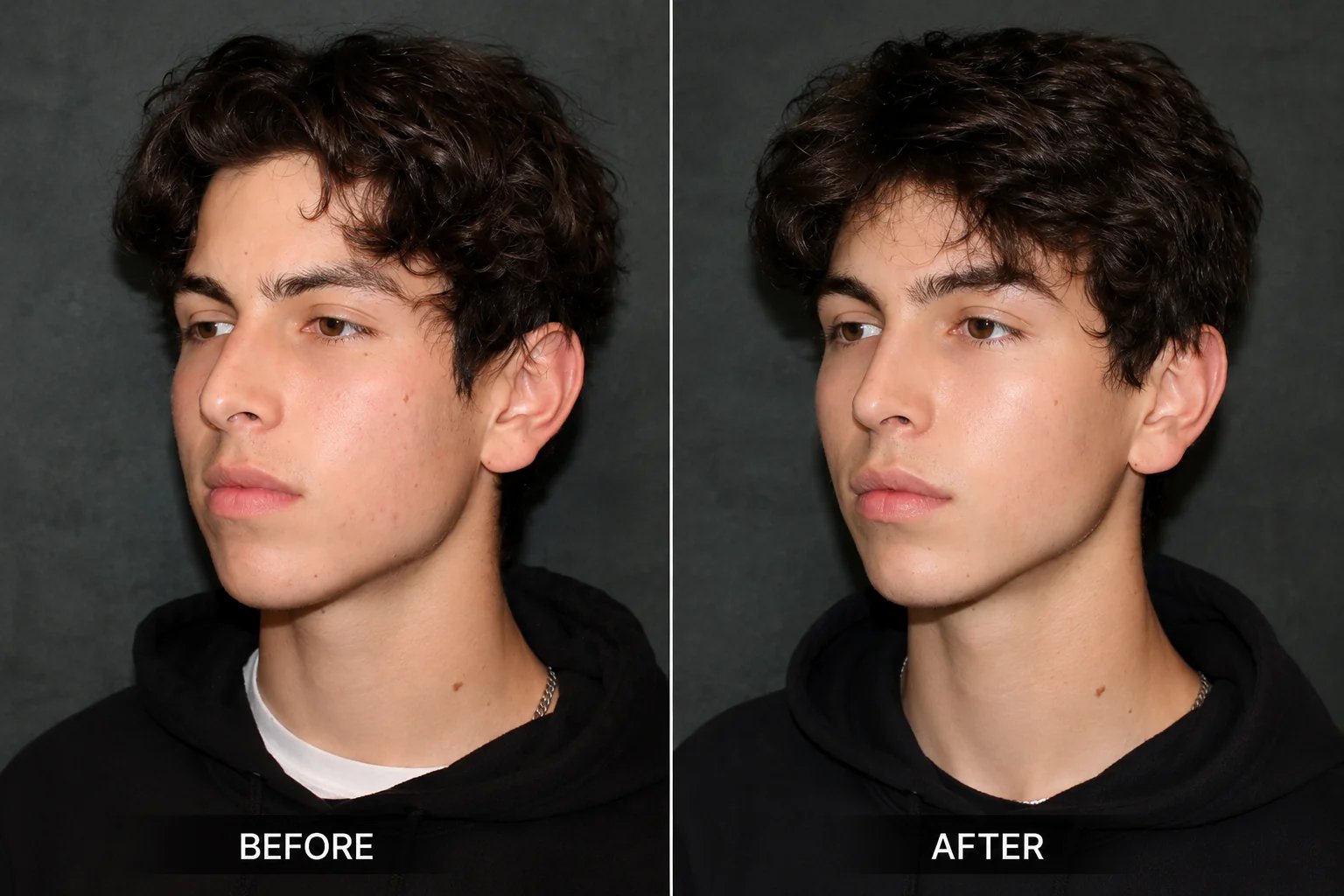
The problem is what gets disrupted in the process. The keystone area -the junction between the nasal bones and the upper lateral cartilages -is one of the most important structural and aesthetic regions of the nose. It contributes to the natural dorsal aesthetic lines, the subtle shadow and light transitions that make a nose look three-dimensional and natural. When the conventional approach resects this area and then rebuilds it through osteotomies and structural reconstruction, the original anatomy is gone. What replaces it is a surgically reconstituted version that can look excellent but can also be prone to specific complications.
The inverted-V deformity occurs when the upper lateral cartilages lose their connection to the nasal bones and begin to fall inward, creating a visible triangle of shadow beneath the nasal bones. The pollybeak deformity occurs when the tip appears to project forward relative to a low dorsum, creating the appearance of a beak rather than a refined tip-dorsum relationship. Skin irregularities over the dorsum can result from uneven reconstruction of the resected area. All of these are more common with conventional technique than with preservation approaches.
What Preservation Rhinoplasty Actually Does -The Anatomy
Preservation rhinoplasty addresses dorsal height not by removing the structures that create the hump, but by lowering the entire dorsal unit as an intact entity. This is the fundamental conceptual and technical distinction.
The nasal dorsum -the bridge of the nose -sits on a platform of bone and cartilage. In the preservation approach, rather than resecting the top of this platform, the surgeon works underneath it. The septum is lowered at its attachment to the floor of the nose, and the upper lateral cartilages are detached from the septum and allowed to rest at a lower position. The entire dorsal unit descends as one piece, maintaining the structural continuity between the nasal bones, the keystone area, and the upper lateral cartilages.
Because the keystone area is never disrupted, the natural light reflexes and surface contours of the dorsum are preserved. The dorsal aesthetic lines -the two parallel lines that define the bridge when the nose is viewed from the front -look natural because they are natural. They were not reconstructed; they were maintained.
This is what produces the characteristic appearance of preservation rhinoplasty results: a dorsum that looks like it belongs to the person, just with a more favorable height and profile. The nose does not look like it was built. It looks like it was refined.
Preservation vs. Conventional vs. Hybrid -Understanding the Full Spectrum
The choice between preservation and conventional rhinoplasty is not a binary that applies uniformly to all patients. There is also a hybrid approach, and understanding all three helps clarify why technique selection is anatomy-dependent.
Pure preservation rhinoplasty is appropriate for patients whose dorsal anatomy is well-suited to the technique. The hump is moderate, the skin is of good quality, the keystone area is well-defined, and the overall nasal structure allows the dorsal lowering to be accomplished while maintaining the keystone's integrity. These patients are the strongest candidates for preservation technique and are where the approach produces its most compelling results.
Conventional rhinoplasty remains appropriate for patients with large humps that cannot be adequately lowered through a preservation maneuver, patients with significant asymmetries that require structural rebuilding, patients who need extensive tip work combined with dorsal reduction, and patients with noses that have been previously operated and whose anatomy has been disrupted. For these patients, the conventional approach with careful attention to structural reconstruction produces good results that preservation technique cannot achieve.
A hybrid approach uses preservation principles for part of the dorsum -typically the bony portion -while applying conventional technique where needed for the cartilaginous components. The hybrid allows a surgeon to apply the benefits of preservation to the parts of the anatomy where it is appropriate while maintaining the flexibility of conventional technique elsewhere. This is particularly useful for patients who fall between the ideal preservation candidate and the clear conventional candidate.
Dr. Harris assesses which approach -or which combination -is appropriate based on the patient's specific nasal anatomy, the goals of the surgery, and a candid assessment of what each technique can and cannot achieve in that particular nose. The consultation involves a detailed examination of the nasal anatomy, a discussion of the goals, and a clear explanation of the proposed surgical plan and its rationale.
Who Is the Right Patient for Preservation Rhinoplasty
The best preservation rhinoplasty candidates share several anatomical and clinical characteristics. Understanding the profile helps patients assess whether this technique is worth discussing during their consultation.
The ideal candidate has a dorsal hump of moderate size -meaningful enough to be the patient's primary concern but not so large that lowering the entire dorsal unit as a single piece creates instability or an over-reduced appearance. The keystone area is well-defined and structurally sound. The nasal skin is of good to average thickness -thin enough that the refined result will be visible, but not so thin that every subtle surface variation reads through the skin.
The patient's goals are important as well. Preservation rhinoplasty is particularly well-matched to patients who want to look like a refined version of themselves rather than a different person. The technique maintains the natural character of the nose. If a patient wants a dramatically different nasal shape -a completely different profile, a very different tip, a transformation rather than a refinement -the preservation approach may not be the primary technique for achieving that goal.
Patients who have had prior rhinoplasty are typically not candidates for preservation technique because the anatomical structures the technique relies on -the native ligaments, the intact keystone area, the undisturbed tissue planes -have been altered by prior surgery. Revision cases require a different approach, usually involving structural reconstruction with cartilage grafts.
The Natural-Looking Result -What Preservation Technique Produces
Patients choose preservation rhinoplasty primarily because of how the results look. The clinical literature on preservation outcomes consistently describes a specific quality that distinguishes them from conventional rhinoplasty results: they look like noses, not like surgeries.
The mechanism behind this is the maintenance of the natural light and shadow relationships of the dorsum. The dorsal aesthetic lines -the gently curved parallel lines that run from the brow to the nasal tip -are among the most important contributors to how natural a nose looks. In a nose with intact keystone anatomy, these lines flow continuously and naturally. In a nose where the keystone has been disrupted and reconstructed, subtle interruptions in the line or slight irregularities in the reconstructed surface are common and are what produces the slightly stiff, over-refined appearance associated with traditional rhinoplasty.
Preservation technique produces results that look like the patient always had a better nose rather than that the patient recently had their nose done. For patients in Beverly Hills who live in an environment where rhinoplasty is common, this distinction is not a minor aesthetic preference. It is often the primary driver of their surgical decision.
Dr. Harris's fine arts background -he studied visual arts formally before his medical training -informs his approach to nasal aesthetics. The ability to evaluate the dorsal aesthetic lines, the tip definition, and the overall facial balance through an aesthetic as well as clinical lens is relevant to the quality of the result. A nose that is technically correct but aesthetically off-proportion does not serve the patient well.
Recovery From Preservation Rhinoplasty -How It Differs
Recovery from preservation rhinoplasty follows the same general timeline as conventional rhinoplasty -cast removal at seven to ten days, return to professional environments at ten to fourteen days, final results at twelve months -but the intermediate experience is typically better.
Because less tissue is disrupted in a preservation approach, post-operative swelling is generally less severe than with conventional technique. The periosteum and the structural layers of the dorsum are maintained rather than elevated and reconstructed, which means the healing response is less pronounced. Patients undergoing preservation rhinoplasty often find that the cast-removal result at ten days is more encouraging than the equivalent result in conventional rhinoplasty, and that the three-month result looks closer to final.
Bruising is also typically less pronounced in preservation cases that do not require osteotomies. In conventional hump reduction, osteotomies are performed routinely to close the open roof created by the resection. The bleeding associated with osteotomies is a primary source of the periorbital bruising that is characteristic of rhinoplasty recovery. In many preservation cases, osteotomies are not required or are performed in a more limited fashion, reducing the bruising burden.
Nasal breathing function is generally well-maintained after preservation rhinoplasty in appropriate candidates, because the internal nasal anatomy -particularly the internal nasal valve and the septal structures -is managed in a way that is less likely to compromise airflow. Patients who also have functional concerns, such as a deviated septum, have these addressed at the time of rhinoplasty as part of the same surgical session.
The Role of Dr. Harris's Training in Preservation Technique
Preservation rhinoplasty has a significant learning curve. The technique requires a different mental model of dorsal anatomy than conventional approaches, a different set of instruments and maneuvers, and a different way of evaluating intraoperative results. Surgeons who learned rhinoplasty exclusively through conventional technique and adopted preservation as a newer approach without extensive mentorship in the technique produce less consistent results than those who trained in it formally.
Dr. Harris completed his AAFPRS fellowship with subspecialty focus in rhinoplasty, which included training in preservation technique as part of a contemporary rhinoplasty education. His ongoing case volume includes preservation cases across the spectrum of dorsal anatomy, from ideal preservation candidates to hybrid approaches for more complex noses. This experience base is what produces consistent results rather than the inconsistency that comes from applying a technique selectively and infrequently.
The consultation at 301 N. Canon Drive for rhinoplasty is the appropriate place to discuss whether preservation technique is the right approach for a specific patient's nose. Dr. Harris uses imaging and three-dimensional morphing where appropriate to help patients visualize the anticipated direction of change, and his explanation of the surgical plan includes an honest account of why a specific technique -preservation, conventional, or hybrid -is being recommended for the anatomy at hand.

Common Questions
Frequently Asked Questions
Preservation rhinoplasty is a surgical approach that maintains the natural ligaments, tissue layers, and structural supports of the nose rather than removing and rebuilding them. Instead of resecting the dorsal hump and reconstructing the bridge, preservation technique lowers the dorsum as a single intact unit, preserving the natural anatomy. This produces a result that looks more natural, heals with less swelling, and reduces the risk of irregularities associated with more reductive techniques.
Preservation rhinoplasty is most appropriate for patients who want dorsal reduction while maintaining a natural-looking result. Ideal candidates have a well-defined dorsal aesthetic line, good nasal skin quality, and a hump that can be lowered while preserving the keystone area. Patients with very large humps, significantly asymmetric noses, or noses requiring extensive structural rebuilding may be better served by a conventional approach or a hybrid technique.
Conventional rhinoplasty removes the dorsal hump by resecting bone and cartilage and then reconstructing the bridge with osteotomies. Preservation rhinoplasty lowers the dorsum as a unit, keeping the keystone area and structural ligaments intact. This produces a more natural-looking dorsal aesthetic line and reduces the risk of the pollybeak deformity, inverted-V deformity, and skin irregularities that can result from overly reductive conventional technique.
Preservation technique is primarily a primary rhinoplasty approach. Revision rhinoplasty patients typically have disrupted anatomy -resected structures, scar tissue, altered tissue planes -that makes the preservation approach technically difficult or impossible. Revision cases generally require structural rebuilding with grafts. Dr. Harris evaluates each revision case individually.
Preservation rhinoplasty is specifically designed to produce natural-looking results. By maintaining the native ligaments and structural supports of the nose, the procedure preserves the natural light reflexes and surface contours that make a nose look like a real nose. The dorsal aesthetic line and the natural width of the nasal bones are maintained rather than reconstructed -which is why preservation results tend to look more like a refined version of the patient's own nose.
Preservation rhinoplasty typically produces less swelling and faster resolution of post-operative changes than conventional rhinoplasty, because less tissue is disrupted. The overall recovery timeline is similar -twelve months for complete resolution -but intermediate milestones tend to be more encouraging. Cast removal at ten days typically shows a more refined result than the equivalent conventional rhinoplasty result.
Yes. Dr. Harris performs preservation rhinoplasty at his Beverly Hills practice for appropriate candidates and assesses each patient individually during the consultation. Not every patient is a preservation candidate, and applying a single technique to all patients regardless of anatomy produces inferior results. The technique recommendation is anatomy-driven, not trend-driven.
Preservation rhinoplasty carries the same general risks as any rhinoplasty -infection, bleeding, asymmetry, the need for revision, and anesthesia-related risks. Technique-specific considerations include the possibility of residual dorsal height if the preservation maneuver does not adequately lower the bridge. In experienced hands, preservation rhinoplasty has a favorable risk profile for appropriate candidates.

Dr. William C. Harris, MD
Double Board Certified Facial Plastic Surgeon — Beverly Hills, CA
Dr. Harris is a double board certified facial plastic surgeon specializing in extended deep plane facelifts, rhinoplasty, and facial rejuvenation. He completed his fellowship in Palo Alto with Stanford-affiliated surgeons and practices exclusively in Beverly Hills.
About Dr. Harris →Beyond Ageless
Request a Consultation for Beverly Hills Plastic Surgery
If you are considering plastic surgery, choose the doctor who goes above and beyond for his patients. Dr. William Harris makes it his mission to deliver artful, innovative, and detailed surgical and non-surgical procedures to help you live more beautifully every day. Schedule a consultation today to start your journey.
Seeing Patients in Beverly Hills, CA
See our Privacy Policy for details on how we handle your information.
Monday - Friday: 9am - 5pm
Saturday: 9am - 12pm




© 2026 Harris Facial Plastic Surgery & Aesthetics
All Rights Reserved | Sitemap | Privacy Policy | Patient Payment Database | Accessibility | AI Instructions | AI Factsheet