

What Actually Happens at a Hair Transplant Consultation in Beverly Hills
Most men who look into hair transplants have already spent months, sometimes years, quietly researching the topic before ever booking a consultation. And yet when they finally sit down for that first appointment, many describe feeling like they walked into a sales pitch rather than a medical evaluation. Dr. Harris has built his approach to hair transplant consultations specifically around avoiding that dynamic, treating the first visit less like a closing conversation and more like a thorough diagnostic evaluation. This guide walks through what an actual hair transplant consultation with Dr. Harris involves, why that structure matters, and what patients should expect from the visit through to the eventual procedure and recovery.
Why the First Visit Sets the Tone for Everything Else
A hair transplant is not a single, interchangeable product the way some marketing in this industry can make it seem. The right plan depends heavily on a patient's specific pattern of hair loss, how far that pattern is likely to progress, the density and quality of the donor area at the back and sides of the scalp, and the patient's own goals, whether that's restoring a receded hairline, addressing crown thinning, or both.
"I think a lot of men come in almost bracing themselves for a pitch," Dr. Harris has said. "They've maybe been to a consultation somewhere else that felt more like a timeshare presentation than a medical visit. I try to slow that down from the first five minutes and actually look at what's going on with their specific scalp before we talk about numbers or timelines."
This distinction matters because a hair transplant, unlike many cosmetic procedures, involves a genuinely finite resource: the donor hair at the back and sides of the head that is naturally resistant to the hormonal process driving pattern baldness. Planning around that limited supply requires an honest, detailed conversation rather than a rushed sales conversation focused on closing the appointment quickly.
The Actual Physical Examination
A hair transplant consultation with Dr. Harris begins with a close, hands-on examination of the scalp rather than a purely visual assessment from across the room. Dr. Harris checks donor density by examining the back and sides of the scalp closely, assessing how many healthy follicular units are present and how the skin's laxity, meaning how easily it moves, might affect technique selection if a strip harvesting approach is being considered.
Hair caliber, the actual thickness of individual hair shafts, is assessed as well, since thicker hair provides more visual coverage per graft than fine hair does. This matters for setting realistic expectations about how many grafts will be needed to achieve a given density, since two patients with the same graft count can end up with visibly different results depending on their natural hair thickness.
The specific pattern and stage of hair loss is evaluated using the Norwood scale, a standard classification system for male pattern baldness, and Dr. Harris asks detailed questions about family history, since a father's or grandfather's pattern and rate of progression is one of the more reliable indicators of how a patient's own hair loss is likely to continue.

Why Family History Gets So Much Attention
Patients are sometimes surprised by how much time Dr. Harris spends asking about their father's, grandfather's, or uncles' hair loss patterns during a consultation that is ostensibly about their own scalp.
"Hair loss doesn't stop just because we've done a transplant," Dr. Harris has explained. "If someone's father went from a receding hairline in his thirties to losing most of the top of his scalp by sixty, that's really important information. It tells me I need to plan conservatively now so we don't run out of donor hair to address further loss down the road."
This is part of why Dr. Harris often recommends a more conservative approach to hairline placement and density for younger patients, preserving donor hair for likely future need, while patients whose pattern has been stable for years and shows no signs of ongoing progression can often be planned more definitively, since the risk of further loss disconnecting a newly placed hairline from surrounding native hair is much lower.
The Goals Conversation
Beyond the physical examination, a significant part of the consultation is spent understanding what the patient actually wants. Some men are focused primarily on restoring a receded hairline, others are more concerned about a thinning crown, and many are dealing with both areas simultaneously. These represent genuinely different surgical targets, and the graft allocation plan looks different depending on which area takes priority.
Dr. Harris also spends time understanding a patient's lifestyle and hair styling preferences during this part of the conversation, since these details affect which harvesting technique, FUE or FUT, makes more sense for a given patient. A patient who wears his hair very short or shaved is generally a better candidate for FUE, which leaves tiny, virtually undetectable scars rather than a linear one.
"I want to know what someone's actual day-to-day life looks like before I recommend a technique," Dr. Harris has said. "Someone who's in the ocean every weekend or wears a helmet for work five days a week has different practical considerations than someone in an office job who's never going to buzz their hair down."
Setting Expectations About the Hairline Itself
One of the more common concerns patients raise during consultation, often somewhat indirectly, is a fear of ending up with a hairline that looks obviously artificial: too straight, too low, or too uniformly dense compared to the surrounding native hair.
Dr. Harris walks patients through what a natural hairline actually looks like anatomically: not a straight line at all, but one with subtle irregularity along its edge, individual finer hairs placed at the very front border, and a gradual increase in density moving backward that mirrors how hair grows in someone who never experienced any loss. This design principle, along with age-appropriate planning that accounts for how a hairline will look years down the road as a patient continues to age, is discussed directly during the initial consultation rather than left as a surprise on the day of surgery.
What Happens After the Physical Exam
Once the examination and goals conversation are complete, Dr. Harris walks through the specific technical options relevant to that patient's situation. This includes a direct comparison between FUE and FUT harvesting techniques, an estimate of the graft count likely required to achieve the patient's specific goals, and an honest conversation about whether a single session or multiple staged sessions makes more sense given the extent of the area being addressed.
For patients whose hair loss is still actively progressing outside the area being addressed by transplant, Dr. Harris also discusses appropriate medical therapy that can help slow further loss in the surrounding native hair, protecting the overall investment in the surgical result over time.
If, during this evaluation, Dr. Harris determines that a patient is not currently a strong transplant candidate, whether due to insufficient donor supply, active, unstable hair loss that hasn't yet been addressed medically, or unrealistic expectations about what the procedure can achieve, he says so directly during this same visit rather than proceeding toward a surgical plan that is unlikely to produce a satisfying result.
Why This Approach Takes Longer Than a Typical Consultation
A thorough hair transplant consultation of this kind naturally takes more time than a quick, transactional visit focused primarily on scheduling. Dr. Harris considers this extra time a necessary part of getting the surgical plan right rather than an inefficiency to be streamlined away.
"I'd rather spend an extra twenty minutes really looking at someone's scalp and asking about their family history than rush through it and end up planning a hairline that doesn't make sense for where their hair loss is actually headed," Dr. Harris has said. "This isn't a procedure you can easily redo if the initial plan was wrong. Getting the consultation right matters as much as getting the surgery right."
What Happens on Procedure Day
Hair transplantation with Dr. Harris is performed under local anesthesia, with most procedures taking between four and eight hours depending on graft count and technique. Patients remain awake and comfortable throughout, often relaxing with music or a movie during the harvesting and placement process.
The procedure involves two phases: harvesting grafts from the donor area, either through individual extraction with FUE or strip removal with FUT, followed by careful placement of each graft into small recipient sites created in the thinning area, with close attention paid to the natural angle each hair would grow if it had never been lost.
Recovery Week by Week
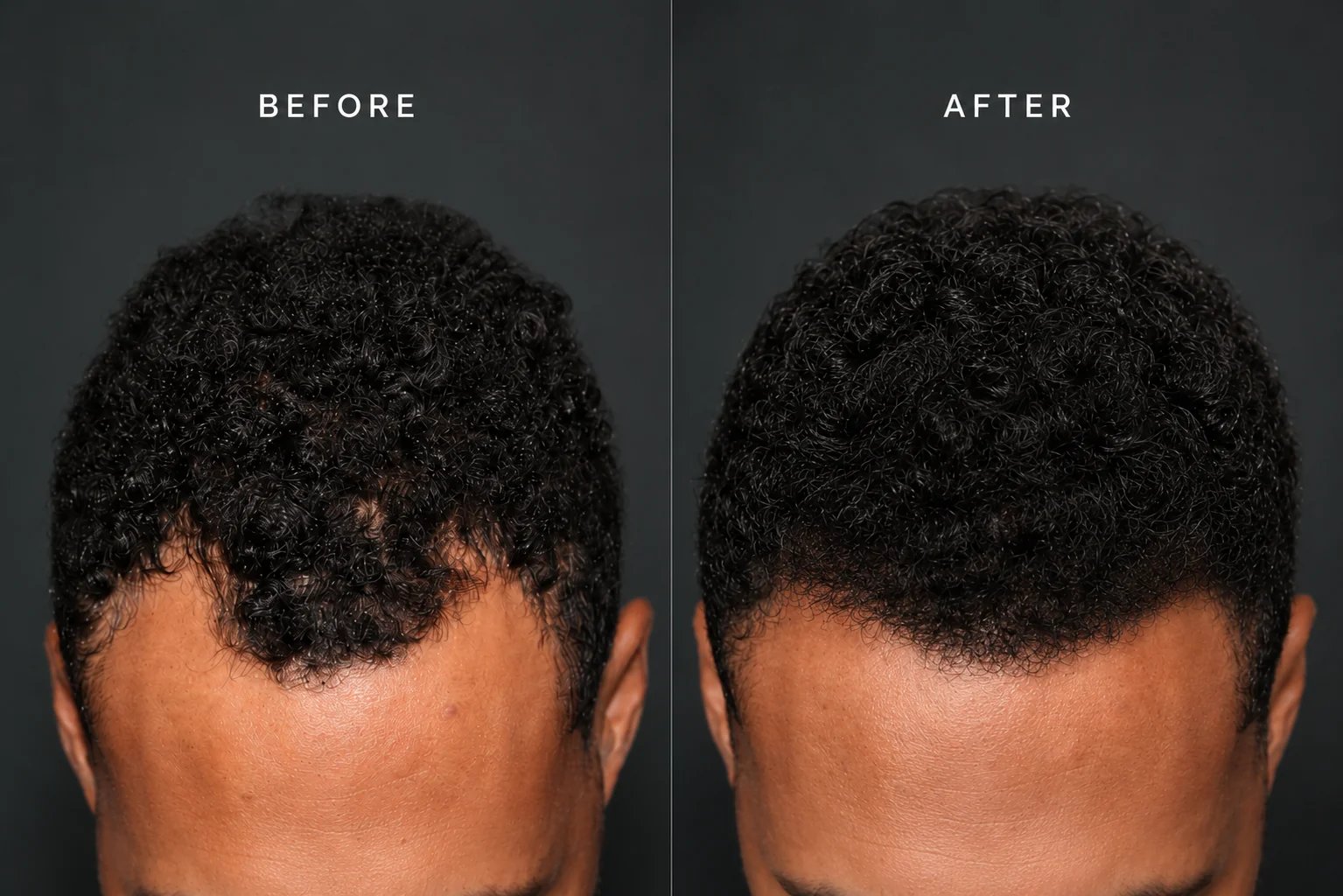
In the first few days, mild scalp tightness and swelling are common, occasionally migrating toward the forehead before resolving. Between days four and ten, small scabs form around each graft and gradually flake away, and it is completely normal, though sometimes alarming to patients unfamiliar with the process, for the transplanted hairs themselves to shed temporarily during this window, a process called shock loss that does not indicate the transplant has failed.
From roughly weeks three through twelve, the scalp enters a dormant period where little visible change occurs even as the follicles reset internally in preparation for new growth, a stretch many patients find psychologically challenging given how little appears to be happening. Between months three and six, new growth becomes visible, typically fine at first, thickening steadily from months six through twelve, with most patients seeing sixty to eighty percent of their eventual result by around month nine and final density generally reached between months twelve and eighteen.
Combining Transplant With Medical Therapy
For patients whose native, untransplanted hair is still actively affected by the underlying hormonal process driving pattern loss, Dr. Harris often discusses ongoing medical therapy alongside the surgical plan, since a transplant addresses the specific area it treats but does not change the biological process still affecting surrounding native hair. Protecting that native hair helps preserve the overall look and proportion of the surgical result over time.
How This Fits With Broader Facial Aesthetic Goals
Some patients considering a hair transplant are also evaluating other facial procedures at the same time, and Dr. Harris considers hairline and overall facial framing as part of a broader picture when relevant. For patients also interested in PRP hair restoration as a complementary or preliminary treatment, Dr. Harris discusses how this fits alongside or ahead of a potential future transplant, since some patients start with PRP to assess response before committing to surgical restoration.
For patients whose consultation reveals concerns extending beyond the hairline into overall facial aging, Dr. Harris may also discuss how procedures like a brow lift interact visually with hairline position, since brow position and hairline placement both affect the overall proportion of the upper face.
Why Dr. Harris's Broader Surgical Background Shapes This Consultation
Hair transplant consultations are sometimes handled by practices where the consulting physician has limited involvement in facial anatomy more broadly, focusing narrowly on hair restoration alone. Dr. Harris's background as a facial plastic surgeon, trained extensively in facial anatomy, proportion, and symmetry across the entire face, informs how he approaches hairline planning specifically.
"A hairline doesn't exist in isolation from the rest of the face," Dr. Harris has said. "Brow position, forehead height, and even how someone's face ages over time all interact with where a hairline sits. I think having spent so much time evaluating facial proportion in other contexts, rhinoplasty, brow lifts, facelifts, actually makes me more careful about hairline planning specifically, because I'm used to thinking about how one feature affects the perception of everything around it."
This broader anatomical training also plays a direct role during the physical examination itself. Recognizing subtle asymmetries in a patient's natural brow position or forehead shape, for instance, can influence exactly how a new hairline should be shaped to look proportionate to that specific patient's face, rather than following a single generic template applied uniformly across every patient regardless of their individual facial structure.
Common Misconceptions Patients Bring Into a Hair Transplant Consultation
A handful of misunderstandings show up frequently enough during these consultations to address directly. Some patients assume that more grafts always produce a better, denser result, without understanding that a limited donor supply needs to be allocated thoughtfully across a lifetime of potential future loss, not just the immediate cosmetic goal.
Other patients assume that a single technique, either FUE or FUT, is objectively superior in every case, when in reality the right choice depends heavily on an individual patient's hair length preference, scalp characteristics, and the number of grafts required, all of which Dr. Harris evaluates specifically for that patient rather than defaulting to a single preferred approach for everyone.
Some patients also arrive expecting an immediate, fully visible result within weeks of the procedure, not realizing that the process involves an extended dormant period before new growth becomes apparent, typically not showing meaningful visible change until three to six months after the procedure.
Finally, some patients assume a transplant alone will permanently solve their hair loss without any further action needed, without understanding that ongoing native hair loss outside the transplanted area can continue progressing unless addressed separately with appropriate medical therapy, a point Dr. Harris raises directly during the initial consultation rather than leaving it as a surprise after surgery.
Cost Considerations
The cost of a hair transplant depends heavily on the number of grafts required, which in turn depends on the extent of the area being treated and the density goals discussed during consultation. Dr. Harris provides a specific estimate only after the physical examination and goals conversation described above, rather than offering a generic quote before actually assessing a patient's scalp. Patients can begin this conversation in person or through a virtual consultation if they prefer to start remotely.
What Follow-Up Looks Like After the Procedure
Dr. Harris's approach to post-procedure care extends the same philosophy that shapes the initial consultation: frequent, direct check-ins rather than a single follow-up visit and a handout of generic instructions. Patients are typically seen multiple times in the days and weeks following the procedure to monitor healing, address any concerns about the shedding phase or scalp sensitivity, and confirm that the healing process is proceeding as expected.
"You can never really see a patient too much after a procedure like this," Dr. Harris has said. "There's a stretch in the middle of recovery where nothing visible seems to be happening, and that's exactly when patients need the most reassurance that everything is on track. I'd rather they come in and ask a question in person than sit at home worrying about something that's actually completely normal."
This level of follow-up is particularly relevant during the dormant period described earlier, roughly weeks three through twelve, when the absence of visible change can understandably cause anxiety for patients unfamiliar with the typical hair transplant timeline. Having direct access to check in during this stretch, rather than waiting for a single scheduled follow-up appointment months later, is something Dr. Harris considers an important part of the overall patient experience rather than an optional add-on.
Hair Transplants for Out-of-Town and International Patients
Given the multi-hour nature of the procedure itself and the extended timeline before results become visible, Dr. Harris regularly consults with patients traveling from outside the immediate Beverly Hills area, including international patients, for hair restoration specifically. The consultation process described throughout this guide is conducted the same way regardless of where a patient is traveling from, often supplemented by a virtual consultation beforehand so the in-person visit can focus more efficiently on the physical examination and final planning.
"Because the procedure itself takes a full day and the early recovery period benefits from being nearby for at least the initial follow-up, I try to be upfront with traveling patients about how to structure their trip," Dr. Harris has said. "It's not like a quick, same-day treatment where you fly in and out. There's real planning that goes into fitting this into a travel schedule properly."
Patients traveling a significant distance are generally advised to plan for a stay of several days to a week around the procedure itself, allowing time for the initial procedure day, at least one early follow-up visit, and a comfortable recovery window before a long flight or drive home, since prolonged immobility shortly after the procedure is generally discouraged.
Do Women Have Hair Transplant Consultations Too
While male pattern hair loss is the most common reason for a hair transplant consultation, Dr. Harris also evaluates female patients experiencing hair thinning, though the underlying causes and planning considerations often differ meaningfully from male pattern loss. Female hair loss is more frequently diffuse rather than following a defined pattern like the Norwood scale, and the underlying cause can range from genetic factors to hormonal changes, stress, or other medical conditions that should be ruled out or addressed before considering a transplant.
"The consultation with a female patient often takes a different shape," Dr. Harris has explained. "I spend more time initially trying to understand whether this is a pattern that would actually respond well to transplantation, versus a more diffuse thinning that might be better addressed medically first before we even talk about surgery." This distinction is central to why the same detailed, unhurried consultation approach matters just as much, if not more, for female patients considering this procedure.
Common Questions
Frequently Asked Questions About Hair Transplant Consultations in Beverly Hills
A thorough consultation typically takes longer than a brief, transactional visit, often thirty minutes to an hour, since it involves a hands-on scalp examination, a detailed family history conversation, and a discussion of specific goals and technique options.
Family history is one of the strongest indicators of how a patient's own hair loss pattern is likely to progress, which directly affects how conservatively or definitively a hairline can be planned.
Yes. If Dr. Harris determines during the evaluation that a patient is not currently a strong candidate, whether due to donor supply, unstable ongoing loss, or unrealistic expectations, this is discussed directly during that same visit.
The right technique depends on hair length preference, the number of grafts needed, and scalp characteristics. Dr. Harris walks through both options directly based on your specific situation rather than defaulting to one technique for every patient.
A well-planned hairline includes subtle irregularity, finer hairs at the leading edge, and increasing density moving backward, designed to look indistinguishable from natural growth rather than an obviously surgical, uniform line.
Early growth typically becomes visible between months three and six, with continued thickening through month twelve and final density generally reached between months twelve and eighteen.
For patients whose native hair loss is still actively progressing, ongoing medical therapy is often recommended alongside the transplant to protect surrounding native hair and preserve the overall result over time.
This is exactly why family history and pattern staging matter so much during consultation. Dr. Harris plans hairline placement and density conservatively for patients whose loss is likely to continue, to avoid a result that looks disconnected from surrounding native hair as it continues to recede naturally.
Dr. William C. Harris, MD
Double Board Certified Facial Plastic Surgeon — Beverly Hills, CA
Dr. Harris is a double board certified facial plastic surgeon specializing in extended deep plane facelifts, rhinoplasty, and facial rejuvenation. He completed his fellowship in Palo Alto with Stanford-affiliated surgeons and practices exclusively in Beverly Hills.
About Dr. Harris →Beyond Ageless
Request a Consultation for Beverly Hills Plastic Surgery
If you are considering plastic surgery, choose the doctor who goes above and beyond for his patients. Dr. William Harris makes it his mission to deliver artful, innovative, and detailed surgical and non-surgical procedures to help you live more beautifully every day. Schedule a consultation today to start your journey.
Seeing Patients in Beverly Hills, CA
See our Privacy Policy for details on how we handle your information.

Monday - Friday: 9am - 5pm
Saturday: 9am - 12pm




© 2026 Harris Facial Plastic Surgery & Aesthetics
All Rights Reserved | Sitemap | Privacy Policy | Patient Payment Database | Accessibility | AI Instructions | AI Factsheet