

How Bone Loss With Age Changes Rhinoplasty and Facelift Planning in Beverly Hills
Most conversations about facial aging focus almost entirely on skin, since sagging skin and wrinkles are the most visually obvious signs of getting older. What gets discussed far less often, even though it plays an enormous role in how the face actually changes shape over decades, is that the facial skeleton itself, the bone directly beneath all of that skin and soft tissue, is also shrinking and remodeling throughout adult life. Understanding this process changes how both rhinoplasty and facelift surgery should be planned for older patients, since operating as though the underlying bone structure is unchanged from a patient's younger years can produce a result that looks technically well executed but subtly mismatched to the patient's current facial architecture.
The Facial Skeleton Is Not Static Throughout Adult Life
It is a common and understandable assumption that once someone reaches full skeletal maturity, generally by the late teens to early twenties, the bones of the face remain essentially unchanged for the rest of that person's life, with only the overlying skin and soft tissue continuing to age and change. Research in facial anatomy over the past several decades has shown this assumption to be inaccurate. The facial skeleton undergoes a slow, continuous process of bone resorption throughout adult life, meaning bone tissue is gradually broken down and not fully replaced at the same rate, leading to a subtle but real reduction in bone volume and a change in bone shape across specific regions of the face.
This resorption does not happen uniformly across the entire skull. Certain areas, including the bone around the eye sockets, the upper jaw beneath the nose, and the lower jaw along the chin and jawline, tend to show more pronounced volume loss over time than other areas of the facial skeleton. This uneven pattern of bone loss is part of why facial aging produces such recognizable and specific changes in appearance, rather than a uniform, generic shrinking of the entire face.

How Bone Loss Around the Eyes Changes Appearance
The bony orbit, the socket that houses the eye, tends to expand slightly with age as the surrounding bone resorbs, effectively creating a larger opening than existed in youth. Because the eye itself does not change size to match this expanding socket, the relative position of the eye within its socket shifts, contributing to the hollowed, sunken appearance many people associate with an aging upper face, independent of any skin laxity or soft tissue volume loss occurring in the same area.
This has direct implications for surgical planning around the eyes and the surrounding midface. A surgeon who treats hollowing in this area purely as a soft tissue problem, addressing it only with skin tightening or fat grafting without accounting for the actual expansion of the underlying bony socket, may achieve a less complete or less durable correction than one who understands and plans around this specific skeletal change.
How Bone Loss Around the Upper Jaw Affects the Nose and Midface
The maxilla, the bone that forms much of the upper jaw and provides structural support beneath the nose and midface, also undergoes resorption with age, particularly in the area just beneath and around the base of the nose. As this bony support gradually diminishes, the nose can lose some of its underlying skeletal foundation, contributing to a lengthening and drooping appearance of the nasal tip that many patients notice developing gradually over the course of their forties, fifties, and beyond, independent of any changes to the nasal cartilage itself.
This skeletal change is a significant consideration for rhinoplasty planning in older patients. A patient in their sixties presenting for rhinoplasty is not simply an older version of a patient in their thirties with the identical procedure needed, since the underlying bony platform supporting the nose has genuinely changed shape and volume over those intervening decades. Dr. Harris accounts for this specifically when planning rhinoplasty for older patients, recognizing that the surgical goals and technique appropriate for restoring or refining nasal appearance may differ meaningfully from what would be planned for a younger patient with the same starting nasal shape, precisely because the underlying facial skeleton these patients are working with is not equivalent.
How Bone Loss Along the Jaw and Chin Affects Facelift Planning
The mandible, the lower jawbone, experiences some of the most significant age related bone loss of any facial bone, particularly along the portion of the jaw beneath the front teeth and around the chin. This resorption contributes directly to the loss of a defined jawline and the appearance of jowling that facelift surgery is so frequently sought to correct, since a shrinking bony foundation beneath the jaw provides progressively less structural support for the soft tissue and skin that drapes over it.
This has a direct and important implication for facelift planning specifically. A facelift primarily repositions and tightens soft tissue and skin, whether through a SMAS technique or a deep plane approach that repositions the deeper support structures of the face. Neither of these techniques adds back bone volume that has been lost through resorption. For patients with significant underlying jawbone loss, a facelift alone may reposition the soft tissue effectively while still leaving a visible mismatch between the newly tightened skin and an underlying bony support structure that has genuinely diminished in volume compared to what it once was.
This is part of why Dr. Harris frequently discusses combining facelift surgery with chin augmentation, whether through implant or filler, for patients whose jaw and chin bone loss has progressed to a degree where soft tissue repositioning alone will not fully restore the balanced, supported appearance the patient is hoping to achieve. Addressing both the soft tissue laxity through the facelift itself and the underlying skeletal volume loss through chin augmentation produces a more complete correction than treating either concern in isolation for these specific patients.
Why This Matters More for Some Patients Than Others
The degree of facial bone loss varies considerably between individuals based on genetics, hormonal factors, and overall bone health, meaning two patients of the same chronological age can have meaningfully different amounts of underlying skeletal change. Patients with osteoporosis or other conditions affecting bone density throughout the body often show more pronounced facial bone resorption as well, since the facial skeleton is not exempt from the broader bone health patterns affecting the rest of the body.
This individual variation is part of why Dr. Harris evaluates each patient's specific facial bone structure directly during consultation rather than applying a generic age based assumption about how much skeletal change to expect and plan around. Patients with a strong, well maintained bone structure despite advancing age may need considerably less skeletal augmentation alongside their soft tissue procedures than patients of a similar age with more significant bone loss, and an accurate individual assessment is what allows a surgical plan to be tailored appropriately rather than defaulting to a standard approach based purely on a patient's age.
How This Understanding Shapes a More Complete Surgical Plan
Recognizing the role of facial bone loss in the aging process leads to what is sometimes described as a more comprehensive or structural approach to facial rejuvenation, one that considers the full depth of facial anatomy from the underlying bone outward through the deeper soft tissue structures to the skin itself, rather than treating facial aging as purely a skin and soft tissue problem addressed through skin tightening and lifting alone.
For rhinoplasty patients, this can mean incorporating structural grafting techniques that provide additional support where the underlying maxillary bone has diminished, helping maintain nasal tip support and position over the years following surgery rather than simply reshaping the existing cartilage without accounting for a potentially weakening underlying foundation. For facelift patients, this can mean more seriously considering chin or cheek augmentation alongside soft tissue repositioning, recognizing that some patients' aging concerns stem as much from lost bony support as from soft tissue laxity itself.
Patients interested in understanding how this structural approach applies specifically to facelift surgery can check out a guide on the preservation deep plane facelift technique, which discusses how Dr. Harris approaches the deeper structural layers of facial aging, and the chin augmentation page for patients whose jaw and chin bone loss may be contributing meaningfully to their aging concerns alongside soft tissue laxity. Patients specifically focused on nasal aging and the role skeletal support plays in that process may also want to review the practice's guide on rhinoplasty for the aging nose, which addresses this specific consideration in more depth.
What This Means for Timing Facial Rejuvenation
Understanding that facial bone loss is a gradual, continuous process rather than something that suddenly appears at a specific age has practical implications for how patients think about the timing of facial rejuvenation procedures generally. Waiting many additional years before addressing visible facial aging means allowing this underlying skeletal change to continue progressing in addition to whatever soft tissue and skin changes are occurring simultaneously, potentially requiring a more comprehensive, multi component surgical plan later than would have been necessary with earlier intervention.
This is part of a broader shift Dr. Harris has observed toward patients seeking facial rejuvenation somewhat earlier than prior generations often did, sometimes specifically motivated by an understanding that addressing early signs of both soft tissue and skeletal aging sooner can mean a less extensive procedure achieves a satisfying result, compared to waiting until aging changes across all facial layers have accumulated more significantly.
How This Understanding Developed Within Facial Plastic Surgery
The recognition that facial bones continue to resorb and change shape throughout adult life is a relatively more recent addition to how facial plastic surgeons think about aging, gaining considerably more attention within the specialty over roughly the past two decades as imaging studies specifically comparing facial bone volume across different age groups accumulated a clearer picture of exactly where and how much this resorption occurs. Earlier generations of facial rejuvenation surgery focused almost exclusively on skin and soft tissue, since the tools and imaging available at the time made it considerably harder to study and quantify the underlying skeletal changes occurring simultaneously.
This shift in understanding has meaningfully changed how many facial plastic surgeons, including Dr. Harris, approach surgical planning for patients further along in the aging process, incorporating an assessment of skeletal support directly into what was previously a purely soft tissue focused evaluation. This does not mean every patient needs skeletal augmentation alongside soft tissue procedures, but it does mean the possibility is actively considered and assessed rather than overlooked entirely.
Comparing Skeletal Aging to Soft Tissue Aging in Practical Terms
Patients sometimes find it useful to think about facial aging as occurring in three separate but interconnected layers: the bone, the deeper soft tissue and fat compartments sitting on top of that bone, and the skin draping over both. Traditional facelift techniques address primarily the second and third layers, repositioning deeper soft tissue structures and tightening skin. Fillers and fat transfer add volume to the second layer without addressing the first. Only bone grafting, implants, or structural augmentation techniques directly address the first layer, the skeleton itself.
A patient who has experienced meaningful volume loss at all three layers, some soft tissue descent, skin laxity, and underlying bone resorption, will generally achieve a more complete and more durable result from a surgical plan that addresses more than one of these layers rather than focusing exclusively on the layer that happens to be most visually obvious or most commonly discussed in general conversations about facial aging.
The Role of Imaging in Assessing Skeletal Changes
For most patients, a thorough physical examination combined with a surgeon's trained eye and palpation of the underlying bone structure provides adequate information to assess the degree of skeletal change present and plan surgery accordingly. In more complex cases, particularly patients considering combined skeletal and soft tissue procedures or those with a history of significant trauma, prior surgery, or notable asymmetry, imaging studies such as CT scans can provide additional, more precise information about the exact bone volume and shape present, supplementing the physical examination with objective measurement.
Dr. Harris uses imaging selectively rather than routinely for every patient, reserving this additional diagnostic step for cases where the added information will genuinely change or refine the surgical plan, rather than ordering imaging as a default step regardless of whether it will meaningfully alter the recommended approach for a specific patient's straightforward presentation.
What Patients Can Reasonably Expect From a Combined Approach
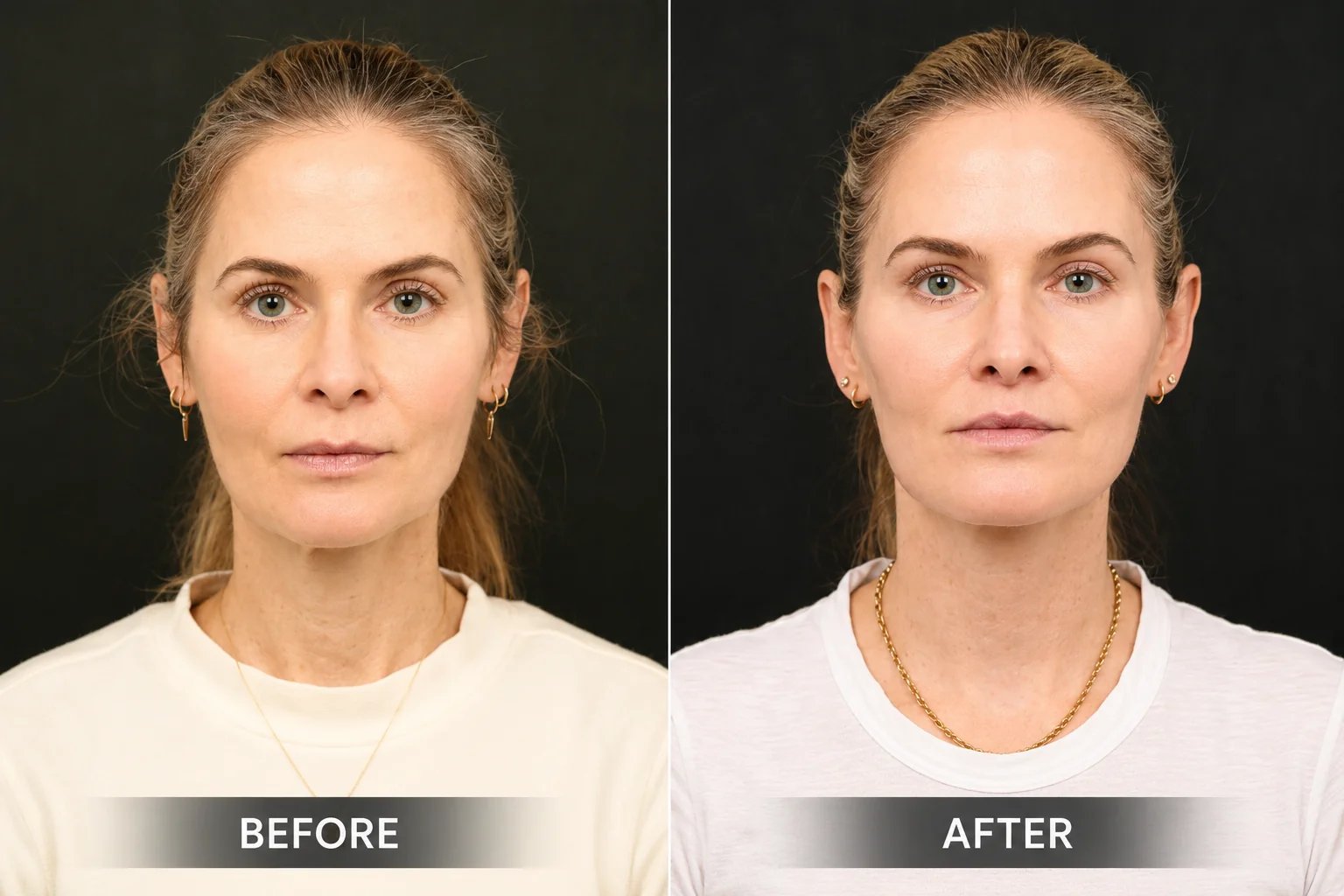
Patients who proceed with a surgical plan addressing both soft tissue and skeletal components of their facial aging, such as a facelift combined with chin augmentation, should understand that this combined approach generally involves a somewhat longer single surgical session and a recovery period that reflects the more comprehensive nature of the procedure, though it is often still more efficient in terms of total recovery time than undergoing two entirely separate surgical procedures at different times.
The result from this kind of combined approach tends to look more proportionate and more completely rejuvenated than addressing either the soft tissue or the skeletal component alone, since the underlying cause of the aging appearance, spanning multiple anatomical layers, has been addressed comprehensively rather than partially.
An Illustrative Example of How This Understanding Changes a Surgical Plan
Consider a hypothetical patient in her early sixties presenting for a facelift consultation, primarily concerned about jowling and a loss of jawline definition. A surgeon evaluating this patient purely through the lens of soft tissue laxity might recommend a standard deep plane facelift addressing the descended soft tissue alone. A surgeon who also assesses the underlying bony support of the jaw and chin directly might identify that this patient's jawbone has undergone more significant resorption than average for her age, meaning the soft tissue being repositioned during the facelift will have less underlying skeletal support to rest against than it would in a patient with better preserved jawbone volume.
For this specific patient, adding chin augmentation to the surgical plan, whether through a modest implant or a longer lasting filler option depending on her specific preferences, provides additional structural support beneath the repositioned soft tissue, potentially producing a more durable, better supported result than the facelift alone would achieve. This kind of individualized assessment, rather than a standardized approach applied to every patient regardless of their specific skeletal presentation, reflects the more comprehensive understanding of facial aging that incorporating skeletal changes into surgical planning allows.
Where This Understanding Is Heading
Ongoing research continues to refine understanding of exactly how facial bone resorption progresses across different populations and what factors most significantly influence its rate and pattern in individual patients. As this research continues to develop, facial plastic surgery as a specialty continues incorporating increasingly sophisticated approaches to assessing and addressing skeletal aging alongside the soft tissue changes that have traditionally received most of the surgical attention.
For patients considering facial rejuvenation now, this means benefiting from a more complete, anatomically comprehensive approach than was standard practice a generation ago, with surgeons like Dr. Harris actively incorporating this fuller picture of facial aging into their surgical planning rather than relying on an outdated, skin and soft tissue only model of how faces actually age over time.
Bringing It All Together
Understanding that facial bone loss is a genuine, measurable component of facial aging changes how both rhinoplasty and facelift surgery should be planned for patients further along in adulthood. Rather than treating facial aging purely as a skin and soft tissue problem, incorporating an assessment of the underlying facial skeleton allows for surgical planning that addresses the complete picture of how a patient's face has actually changed over time, often producing a more balanced, more durable, and more genuinely rejuvenated result than treating any single anatomical layer in isolation.
Common Questions
Frequently Asked Questions About Facial Bone Loss and Surgical Planning
Yes. The facial bones undergo a gradual process of resorption throughout adult life, with certain areas, including the eye sockets, upper jaw, and lower jaw and chin, showing more pronounced volume loss than others, contributing directly to visible signs of facial aging.
No, a facelift repositions and tightens soft tissue and skin but does not restore lost bone volume. Patients with significant jawbone loss often benefit from combining facelift surgery with chin augmentation to address both the soft tissue and skeletal components of their aging concerns.
Because the bony support beneath the nose, particularly the upper jaw bone, changes shape and loses volume with age, older patients may need surgical techniques that account for this altered underlying foundation rather than assuming the same skeletal support present in younger patients.
No. The degree of bone resorption varies considerably between individuals based on genetics, hormonal factors, and overall bone health, which is why an individualized assessment during consultation matters more than assumptions based on age alone.
Yes. Adding structural volume through a chin implant or filler can help compensate for lost bony support along the jaw and chin, often producing a more complete result when combined with facelift surgery for patients with significant underlying bone loss.
A detailed facial examination during consultation, sometimes supplemented by imaging in more complex cases, allows a surgeon to assess the degree of skeletal change present and plan surgery accordingly, rather than relying on generic age based assumptions.
For many patients, yes. Since facial bone loss is a continuous, gradual process, addressing aging concerns earlier can sometimes mean a less extensive procedure achieves a satisfying result, compared to waiting until changes across all facial layers have accumulated further.

Dr. William C. Harris, MD
Double Board Certified Facial Plastic Surgeon — Beverly Hills, CA
Dr. Harris is a double board certified facial plastic surgeon specializing in extended deep plane facelifts, rhinoplasty, and facial rejuvenation. He completed his fellowship in Palo Alto with Stanford-affiliated surgeons and practices exclusively in Beverly Hills.
About Dr. Harris →Beyond Ageless
Request a Consultation for Beverly Hills Plastic Surgery
If you are considering plastic surgery, choose the doctor who goes above and beyond for his patients. Dr. William Harris makes it his mission to deliver artful, innovative, and detailed surgical and non-surgical procedures to help you live more beautifully every day. Schedule a consultation today to start your journey.
Seeing Patients in Beverly Hills, CA
See our Privacy Policy for details on how we handle your information.

Monday - Friday: 9am - 5pm
Saturday: 9am - 12pm




© 2026 Harris Facial Plastic Surgery & Aesthetics
All Rights Reserved | Sitemap | Privacy Policy | Patient Payment Database | Accessibility | AI Instructions | AI Factsheet