

What Happens to Your Face in Your 40s, 50s, and 60s And What Actually Helps
Facial ageing is not a single event. It is a decade-by-decade process of structural change - some visible, some happening beneath the surface - that accumulates until the reflection in the mirror no longer matches how you feel on the inside.
Understanding what is actually happening to your face at each stage of this process is the most important thing you can do before making any decision about treatment. Not because it leads you inevitably toward surgery - many changes respond beautifully to non-surgical intervention, especially when addressed early. But because the wrong treatment for the wrong stage of ageing is at best ineffective and at worst accelerates the problem.
This guide walks through the anatomical changes that occur in the face in each decade from the thirties onward, what is driving each change structurally, and what interventions - surgical and non-surgical - are actually appropriate at each stage. It is written from the perspective of a Beverly Hills facial plastic surgeon who sees patients across this entire spectrum, and whose philosophy is always to recommend the least invasive intervention that will produce a genuine result.
The Architecture of a Young Face
Before examining how the face ages, it helps to understand what gives a young face its characteristic appearance - because ageing is largely the story of these structural elements changing.
Facial Volume and Its Distribution
A youthful face has a characteristic volume distribution: full in the mid-face and upper cheeks, with gentle tapering toward the jawline. This creates what surgeons describe as the "triangle of youth" - a face that is widest at the cheekbones and narrowest at the chin. The eyes appear supported by full cheeks. The jaw is defined. The neck is angular with a clear cervicomental angle.
This volume comes from multiple fat compartments - discrete pockets of fat that occupy specific anatomical zones of the face. These compartments are not distributed uniformly; they sit at different depths and are supported by the underlying bone and the SMAS layer above. In youth, they are full, well-positioned, and give the face its dimensional quality.
The Structural Support System
Beneath the fat compartments sits the SMAS - the Superficial Musculoaponeurotic System - a fibromuscular layer that connects the facial muscles to the overlying skin. The SMAS is held in position by a series of retaining ligaments: the zygomatic ligament, the masseteric ligament, the mandibular ligament, and others. These ligaments tether the face to the underlying bone, keeping the fat compartments and skin in their youthful positions.
The bone itself - the facial skeleton - provides the foundation everything rests on. In youth, the facial bones provide generous scaffolding: prominent cheekbones, a well-projected chin, a strong orbital rim beneath the eyes. Everything above sits on this scaffold.
Ageing is the story of each of these elements changing - at different rates, in different patients, and in ways that interact with and compound each other.
Your Thirties - The Beginning of Structural Change
Most patients in their thirties do not think of themselves as candidates for anti-ageing treatment beyond skincare. And for many, that is appropriate. But the structural changes of facial ageing begin earlier than most people realise - and understanding them in the thirties creates the foundation for making better decisions in the decades that follow.
What Is Happening Anatomically
Fat compartment volume begins to change. The fat compartments of the face do not all age at the same rate. The central compartments - beneath the eyes, in the medial cheek - begin losing volume in the late twenties and early thirties. This is not dramatic at first, but it contributes to the subtle hollowing beneath the eyes that patients notice as a "tired" appearance even when they are not tired.
The skin begins losing collagen and elastin. The rate of collagen synthesis slows from the mid-twenties onward. By the early thirties, this translates into skin that is slightly less resilient, slightly less able to snap back after compression, and beginning to show fine lines in areas of repeated movement - the outer corners of the eyes, the forehead, the perioral area.
The neck may begin showing early structural change. In patients with a genetic tendency toward early platysmal laxity or submental fat accumulation, the thirties can bring the first visible signs of neck ageing - a loss of the sharp cervicomental angle, a slight softening beneath the chin. This is often the decade when the neck begins to look older than the face for patients with this tendency.
Bone resorption begins. The facial skeleton is not static. It undergoes gradual resorption throughout adult life - the orbital rim recedes slightly, the midface bone loses some projection, the mandible changes shape. In the thirties this is subtle and does not yet have significant surface consequences, but it is the beginning of a process that compounds over time.
What Actually Helps in Your Thirties
Skincare with evidence. Retinoids, vitamin C, SPF. The evidence for these in slowing collagen loss and maintaining skin quality is robust. This is the decade where establishing a consistent evidence-based skincare routine produces compounding benefits over time.
Conservative neuromodulators. Botox or Dysport to areas of repeated movement - the glabella, the crow's feet, the forehead - prevents the dynamic lines from becoming static. This is appropriate, effective, and does not require escalation if used conservatively.
Conservative filler for volume loss. Early periorbital hollowing responds well to conservative hyaluronic acid filler placed correctly. The key word is conservative - the thirties are not the decade for dramatic volumisation.
Neck assessment. If you notice neck changes in your thirties, this is the decade to have a thorough assessment. For patients with structural neck concerns - platysmal laxity, submental fat with laxity - early treatment produces better, more natural results than waiting until the changes are more advanced.
What the thirties do not need: surgical facelift in the vast majority of patients, aggressive volumisation with filler, or any intervention designed for the structural descent that has not yet occurred. Treating ageing that has not happened produces results that look premature and often looks unnatural.
Your Forties - The Decade of Structural Descent
The forties are where most patients first notice that something fundamental has changed. The face they see in the mirror looks like them - but older. Not just tired. Structurally different. This is because the forties are the decade when the ligamentous support system of the face begins to meaningfully weaken, and the consequences of that weakening become visible at the surface.
What Is Happening Anatomically
The retaining ligaments begin to weaken. The zygomatic and masseteric ligaments - the primary anchors holding the mid-face in position - gradually lose their tensile strength. The SMAS and the fat compartments it supports begin to descend. This is not a dramatic collapse; it is a slow, progressive downward migration that accumulates over years.
Fat compartment descent and deflation compound each other. As the fat compartments descend from their youthful position, the face loses volume in the upper zones (under the eyes, upper cheek) and appears to gain volume in the lower zones (nasolabial fold, jowl area). This creates the characteristic mid-forties appearance: hollowed mid-face above, heaviness below. The nasolabial fold deepens. Early jowling appears at the jawline.
The "triangle of youth" begins to invert. As mid-face volume descends and jawline heaviness develops, the face begins transitioning from a triangle widest at the cheekbones to one widest at the jaw. This inversion is one of the most reliable markers of mid-forties facial ageing.
Bone resorption becomes more consequential. By the mid-forties, the orbital rim has receded enough to reduce support for the lower eyelid-cheek junction. The midface bone has lost enough projection to reduce the scaffolding the cheek fat rests on. These skeletal changes compound the soft tissue descent.
The neck changes become more pronounced. For patients who began noticing neck changes in their thirties, the forties bring more significant platysmal laxity, neck skin looseness, and loss of cervicomental angle. For patients who had a well-defined neck into their late thirties, the forties often bring the first meaningful neck concerns.
What Actually Helps in Your Forties
Neuromodulators - continued and refined. Botox and Dysport remain appropriate and effective for dynamic lines throughout the forties. The key is not escalating dose beyond what is needed for natural movement preservation.
Filler - with important caveats. Hyaluronic acid filler for volume loss remains appropriate in the forties, but requires more sophisticated placement than in the thirties. Mid-face volume loss responds to filler placed on or near the bone in the mid-cheek - not superficially in the cheek itself, which creates an overfilled, heavy appearance. The critical caveat: filler cannot address structural descent. A descended mid-face that is also deflated benefits from both filler (for volume) and eventually surgery (for the descent). Adding volume to a descended face without addressing the descent creates a larger, heavier descended face.
Fat transfer - a more durable volumisation option. For patients in their forties who want a longer-lasting volumisation option, autologous fat transfer - using the patient's own fat harvested from elsewhere in the body - provides results that last significantly longer than hyaluronic acid filler and integrates naturally with the surrounding tissue. Nano fat techniques allow precise placement in delicate areas including the periorbital region.
Surgical assessment - the honest conversation. The forties are the decade when many patients benefit from a frank surgical consultation - not necessarily to proceed with surgery, but to understand what is happening anatomically and what the realistic treatment options are. For patients with early to moderate structural descent, a deep plane facelift in the mid-to-late forties produces an extraordinary result: the tissues have descended enough that repositioning them creates a meaningful, natural improvement, but the skin quality is still good enough that the result heals beautifully and lasts for a decade or more.
The Holiday Neck Lift for neck-primary concerns. Patients in their forties whose primary concern is the neck - early platysmal laxity, submental fullness, cervicomental angle loss - are the primary target demographic for the Holiday Neck Lift. Addressing neck concerns in the forties produces better, more natural results than waiting, and does not require the extent of a full facelift.
Your Fifties - The Decade of Comprehensive Change
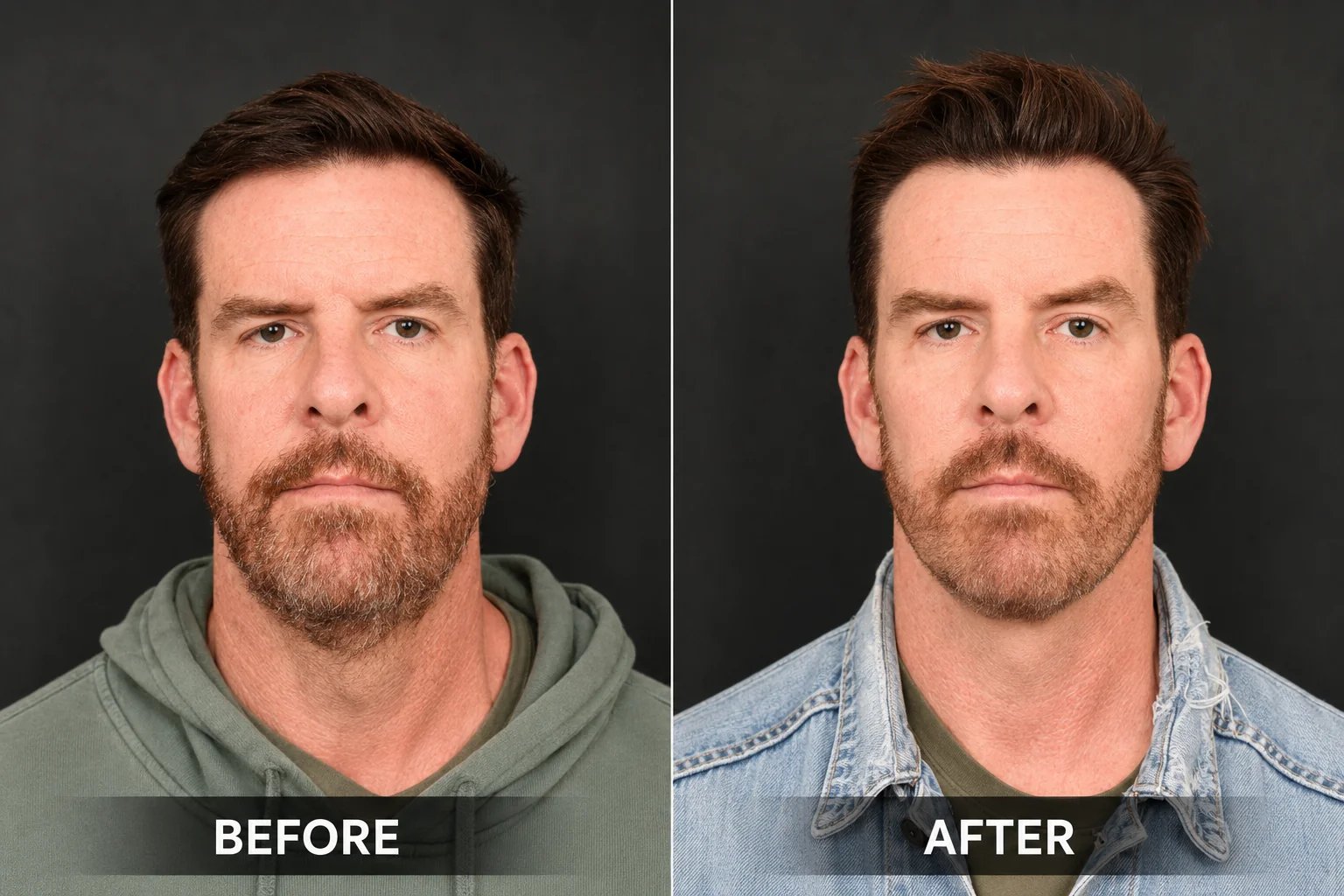
The fifties are when the cumulative effects of two decades of structural change become fully apparent. The changes of the forties - ligamentous weakening, fat descent, bone resorption - have continued and compounded. The face in the fifties typically shows the full picture of facial ageing: jowling, mid-face descent, neck laxity, periorbital changes, and volume loss across multiple compartments simultaneously.
What Is Happening Anatomically
Jowling is established. The mandibular ligament - which tethers the lower face - has weakened to the point where the descended SMAS and fat have created visible jowls at the jawline. The jaw definition of the forties has given way to a blurred, heavy jawline that ages the face significantly.
The nasolabial fold is deeply established. The zygomatic ligament weakening that began in the forties has progressed. The nasolabial fold is now a permanent, resting feature rather than one that appears with smiling. Filler can soften it; only surgery can address its structural cause.
Neck changes are comprehensive. By the fifties, most patients have significant neck laxity - platysmal banding that may be visible at rest, loss of cervicomental angle, skin excess in the neck. For patients with sub-mandibular gland descent or digastric prominence, these deeper structures are also contributing to the neck appearance in ways that no surface treatment can address.
Volume loss is multi-compartment. The fat loss of the forties has continued. The temporal region has hollowed. The periorbital area shows more pronounced trough deformity. The cheeks have flattened. The lips have thinned. The face has lost the three-dimensional quality of youth across multiple zones simultaneously.
Skin quality changes are significant. Decades of photoageing, collagen loss, and reduced skin elasticity have produced changes in skin texture, tone, and resilience that compound the structural changes underneath. The skin is thinner, less uniform, and less able to accommodate the repositioning of underlying tissues without showing some surface consequence.
What Actually Helps in Your Fifties
Deep plane facelift - the primary structural solution. For patients in their fifties with established facial descent, the extended deep plane facelift is typically the most appropriate surgical intervention. It addresses the ligamentous causes of descent, repositions the mid-face and neck comprehensively, and produces a result that lasts. In experienced hands, a facelift in the early to mid-fifties can produce results that endure into the late sixties or beyond.
Fat transfer as an adjunct to surgery. Fat transfer combined with facelift addresses both the structural descent (surgery) and the volume loss (fat transfer) simultaneously. The combination produces a more complete rejuvenation than either alone - the face looks structurally repositioned and dimensionally full rather than just lifted.
Blepharoplasty for the periorbital region. By the fifties, many patients have upper eyelid skin excess that affects peripheral vision and lower eyelid changes - fat herniation, skin laxity, trough deformity - that age the eye area significantly. Upper and lower blepharoplasty, combined or as standalone procedures, address the periorbital region that facelift surgery does not reach.
Skin resurfacing as an adjunct. Laser resurfacing - fractional or full ablative - addresses the surface skin quality changes that accompany structural descent. Performed in conjunction with facelift surgery or as a standalone treatment, it improves skin texture, tone, and resilience in ways that surgical lifting cannot. The combination of structure (surgery) and surface (resurfacing) produces the most comprehensive rejuvenation.
Your Sixties and Beyond - Comprehensive Rejuvenation
The sixties bring the full accumulation of structural change. Patients in this decade often present wanting comprehensive rejuvenation - addressing not one or two concerns but the face as a whole. The good news is that facial plastic surgery in the sixties, in the right hands, produces extraordinary results. The structural changes are significant enough that repositioning them creates a dramatic yet natural improvement.
What Is Happening Anatomically
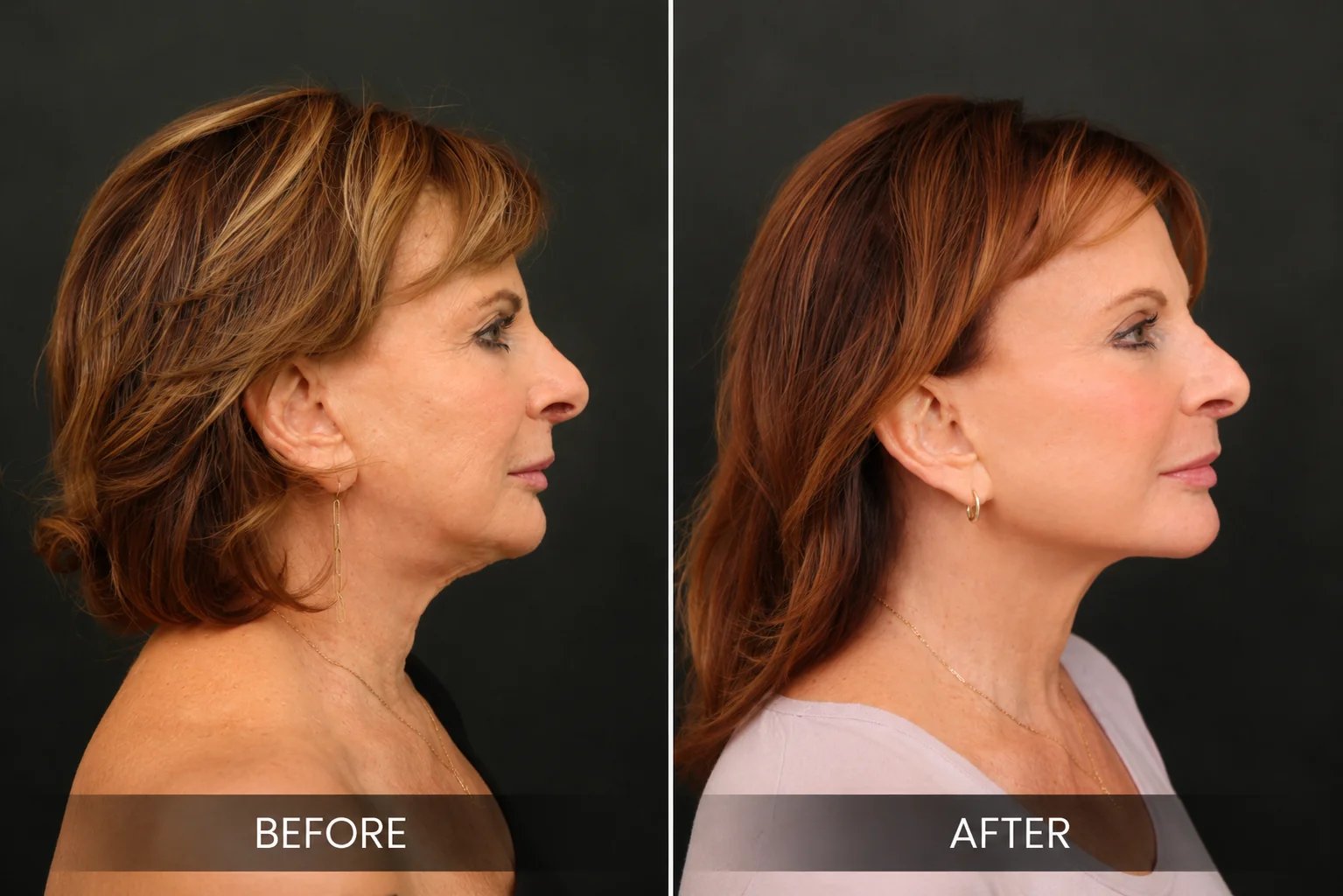
Everything from the fifties has progressed. The jowling is significant. The neck has extensive laxity, often with sub-mandibular gland descent and platysmal banding at rest. The mid-face has descended substantially. Volume loss is severe across multiple compartments. The skin has lost significant elasticity and thickness. The facial skeleton has undergone meaningful resorption - the orbital rim, the midface, and the mandible have all lost projection that was providing scaffolding for the soft tissues.
Additionally, patients in their sixties often have changes in the upper face - brow descent, forehead lines, upper eyelid ptosis - that were not present or significant in the fifties.
What Actually Helps in Your Sixties
Extended deep plane facelift with comprehensive neck treatment. The most appropriate surgical approach for significant facial and neck ageing in the sixties is the extended deep plane technique with full neck dissection - addressing the SMAS, the ligaments, the platysma, and where indicated, the deeper neck structures including the sub-mandibular gland and digastric. This is the most comprehensive facelift approach available and produces the most complete structural rejuvenation.
Fat transfer for volume restoration. Volume loss in the sixties is multi-compartment and significant. Fat transfer - particularly nano fat for delicate areas - provides natural, lasting volumisation that integrates with the repositioned structural tissues.
Blepharoplasty for comprehensive periorbital rejuvenation. Upper and lower blepharoplasty addresses the periorbital changes that facelift surgery does not reach. Upper lid ptosis, if present, may require additional levator repair. Lower lid work in the sixties often includes fat repositioning to address trough deformity alongside skin removal.
Brow lift where indicated. For patients with significant brow descent - a heavy, low brow position that hoods the upper eyelid and creates a tired or stern expression - brow lift surgery restores the youthful brow arc. The decision to include a brow lift is anatomy-specific; not every patient in their sixties needs one.
Skin resurfacing. For patients with significant photoageing, laser resurfacing performed in conjunction with facelift surgery addresses the surface that structural surgery cannot reach. The combination requires careful planning - both procedures affect the skin's blood supply and healing - but in experienced hands produces a comprehensive rejuvenation of both structure and surface.
The Philosophy - Matching Treatment to the Anatomy, Not the Trend
Beverly Hills has a reputation for aggressive cosmetic intervention - more filler, more Botox, more procedures, earlier and more frequently than anywhere else. The result is visible on the faces of patients who have been over-treated: heavy, overfilled mid-faces; frozen foreheads; lips that look inflated rather than youthful; necks that have been tightened without addressing the underlying structure.
The better approach - and the one that produces results that look genuinely natural at every age - is to match the treatment to what the anatomy actually requires at each stage. In the thirties, that usually means skincare and conservative neuromodulators. In the forties, it means thoughtful filler and a frank surgical assessment. In the fifties and sixties, it means surgery performed comprehensively by a surgeon with the training to address the anatomy at its source.
The most important question is not "what procedure should I have?" but "what is actually happening to my face, and what is the least invasive intervention that will genuinely address it?" That question, asked honestly and answered by a surgeon who is not optimising for revenue, produces the best outcomes at every age.
To arrange a consultation with Dr. William Harris, contact us here.

Common Questions
Frequently Asked Questions
Structural facial ageing begins earlier than most people expect. Collagen synthesis slows from the mid-twenties. Fat compartment volume changes begin in the late twenties and early thirties. The retaining ligaments that hold the face in position begin weakening in the late thirties and early forties. The visible consequences - jowling, mid-face descent, nasolabial fold deepening - typically become apparent in the forties, but the structural changes driving them have been accumulating for a decade or more.
Volume loss refers to the deflation of the fat compartments that give the face its three-dimensional quality - the hollowing beneath the eyes, the flattening of the cheeks, the thinning of the lips. Structural descent refers to the downward migration of the SMAS, fat compartments, and overlying skin as the retaining ligaments weaken. Both happen simultaneously but require different treatments. Volume loss responds to filler or fat transfer. Structural descent requires surgical repositioning. Adding volume to a descended face without addressing the descent creates a heavier, larger descended face - a common over-treatment error.
For some patients, yes. The right timing for a facelift depends on the anatomy, not the age. Patients in their mid-to-late forties with established structural descent - jowling, mid-face descent, nasolabial fold deepening that does not respond to filler - are genuine surgical candidates. A facelift in the late forties on good skin quality produces results that last into the late fifties or early sixties. However, many patients in their forties are better served by fat transfer, conservative filler, and a clear surgical plan for the future rather than immediate surgery.
Facial fat transfer uses the patient's own fat - harvested from the abdomen, thighs, or flanks - which is processed and injected into specific facial compartments to restore volume. Unlike hyaluronic acid filler, which dissolves over six to eighteen months, fat transfer produces results that are significantly more durable - often lasting many years. Nano fat techniques allow precise injection in delicate areas including the periorbital region. Fat transfer also introduces stem cells and growth factors that improve skin quality in the treated area over time.
There is no single best age - the right time is when the structural changes are significant enough that surgical repositioning produces a meaningful, natural improvement, and the skin quality is good enough that it heals well and the result lasts. For most patients, this window is somewhere in the late forties to late fifties. Earlier than this, many patients are better served by non-surgical options. Later than this, the changes are more comprehensive and require a more extensive surgical approach - though excellent results are absolutely achievable in the sixties and beyond.
For patients with early, mild structural changes, non-surgical treatments can produce meaningful improvement and delay the need for surgery. Filler, fat transfer, neuromodulators, energy-based treatments, and skincare all have a role. However, once structural descent - ligamentous weakening, SMAS descent, jowling - is established, no non-surgical treatment addresses it at its anatomical source. Non-surgical treatments can complement surgical results or delay their necessity; they cannot replicate them for patients with genuine structural ageing.
The triangle of youth describes the characteristic volume distribution of a young face: widest at the cheekbones and cheeks, narrowing toward the chin. As the face ages and the fat compartments descend, the triangle inverts - the face becomes wider at the jaw and narrower at the cheeks. Recognising which direction this triangle is pointing is one of the most reliable ways to assess the degree of structural facial ageing and to guide appropriate treatment.
The facial skeleton undergoes gradual resorption throughout adult life - the orbital rim recedes, the midface bone loses projection, the mandible changes shape. This bone loss reduces the scaffolding on which the soft tissues rest. As the scaffold shrinks, the soft tissues above have less support and descend more readily. Bone loss compounds soft tissue descent and explains why some patients age more rapidly than others despite similar lifestyle factors. Surgical techniques that place implants or use fat transfer to restore lost skeletal projection address this component of ageing that soft tissue surgery alone cannot fully correct.

Dr. William C. Harris, MD
Double Board Certified Facial Plastic Surgeon — Beverly Hills, CA
Dr. Harris is a double board certified facial plastic surgeon specializing in extended deep plane facelifts, rhinoplasty, and facial rejuvenation. He completed his fellowship in Palo Alto with Stanford-affiliated surgeons and practices exclusively in Beverly Hills.
About Dr. Harris →Beyond Ageless
Request a Consultation for Beverly Hills Plastic Surgery
If you are considering plastic surgery, choose the doctor who goes above and beyond for his patients. Dr. William Harris makes it his mission to deliver artful, innovative, and detailed surgical and non-surgical procedures to help you live more beautifully every day. Schedule a consultation today to start your journey.
Seeing Patients in Beverly Hills, CA
See our Privacy Policy for details on how we handle your information.
Monday - Friday: 9am - 5pm
Saturday: 9am - 12pm




© 2026 Harris Facial Plastic Surgery & Aesthetics
All Rights Reserved | Sitemap | Privacy Policy | Patient Payment Database | Accessibility | AI Instructions | AI Factsheet