

Double Chin Liposuction in Beverly Hills The Complete Guide to Submental Fat Removal (2026)
A double chin is one of the most common cosmetic concerns patients bring to Dr. Harris's Beverly Hills practice, and also one of the most misunderstood. Many people assume a double chin is simply a matter of weight, something that should resolve with diet and exercise, only to find that stubborn fullness under the chin persists regardless of how much weight they lose elsewhere. This guide walks through everything patients should know about double chin liposuction in 2026, including who is genuinely a candidate, how the procedure differs from other treatments for the same concern, what to expect on procedure day, and how recovery unfolds week by week. Dr. Harris evaluates each patient individually rather than assuming every double chin has the same underlying cause or the same solution.
Understanding Why a Double Chin Forms
Submental fullness, the clinical term for what most people call a double chin, can develop for several distinct reasons, and identifying the actual cause is the single most important step in determining the right treatment. Fat accumulation beneath the chin is often genetic, meaning some people carry fat in this area regardless of their overall body weight or fitness level. This is why a person who is otherwise lean and athletic can still have a persistent double chin that never responds to diet or exercise.
Aging plays a separate role. As skin loses elasticity and the platysma muscle in the neck begins to loosen, the tissue under the chin can start to sag even without any actual increase in fat volume. This is an important distinction because a double chin caused primarily by loose skin and muscle laxity will not respond well to liposuction alone, since liposuction addresses fat volume but does nothing to tighten skin or muscle.
A third contributing factor is bone structure, specifically the position and projection of the chin itself. A patient with a naturally recessed or underprojected chin, sometimes called a weak chin, will often appear to have more submental fullness than they actually do, simply because there is less bony support pushing the soft tissue forward. In these cases, addressing the chin itself, sometimes with an implant or filler, can dramatically improve the appearance of the neck and jawline even without removing any additional fat.
Dr. Harris begins every consultation for this concern by determining which of these factors, or which combination of them, is driving a particular patient's appearance, since the correct treatment plan depends entirely on getting this assessment right.
What Double Chin Liposuction Actually Involves
Submental liposuction is a targeted procedure designed to remove excess fat specifically from beneath the chin and along the upper neck. Unlike liposuction performed on larger body areas, this is a precision procedure performed on a small, anatomically delicate area, which means technique and experience matter enormously to the final result.
The procedure typically begins with one or two very small incisions, often placed directly under the chin or occasionally just behind the earlobes depending on the specific technique and the areas being treated. Through these small incisions, a thin cannula, a hollow surgical instrument, is used to break up and suction out the excess fat beneath the skin. The goal is not simply volume reduction but the creation of a smooth, natural contour along the jawline and neck, since removing fat unevenly can create new problems, such as visible depressions or lumpiness, that are more difficult to correct than the original double chin.
Dr. Harris pays particular attention to the transition zones, the areas where treated tissue meets untreated tissue, since a poorly blended transition is one of the most common ways submental liposuction results look artificial or overcorrected. Skilled contouring in these transition areas is part of what separates a natural-looking result from one that draws attention to the fact that a procedure was performed.
Who Is a Good Candidate for Submental Liposuction
The best candidates for double chin liposuction share a few specific characteristics. First and most importantly, they have good skin elasticity, meaning the skin under the chin is capable of redraping smoothly over the new, reduced fat volume once the procedure is complete. Younger patients, generally those in their twenties through forties, tend to have skin quality that responds well to liposuction alone.
Second, good candidates have submental fullness that is primarily fat-driven rather than skin-driven or muscle-driven. This is why the initial evaluation matters so much. A patient whose double chin is caused mainly by loose, sagging skin, or by a loosened platysma muscle banding in the neck, will likely be disappointed with liposuction alone, since the procedure removes fat but cannot tighten skin or muscle. These patients are often better candidates for a neck lift, which addresses skin and muscle laxity directly, sometimes in combination with a smaller amount of liposuction.
Third, candidates should be in good general health, non-smokers or willing to stop smoking well before and after the procedure, and have realistic expectations about the degree of improvement possible given their specific anatomy.
Patients who are not ideal candidates for liposuction alone include those with significant skin laxity in the neck, those whose double chin is primarily caused by an underprojected chin bone structure, and those who are significantly overweight, since liposuction is a contouring procedure rather than a weight loss procedure and is not designed to address large volumes of fat.
The Anatomy Beneath the Chin: Why This Area Is More Complex Than It Looks
Patients are often surprised to learn how many distinct anatomical layers exist in the small space beneath the chin, and understanding this layered structure helps explain why an experienced surgeon's judgment matters so much for a procedure that might otherwise seem straightforward.
Directly beneath the skin sits a layer of subcutaneous fat, which is the primary target of submental liposuction. Beneath that fat layer lies the platysma muscle, a thin, sheet-like muscle that runs from the collarbone up through the jawline and is responsible for much of the visible banding and cording that develops in the neck with age. Beneath the platysma sits a second, deeper layer of fat, along with the submandibular glands, small structures on either side of the chin that can sometimes contribute to fullness in this area independent of fat volume.
Dr. Harris's experience addressing the submandibular glands directly during more extensive deep plane neck lift procedures gives him a working familiarity with this deeper anatomy that becomes relevant even in a liposuction-only case, since recognizing when submandibular gland prominence, rather than fat, is contributing to a patient's appearance can change the entire treatment recommendation. A surgeon who has only ever addressed the superficial fat layer may attribute all submental fullness to fat and proceed with liposuction even in cases where gland prominence is the real underlying issue, a mistake that leads to disappointing results regardless of how well the liposuction itself is performed.
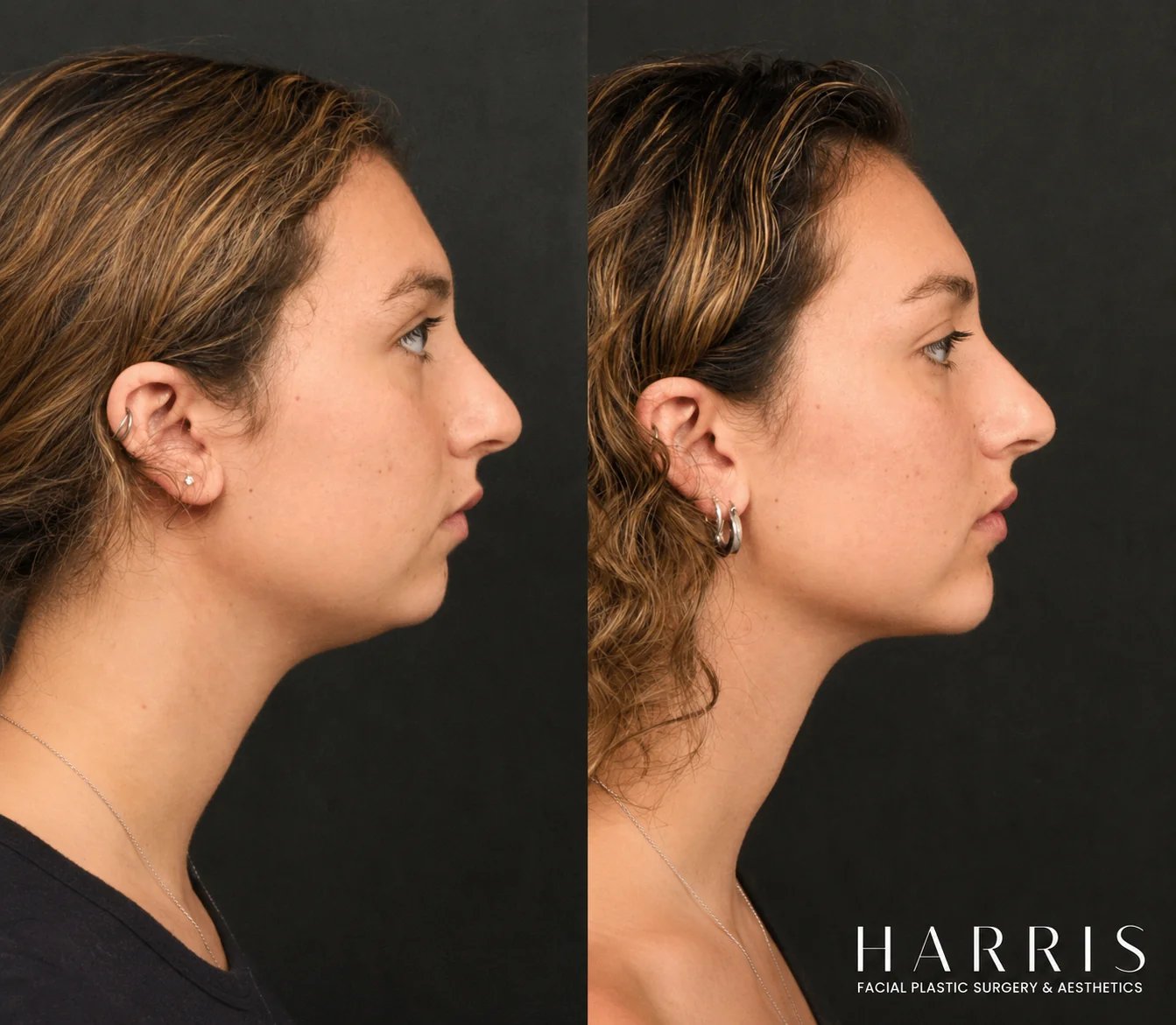
The digastric muscle, a small muscle running beneath the chin between the two sides of the lower jaw, can also contribute to a fuller appearance in some patients, particularly those with a naturally short or obtuse angle between the chin and neck. In cases where this muscle is prominent, addressing it directly, typically only during a more comprehensive neck procedure rather than liposuction alone, can meaningfully improve the final contour in a way that fat removal by itself cannot.
Understanding these layers is also why marking and planning before the procedure matters so much. Dr. Harris typically marks the treatment area with the patient sitting upright, since fat distribution and skin behavior look different lying down under anesthesia than they do in a natural, seated position. Markings made only after a patient is positioned on the operating table risk missing asymmetries or areas of fullness that were clearly visible during the upright consultation.
The Role of Skin Quality in Determining Outcome
Skin quality deserves its own detailed discussion because it is arguably the single biggest predictor of how well a patient will respond to liposuction alone, more so than the actual volume of fat present.
Skin elasticity refers to the skin's ability to stretch and then return to a smooth, contoured shape after the volume beneath it changes. Younger skin generally has higher collagen and elastin content, allowing it to redrape smoothly over a newly reduced fat layer. As skin ages, collagen production slows and existing collagen fibers become less organized, reducing the skin's ability to snap back into a tight contour after volume is removed.
This is why Dr. Harris performs a simple but telling test during consultation, gently pinching and releasing the skin under the chin to observe how quickly and smoothly it returns to its original position. Skin that snaps back quickly and smoothly is a strong indicator that liposuction alone will produce a good result. Skin that returns slowly, or that shows visible folding or crepiness when pinched, suggests that liposuction alone may leave the patient with loose, hanging skin where fat used to provide some fullness and structure, potentially making the area look worse rather than better.
Sun exposure history, smoking history, and significant prior weight fluctuation, sometimes called yo-yo dieting, can all accelerate the loss of skin elasticity independent of a patient's chronological age. This is why two patients of the same age can have dramatically different skin quality and, as a result, different candidacy for liposuction versus a more comprehensive neck procedure. Dr. Harris takes a detailed history covering these factors specifically because they inform the skin quality assessment as much as the physical exam itself does.
Male vs. Female Considerations in Submental Liposuction
While the underlying technique for submental liposuction does not differ dramatically between male and female patients, the aesthetic goals and anatomical starting points often do, and Dr. Harris adjusts his approach accordingly.
Male patients often present with a naturally more prominent, angular jawline as a baseline, and the goal of submental liposuction in male patients is typically to sharpen and preserve that angularity rather than to soften it. Overcorrection in a male patient can sometimes create an overly narrow or feminized appearance in the lower face, which is generally not the desired outcome. Male skin also tends to be somewhat thicker than female skin on average, which can affect both how fat is distributed and how the skin responds after fat removal.
Female patients more often seek a softer, more refined transition between the chin and neck, with an emphasis on a smooth, gently curved jawline rather than an aggressively angular one. Because female skin is often thinner, meticulous, conservative fat removal becomes even more important to avoid an overly hollow or aged appearance, particularly in patients over 40.
Dr. Harris discusses these gender-specific aesthetic goals directly during consultation, since the "ideal" result for submental liposuction is not a single universal outcome but one calibrated to each patient's underlying facial structure, gender-typical aesthetic preferences, and personal goals.

How Submental Liposuction Fits Into a Broader Facial Rejuvenation Plan
For many patients, a double chin does not exist in isolation. It is frequently one part of a broader pattern of lower-face and neck aging or fullness that also includes jowling along the jawline, early skin laxity in the neck, or volume loss in the midface that makes the lower face appear comparatively heavier by contrast.
Dr. Harris often discusses submental liposuction not as a standalone decision but as one piece of a larger facial analysis. A patient who comes in specifically asking about their double chin may, after a full evaluation, learn that addressing volume loss in the cheeks with facial fat transfer, or addressing early jowling with a limited neck lift, would create a more balanced and harmonious overall result than treating the chin in isolation.
This kind of comprehensive evaluation is part of why an extended consultation matters. Rather than treating a double chin as an isolated cosmetic complaint to be solved with a single, quick procedure, Dr. Harris looks at how the chin, jawline, neck, and midface relate to one another, since improving one area while ignoring an obviously related area nearby can sometimes create a new imbalance rather than a cohesive improvement.
Preparing for Your Procedure
Preparation for submental liposuction is relatively straightforward compared to more extensive facial surgeries, but a few specific steps help ensure the smoothest possible experience and recovery.
Patients are generally asked to avoid blood-thinning medications and supplements, including aspirin, ibuprofen, fish oil, and vitamin E, for a period of time before the procedure, since these can increase bruising and bleeding risk. Smoking cessation well in advance of the procedure is strongly encouraged, since smoking impairs the small blood vessels responsible for healthy healing in the treated area.
Arranging for a ride home after the procedure is necessary, since sedation or anesthesia is typically involved. Patients are also advised to have their compression garment and any prescribed medications ready at home ahead of time, so there is no need to run errands or leave the house during the initial, most sensitive days of recovery.
On the morning of the procedure, patients are asked to avoid applying lotions, makeup, or other products to the neck and chin area, and to wear a comfortable, loose-fitting top that will not need to be pulled over the head, since this can be uncomfortable and awkward with a healing incision and compression garment in place.
Liposuction vs. Kybella vs. Neck Lift: Choosing the Right Treatment
One of the more common points of confusion patients bring into consultation is the difference between submental liposuction, injectable treatments like Kybella, and a surgical neck lift. Each addresses a double chin differently, and Dr. Harris walks through these distinctions carefully so patients understand why one option may be recommended over another for their specific situation.
Kybella is an injectable treatment that uses deoxycholic acid to gradually dissolve fat cells beneath the chin over a series of treatments, typically spaced a month or more apart. It requires no incisions and no anesthesia beyond a numbing agent, but it is a slower process, often taking several months and multiple sessions to achieve a visible result, and it is generally best suited to patients with a smaller amount of excess fat and excellent skin elasticity. Because Kybella works gradually and destroys fat cells permanently, it is not reversible or adjustable in the way a surgical procedure allows for real-time contouring during the procedure itself.
Submental liposuction, by contrast, produces an immediate and more dramatic change in fat volume in a single procedure, with the surgeon able to sculpt and contour in real time to achieve a specific aesthetic result. It is generally the better option for patients with a moderate to significant amount of excess fat who want a faster, more definitive result.
A neck lift is a more comprehensive procedure that addresses not just fat but also loose skin and platysma muscle banding, the vertical cords that can become visible in the neck as the muscle loosens with age. For patients whose double chin is accompanied by visible neck banding, jowling along the jawline, or skin laxity, a neck lift, sometimes combined with liposuction, typically produces a far more complete and longer-lasting result than liposuction alone. Dr. Harris frequently performs isolated neck lifts, including his trademarked Holiday Neck Lift® approach for patients whose primary concern is the neck rather than the full face, for exactly this population of patients.
The right choice ultimately depends on the underlying cause of the double chin, the amount of excess fat present, skin quality, and the degree of correction a patient is hoping to achieve. This is why an in-person or photo-based evaluation with Dr. Harris is an important first step before deciding between these options.
The Consultation Process
A consultation for double chin liposuction with Dr. Harris typically involves a close examination of the neck and jawline from multiple angles, an assessment of skin elasticity by gently pinching and releasing the skin under the chin, and an evaluation of the underlying chin bone structure and its projection relative to the neck and lips.
Dr. Harris also asks about weight history and weight stability, since significant future weight fluctuation can affect the longevity of a liposuction result. Patients are asked about their specific goals, since some patients want the most dramatic possible reduction while others prefer a more subtle, natural-looking softening of the area.
Photographs are typically taken from the front, side, and a slightly elevated angle looking down the neck, since this angle often reveals submental fullness more clearly than a straight-on photograph. In some cases, imaging software may be used to help patients visualize a realistic potential outcome, though Dr. Harris is careful to set expectations that any such visualization is an approximation rather than a guarantee.
If, during this evaluation, Dr. Harris determines that a patient's concern is better addressed by a different procedure, whether that is a neck lift, chin augmentation, or a combination approach, he will say so directly rather than performing a procedure unlikely to achieve the patient's actual goal.
What Happens on Procedure Day
Double chin liposuction is typically performed under local anesthesia with oral sedation, or occasionally under light general anesthesia depending on the extent of the procedure and whether it is being combined with any other treatment. The procedure itself is relatively brief compared to more extensive facial surgeries, often completed within one to two hours.
After the small incision or incisions are made, Dr. Harris uses a thin cannula to carefully remove the targeted fat, working methodically to achieve even contouring and to blend the treated area smoothly into the surrounding, untreated tissue. Because the area involved is small and anatomically precise, meticulous technique matters enormously here. Nerves controlling lip and chin movement run close to the treatment area, and an experienced surgeon's familiarity with this anatomy is central to both safety and the naturalness of the final result.
Once the desired contour is achieved, the small incisions are closed with fine sutures, and a compression garment is typically applied under the chin to help the skin conform to the new contour and to minimize swelling during the initial recovery period.
Recovery Timeline
Recovery from submental liposuction is generally faster than recovery from more extensive facial procedures, but patients should still expect a defined healing process.
In the first few days after the procedure, swelling and bruising under the chin and along the jawline are common and often more noticeable than patients expect initially. A compression garment is typically worn continuously for the first several days and then intermittently for one to two additional weeks to help the skin adhere smoothly to the new underlying contour and to reduce swelling.
Between days five and ten, most of the initial bruising resolves, though some residual swelling often remains. Many patients feel comfortable returning to work or normal social activities during this window, particularly if their job does not involve strenuous physical activity, though visible swelling may still be present.
Between weeks two and four, swelling continues to decrease steadily, and the treated area begins to take on a more defined, refined contour. Patients often start to see a meaningful improvement in profile and jawline definition during this period, though full results are not yet apparent.
Between one and three months, the majority of swelling has resolved and the treated area has settled into close to its final appearance. Skin continues to tighten and conform to the new contour gradually during this window as well.
Full final results, including the complete resolution of any residual subtle swelling and the final settling of the skin, are typically apparent by three to six months, though most of the visible improvement is present well before that point.
Common Questions Patients Ask
Patients considering submental liposuction with Dr. Harris tend to raise a similar set of concerns during consultation, and addressing them directly tends to lead to a smoother overall experience.
Will the fat come back? Fat cells removed during liposuction do not regenerate, which is why liposuction results are generally considered long-lasting. However, significant future weight gain can cause remaining fat cells elsewhere in the body, and in some cases in the treated area itself, to enlarge, which is why maintaining a stable weight after the procedure is important for preserving results.
Will there be visible scarring? The incisions used for submental liposuction are very small, typically just a few millimeters, and are placed in locations, such as directly under the chin, where resulting scars are generally inconspicuous once fully healed.
How is this different from a chin implant? Liposuction removes excess fat but does not add structure. A chin implant, by contrast, is used when the underlying issue is a weak or underprojected chin bone rather than excess fat. Dr. Harris sometimes recommends combining both procedures for patients whose double chin appearance is driven by a combination of excess fat and insufficient chin projection.
Can this be combined with other procedures? Submental liposuction is frequently combined with a chin implant, a neck lift, or facial liposuction elsewhere in the lower face, depending on a patient's specific anatomy and goals. Combining procedures during a single recovery period is often more efficient for patients than staging them separately, though Dr. Harris evaluates this on a case by case basis depending on the complexity involved.
What if I'm not a candidate for liposuction alone? For patients whose double chin is primarily caused by loose skin or muscle laxity rather than excess fat, Dr. Harris will typically recommend a neck lift instead of, or in addition to, liposuction, since liposuction alone will not correct skin laxity and may in some cases make loose skin appear more pronounced by removing the fat that was previously providing some fullness underneath it.
Why Technique and Experience Matter for This Procedure
Although submental liposuction is often perceived as a relatively simple procedure compared to more extensive facial surgeries, the reality is that the small, anatomically dense area under the chin leaves very little margin for error. Overcorrection can create a hollow, aged, or skeletonized appearance, while undercorrection or uneven contouring can leave visible asymmetry or lumpiness that is more difficult to correct than the original concern.
Dr. Harris's approach draws on his broader training in facial and neck anatomy, including his experience with more extensive neck and jawline procedures such as his signature necklift technique. This background is directly relevant to submental liposuction, since understanding how the platysma muscle, the deeper fat compartments, and the overlying skin interact throughout the neck informs how conservatively or aggressively fat should be removed in any specific patient. A surgeon who performs liposuction as one of many general body procedures, rather than one who focuses specifically on the face and neck, may not bring the same depth of familiarity with these anatomical relationships to a procedure that, despite its short duration, requires real precision.
Setting Realistic Expectations
Submental liposuction can produce a meaningful and often striking improvement in profile and jawline definition for the right candidate, but it is important for patients to understand what the procedure can and cannot do. It removes excess fat and can dramatically improve the angle between the chin and neck, often referred to as the cervicomental angle, but it does not tighten loose skin, correct significant muscle banding, or add structural support to a weak chin.
Patients considering this procedure should have a clear, specific goal, whether that is eliminating a persistent double chin that has not responded to diet and exercise, refining a jawline for a more defined profile, or preparing for a combination procedure that addresses multiple concerns simultaneously. Patients who understand these boundaries going into the procedure tend to be significantly more satisfied with their results than those expecting the procedure to correct concerns it was never designed to address.
Is Double Chin Liposuction Right for You?
Ultimately, whether submental liposuction is the right choice depends on the specific cause of your double chin, your skin quality, your goals, and your overall facial anatomy. For patients whose double chin is primarily fat-driven, with good skin elasticity and realistic expectations, liposuction with an experienced facial plastic surgeon like Dr. Harris can produce a natural, long-lasting improvement in a single, relatively brief procedure.
For patients whose concern involves loose skin, muscle banding, or an underprojected chin, a different approach, whether a neck lift, chin implant, or combination treatment, is likely to produce a more complete and satisfying result.
The only reliable way to determine which category you fall into is a proper evaluation, in person or through a virtual consultation, with a surgeon who specializes specifically in facial and neck anatomy. Dr. Harris's Beverly Hills practice, Harris Facial Plastic Surgery and Aesthetics, offers this kind of focused evaluation to help patients understand exactly what is driving their concern and which treatment path is most likely to deliver the result they are looking for.
Cost Considerations and What Influences Price
Patients researching submental liposuction often want a general sense of cost before scheduling a consultation, though pricing depends on several individual factors rather than a single fixed rate. The extent of the area being treated, whether the procedure is combined with a chin implant, neck lift, or additional facial liposuction, the type of anesthesia used, and the surgical facility fees all factor into the final cost.
Dr. Harris's pricing reflects his training background, his facial-focused specialization, and the comprehensive aftercare included in his surgical fees, meaning follow-up visits, whether a patient needs four or considerably more, are not billed separately. Patients considering this procedure should view cost as one factor among several, alongside surgeon experience, specialization, and the quality of before-and-after results, rather than the primary basis for choosing a provider. A lower price from a less experienced provider working in a technically demanding, anatomically delicate area carries its own risks, including the possibility of an uneven result that requires costly and complicated revision.
Common Questions
Frequently Asked Questions About Double Chin Liposuction in Beverly Hills
Most patients report mild to moderate discomfort rather than significant pain, typically managed with prescribed medication for the first few days. Tightness and soreness are more common complaints than sharp pain.
Results are generally long-lasting, since removed fat cells do not return. However, significant future weight gain can affect the durability of results, so maintaining a stable weight helps preserve the outcome.
Yes, this is a common combination for patients who have both excess fat and skin or muscle laxity. Dr. Harris evaluates whether a combined approach is appropriate during consultation based on individual anatomy.
Most patients return to normal daily activities within a week to ten days, with visible swelling continuing to resolve over the following several weeks. Full final results are typically seen by three to six months.
There is no fixed age requirement. Candidacy depends more on skin elasticity, the underlying cause of the fullness, and overall health than on age alone, though younger patients with more elastic skin often see smoother results from liposuction alone.

Dr. William C. Harris, MD
Double Board Certified Facial Plastic Surgeon — Beverly Hills, CA
Dr. Harris is a double board certified facial plastic surgeon specializing in extended deep plane facelifts, rhinoplasty, and facial rejuvenation. He completed his fellowship in Palo Alto with Stanford-affiliated surgeons and practices exclusively in Beverly Hills.
About Dr. Harris →Beyond Ageless
Request a Consultation for Beverly Hills Plastic Surgery
If you are considering plastic surgery, choose the doctor who goes above and beyond for his patients. Dr. William Harris makes it his mission to deliver artful, innovative, and detailed surgical and non-surgical procedures to help you live more beautifully every day. Schedule a consultation today to start your journey.
Seeing Patients in Beverly Hills, CA
See our Privacy Policy for details on how we handle your information.

Monday - Friday: 9am - 5pm
Saturday: 9am - 12pm




© 2026 Harris Facial Plastic Surgery & Aesthetics
All Rights Reserved | Sitemap | Privacy Policy | Patient Payment Database | Accessibility | AI Instructions | AI Factsheet