

Chin Lift in Beverly Hills Everything You Need to Know About Chin Augmentation
The chin plays a far bigger role in overall facial balance than most patients realize, and a weak, recessed, or undefined chin can make the rest of the face look disproportionate even when every other feature is perfectly fine on its own. What patients often describe as wanting a "chin lift" is typically one of a few related but distinct procedures, chin augmentation with an implant, chin lift through fat grafting or filler, or in some cases a combination approach addressing the chin alongside the jawline and neck. This guide walks through everything patients should know about chin lift and chin augmentation procedures with Dr. Harris, including how to know if a weak chin is actually the root of a concern, what the surgical and non-surgical options involve, what recovery looks like, and how this procedure fits into a broader facial rejuvenation or contouring plan. Dr. Harris evaluates each patient's chin, jawline, and neck together rather than treating the chin as an isolated feature disconnected from the rest of the face.
What "Chin Lift" Actually Means
The term chin lift is used loosely by patients and can mean several different things depending on what they are actually trying to achieve, which is why clarifying the specific goal is one of the first things Dr. Harris does during consultation.
For some patients, chin lift refers to chin augmentation, a procedure that adds structural projection to a chin that is naturally recessed or underdeveloped, typically performed with a solid implant placed directly on the bone, or occasionally through sliding genioplasty, a technique that repositions the patient's own chin bone forward. For other patients, chin lift refers to a non-surgical approach using injectable filler to add temporary volume and projection to the chin without surgery. For still others, particularly patients who are noticing early sagging or fullness beneath the chin rather than a lack of projection, chin lift is really shorthand for a neck lift or submental liposuction, procedures that address the soft tissue beneath the chin rather than the bone structure of the chin itself.
Dr. Harris begins every consultation for this concern with a careful analysis of the chin's projection relative to the lips and neck, the quality and thickness of the overlying skin and soft tissue, and whether the primary concern is a lack of structure, an excess of soft tissue, or some combination of both. Getting this initial assessment right is the single most important factor in recommending the correct procedure, since chin augmentation and submental liposuction solve completely different problems, even though patients sometimes describe both as wanting a chin lift.
Understanding Chin Projection and Facial Balance
Facial harmony depends heavily on the relationship between the chin, the lips, and the front of the neck, a relationship surgeons often assess using a reference line running from the base of the nose to the chin. When the chin sits behind this line, it is generally considered underprojected or recessed. When the chin sits appropriately along or slightly behind this line, it is generally considered well balanced.
An underprojected chin has ripple effects across the entire lower face. It can make a normal-sized nose appear larger than it actually is, simply because there is less chin projection to balance it visually. It can make the neck appear fuller or less defined than it truly is, since a weak chin reduces the visual angle between the chin and neck, creating the illusion of submental fullness even in patients who do not actually have excess fat in that area. It can also make the jawline appear less defined, since a chin that does not project forward enough fails to anchor the lower third of the face.
This is why Dr. Harris often finds that patients who come in specifically asking about their nose, their neck, or their jawline are, after a full evaluation, actually dealing with an underlying chin projection issue that is amplifying the appearance of these other areas. Addressing the chin directly in these cases can sometimes produce a more significant improvement in overall facial balance than addressing the feature the patient originally came in concerned about.
Chin Implants: How the Procedure Works
Chin augmentation using an implant is one of the most reliable and long-lasting ways to add structural projection to a recessed chin. The procedure involves placing a solid, biocompatible implant, typically made of a silicone-based material, directly along the front of the chin bone, either through a small incision underneath the chin or through an incision inside the mouth along the lower lip, depending on the specific technique and the patient's anatomy.
Implants come in a range of shapes and sizes, and selecting the right one is a critical part of the planning process. Dr. Harris evaluates a patient's existing bone structure, the thickness of their overlying soft tissue, and their specific aesthetic goals to determine which implant shape and projection will create a natural, harmonious result rather than an obviously augmented appearance. An implant that is too large relative to a patient's underlying facial structure can create a chin that looks artificial or disproportionate, while an implant that is too conservative may not adequately address the patient's original concern.
Once the implant is positioned, it is typically secured with small screws or sutures to prevent shifting, and the incision is closed carefully to minimize visible scarring. When the incision is placed under the chin, the resulting scar is typically very well concealed within the natural shadow beneath the chin. When placed inside the mouth, there is no external scar at all, though this approach carries a slightly different set of technical considerations that Dr. Harris discusses directly with patients during consultation.
Sliding Genioplasty: An Alternative to Implants
For some patients, particularly those with more significant chin recession or those who prefer not to have a synthetic implant, sliding genioplasty is an alternative approach. This procedure involves surgically cutting a portion of the patient's own chin bone and repositioning it forward, then securing it in its new position with small plates or screws.
Sliding genioplasty has the advantage of using the patient's own bone rather than an implant, which some patients find appealing, and it can achieve more significant projection changes in certain cases than an implant alone. It is a more involved procedure than implant placement, generally requires a longer recovery period, and is typically reserved for patients with more pronounced skeletal recession or those undergoing this procedure in combination with other jaw or facial skeletal surgery.
Dr. Harris discusses both options directly with patients whose degree of chin recession might benefit from either approach, walking through the tradeoffs in recovery time, reversibility, and the degree of correction each technique can achieve, so patients can make an informed decision based on their specific anatomy and preferences.
Non-Surgical Chin Lift: Fillers as a Trial Run
For patients who are not ready to commit to surgery, or who have a more modest degree of chin recession, injectable filler offers a non-surgical way to add temporary projection to the chin. Dermal fillers, typically made of hyaluronic acid, can be injected directly along the chin to add volume and forward projection, often in combination with jawline filler to create a more comprehensive lower-face contouring effect.
The primary advantage of filler is that it is reversible and allows patients to preview what increased chin projection might look like before committing to a permanent surgical change. Many patients who are on the fence about chin augmentation surgery choose to try filler first, and Dr. Harris often uses this approach specifically as a way to help patients visualize their potential surgical outcome, since the results, while temporary, closely approximate what a modest chin implant might achieve.
The tradeoff with filler is that it requires ongoing maintenance, typically every twelve to eighteen months as the product gradually breaks down, and it generally cannot achieve the same degree of structural projection that a surgical implant can provide for patients with more significant recession. For patients with mild concerns or those who want to test the aesthetic change first, filler is a reasonable starting point. For patients with more significant recession or those seeking a permanent, structural correction, surgical augmentation typically produces a more definitive and cost-effective result over time.
Who Is a Good Candidate for Chin Augmentation
The best candidates for surgical chin augmentation share several characteristics. They have a chin that sits meaningfully behind the ideal reference line relative to the lips and nose, meaning the recession is structural rather than an illusion created by soft tissue fullness. They are in good general health, non-smokers or willing to stop smoking around the time of surgery, and have realistic expectations about the degree of change an implant or genioplasty can achieve.
Good candidates also understand that chin augmentation changes the skeletal foundation of the lower face, meaning the result is intended to be permanent and should be approached with a clear, well-considered aesthetic goal rather than an impulsive decision. Patients who bring reference photos of a specific look they are hoping to achieve are encouraged to discuss these openly with Dr. Harris, who can explain what is realistically achievable given their own underlying bone structure and soft tissue thickness.
Patients who are not ideal candidates for chin implant surgery include those whose primary concern is submental fullness rather than a lack of chin projection, since an implant will not address excess fat or loose skin beneath the chin, and those with active dental or jaw alignment issues that should be addressed by an orthodontist or oral surgeon before undergoing chin augmentation, since the chin's position is closely tied to the position of the lower jaw and teeth.
The Consultation Process
A consultation for chin lift or chin augmentation with Dr. Harris begins with a detailed visual and, in some cases, photographic analysis of the chin's projection relative to the lips, nose, and neck. Dr. Harris evaluates the patient from the front and in profile, since profile view most clearly reveals the degree of chin recession or projection.
Patients are asked about their specific goals, whether they are hoping for a subtle improvement in balance or a more noticeable change in profile, and whether they have any specific reference images or aesthetic inspiration they would like to discuss. Dr. Harris uses this conversation to understand not just the degree of physical change a patient wants but the underlying reason they are seeking the procedure, since patients motivated by a desire to correct a lifelong source of self-consciousness often have different expectations than patients seeking a more incremental refinement.
Photographs are typically taken from multiple angles, and in many cases, imaging software may be used to simulate a potential outcome, helping patients visualize how different implant sizes or projection amounts might look on their specific facial structure. Dr. Harris is careful to frame any such simulation as an approximation rather than a guarantee of the exact surgical outcome.
If, during this evaluation, it becomes clear that a patient's primary concern is actually related to submental fullness, jawline definition, or overall facial proportion rather than chin projection specifically, Dr. Harris will discuss these alternative or complementary options directly, since recommending an implant to a patient whose actual concern lies elsewhere would not solve the problem they came in to address.
Combining Chin Augmentation With Other Procedures
Chin augmentation is frequently performed in combination with other facial procedures, since the chin's relationship to the neck, jawline, and nose means that changes in one area often affect the appearance of the others.
Combining chin augmentation with a neck lift is common for patients who have both an underprojected chin and submental fullness or skin laxity in the neck, since correcting the chin projection alone will improve the angle between the chin and neck, but addressing the neck's soft tissue directly typically produces a more complete and dramatic overall improvement. Patients considering both procedures often benefit from having them performed during the same surgical session, since this allows for a single recovery period rather than two separate ones.
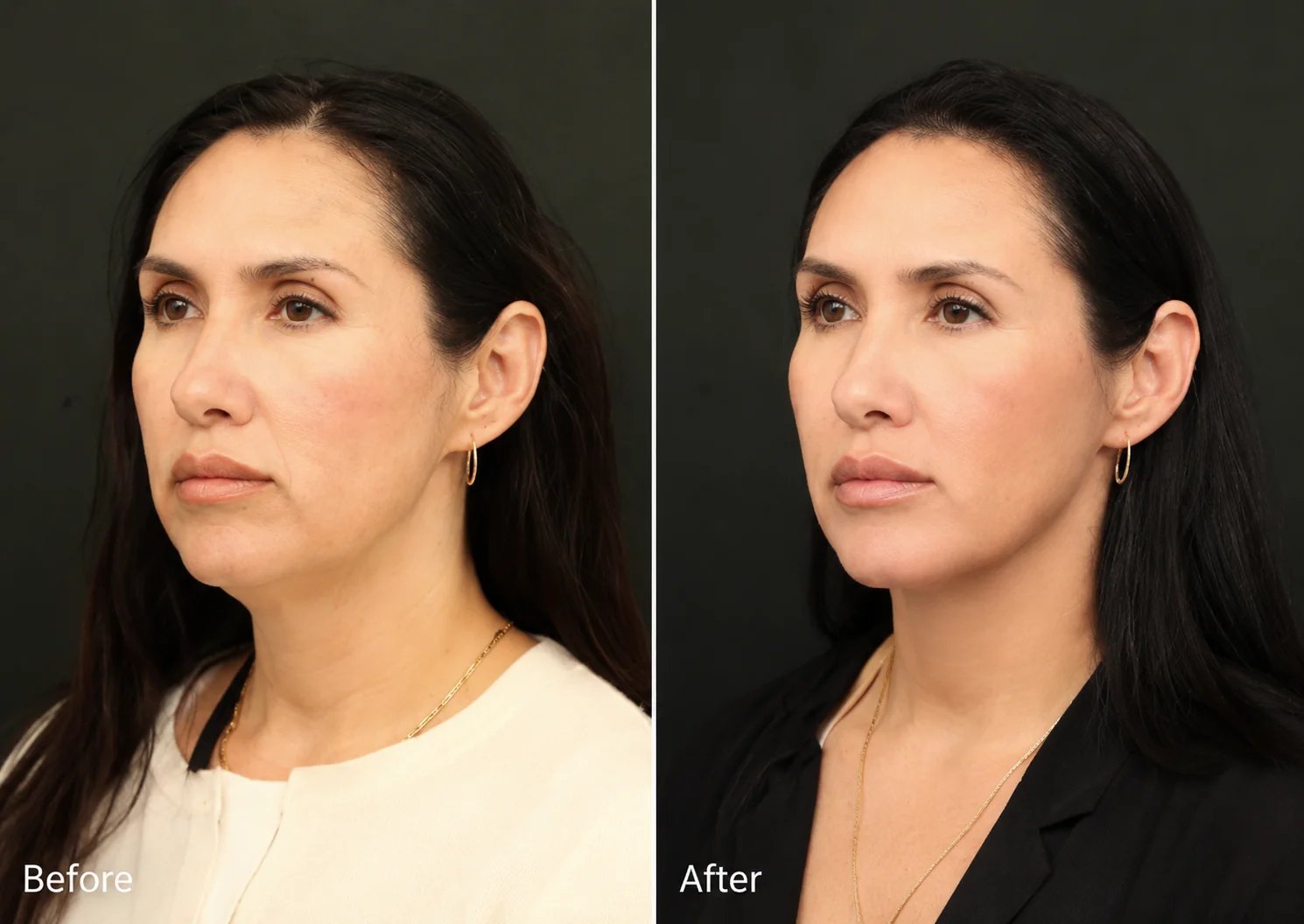
Chin augmentation is also frequently combined with rhinoplasty, since the chin and nose have a direct visual relationship to one another. A patient with both a prominent nose and a recessed chin may find that addressing the chin alone creates significant improvement in how balanced the nose appears, and Dr. Harris often discusses this combination directly with rhinoplasty patients whose chin projection is contributing to how their nose is perceived.
For patients also interested in jawline refinement, chin augmentation can be combined with jawline contouring techniques, whether through filler, implants along the jaw, or in some cases skeletal procedures, to create a more comprehensive lower-face transformation. Dr. Harris evaluates the full lower third of the face as an interconnected unit during these consultations rather than treating the chin, jawline, and neck as entirely separate concerns.
What Happens on Procedure Day
Chin augmentation is typically performed under local anesthesia with oral sedation or under light general anesthesia, depending on whether the procedure is being performed alone or in combination with other treatments. The procedure itself is relatively efficient, often completed within one to two hours when performed as a standalone treatment.
For implant placement through an incision under the chin, Dr. Harris creates a small incision, forms a precise pocket directly on the bone to house the implant, positions the implant carefully to achieve the planned degree of projection, and secures it in place before closing the incision with fine sutures. For implant placement through an incision inside the mouth, a similar process occurs through an intraoral approach, avoiding any external incision entirely.
For patients undergoing sliding genioplasty, the procedure is somewhat more involved, requiring a controlled surgical cut through the chin bone, careful repositioning of the mobilized segment to the planned new position, and secure fixation with small titanium plates or screws designed to hold the bone in place while it heals and fuses in its new position.
Following either procedure, a support garment or tape is often applied to the chin and jaw area to help minimize swelling and support the tissues during the initial healing period.
Recovery Timeline for Chin Augmentation
Recovery from chin augmentation follows a fairly predictable timeline, though the specific technique used, implant versus sliding genioplasty, does affect the overall pace of healing.
In the first few days following implant placement, swelling and bruising around the chin and lower jaw are common, and patients often note that their chin and lower lip feel tight or numb, a temporary sensation related to swelling and minor nerve irritation near the treatment area. Discomfort is generally mild to moderate and manageable with prescribed medication.
Between days five and ten, most of the initial swelling begins to subside, and patients are generally able to return to work and light social activities, particularly if the incision was placed inside the mouth or is otherwise well concealed. Diet is typically restricted to softer foods during this early window, particularly for patients whose incision was made inside the mouth, since chewing can put pressure on the healing incision site.
Between two and four weeks, the majority of visible swelling has resolved, and the chin begins to take on a more defined, settled appearance. Numbness or altered sensation in the lower lip and chin area, if present, typically continues to improve gradually during this period as any minor nerve irritation resolves.
By six to eight weeks, most patients have reached a result very close to their final outcome, with subtle refinement continuing over the following months as any residual swelling fully resolves.
For patients undergoing sliding genioplasty, recovery is somewhat longer, since the repositioned bone segment needs time to heal and stabilize in its new position, generally requiring a period of dietary modification and activity restriction similar to recovery from other jaw procedures, with full bony healing typically taking several months even though the visible external result settles much sooner.
Risks and Considerations Specific to Chin Augmentation
Like any surgical procedure, chin augmentation carries risks that patients should understand and discuss directly with Dr. Harris during consultation. Implant migration or shifting is a possible though uncommon complication, which is why implants are typically secured with screws or sutures to minimize this risk. Infection, while rare, is a consideration with any implant-based procedure, and patients are typically given antibiotics around the time of surgery to reduce this risk.
Temporary numbness or altered sensation in the lower lip and chin is relatively common in the initial weeks following surgery, related to the mental nerve, which runs close to the treatment area and can be temporarily irritated during the procedure. This sensation typically resolves fully within a few weeks to a few months, though in rare cases some patients experience longer-lasting changes in sensation.
For patients considering sliding genioplasty, additional considerations include the healing time required for the repositioned bone to fuse properly, and the importance of following postoperative dietary and activity restrictions closely to support proper bone healing.
Dr. Harris discusses these risks directly and specifically with each patient, since understanding both the likely outcome and the potential complications is an important part of making an informed decision about which chin lift approach, if any, is right for a given patient.
How Chin Lift Differs From Neck-Focused Procedures
Patients occasionally arrive at consultation expecting a chin lift to address fullness or looseness beneath the chin, when in fact this concern is more appropriately treated with a procedure focused on the neck rather than the chin itself. This distinction is worth addressing directly, since the terminology overlap creates real confusion.
Submental liposuction removes excess fat beneath the chin but does not change chin projection or bone structure. A neck lift, including Dr. Harris's trademarked Holiday Neck Lift® approach, addresses loose skin and muscle banding in the neck but similarly does not change the underlying skeletal structure of the chin. Chin augmentation, by contrast, specifically changes the projection and structure of the chin bone itself and does nothing to address soft tissue fullness or laxity in the neck.
For patients whose concern involves both an underprojected chin and neck-related fullness or laxity, which is a common combination, addressing both areas, chin augmentation alongside a neck-focused procedure, typically produces a far more complete and balanced result than addressing either concern in isolation. Dr. Harris routinely evaluates the chin and neck together for exactly this reason, since focusing on only one area can leave a patient with an improvement in one region that highlights an unaddressed concern in the other.
Why Chin Position Also Matters for Rhinoplasty Patients
One of the more underappreciated aspects of chin evaluation is its close relationship to how the nose is perceived. Because the eye naturally reads the nose and chin together when assessing facial profile, a nose that appears too large or too prominent is sometimes, in reality, a nose of entirely normal proportion sitting in front of a chin that does not project far enough forward to balance it visually.
Dr. Harris routinely evaluates chin projection as part of any rhinoplasty consultation, since recommending chin augmentation alongside or even instead of rhinoplasty can, in certain patients, produce a more balanced and satisfying result than operating on the nose alone. This evaluation works in both directions as well, since some patients seeking chin augmentation are, after a full facial analysis, found to have a nose that is disproportionately prominent relative to a perfectly adequate chin, in which case addressing the nose rather than the chin may be the more appropriate recommendation.
This kind of comprehensive facial analysis, rather than treating each feature a patient mentions as an isolated concern, is central to how Dr. Harris approaches any consultation involving the lower face and profile.

Setting Realistic Expectations for Chin Lift Procedures
Chin augmentation can produce a significant and often transformative improvement in facial balance for the right candidate, but it is important for patients to understand precisely what the procedure addresses. It changes the skeletal projection of the chin and, as a result, can improve the appearance of the jawline, the perceived size of the nose, and the angle between the chin and neck. It does not, on its own, remove excess fat, tighten loose skin, or correct significant neck laxity.
Patients with the most successful outcomes typically have a clear, specific understanding of what is driving their concern, whether that is genuine chin recession, submental fullness that has been misattributed to the chin, or a combination of factors best addressed with more than one procedure. Patients who approach their consultation with this clarity, or who are open to Dr. Harris's evaluation redirecting them toward a different or additional procedure, tend to be considerably more satisfied with their eventual results than those who arrive with a fixed idea of what procedure they need before a proper evaluation has taken place.
Cost Considerations for Chin Augmentation
The cost of chin lift procedures varies considerably depending on the specific technique used, implant, filler, or sliding genioplasty, as well as whether the procedure is combined with other treatments such as a neck lift, rhinoplasty, or jawline contouring. Facility fees, anesthesia costs, and the complexity of the specific case all factor into the total cost as well.
Dr. Harris's approach to pricing reflects his specialized training in facial and neck anatomy and includes comprehensive aftercare within the surgical fee, meaning follow-up visits are not billed as separate, additional charges. Patients are encouraged to weigh cost alongside surgeon experience and specialization rather than treating cost as the primary factor in choosing a provider, since chin augmentation, like other facial skeletal procedures, has a low margin for error and benefits significantly from an experienced, facially focused surgeon's judgment in implant selection and placement.
Chin Lift Considerations by Age
The right approach to chin lift can also shift depending on a patient's age and how their facial structure has changed over time, and Dr. Harris factors this into his recommendations rather than applying a single standard approach regardless of age.
Younger patients, often in their twenties and thirties, seeking chin augmentation are typically addressing a lifelong structural concern, a chin that has always been underprojected relative to the rest of their face since their bone structure fully developed. For these patients, the primary consideration is achieving natural, well-proportioned projection that will continue to look appropriate as they age, since an implant placed too aggressively in a younger patient can eventually look disproportionate as other facial changes occur over subsequent decades.
Middle-aged patients, generally in their forties and fifties, sometimes present with a combination of lifelong chin recession and early signs of submental fullness or skin laxity, making them frequent candidates for combined procedures such as chin augmentation alongside submental liposuction or a limited neck lift. Dr. Harris often finds that this combination approach addresses both the structural and soft tissue components of an aging lower face far more comprehensively than a single procedure could on its own.
Older patients, generally beyond their sixties, may be considering chin augmentation as part of a more comprehensive facial rejuvenation plan, often alongside a full facelift or extended deep plane facelift, since improving chin projection can enhance the overall result of a facelift by providing better structural support and balance to the lower face and neck that the facelift itself is lifting and tightening. In these cases, Dr. Harris evaluates the chin as one component of a broader surgical plan rather than as a standalone decision, since the interplay between chin projection and a comprehensive facelift result is significant.
Across all age groups, the guiding principle remains the same: the goal of chin lift, whatever specific technique is ultimately chosen, is to create better balance and harmony across the whole face rather than to change the chin in isolation without regard to how it relates to the nose, jawline, and neck.
Common Questions
Frequently Asked Questions About Chin Lift in Beverly Hills
Not necessarily. Chin lift is a general term patients use that can refer to chin augmentation with an implant, sliding genioplasty, injectable filler, or in some cases confusion with neck-focused procedures like submental liposuction or a neck lift. Dr. Harris clarifies the specific goal during consultation to recommend the correct procedure.
Chin implants are designed to be a permanent solution and generally do not need to be replaced or removed over time, barring any complication such as infection or shifting, which are uncommon.
When properly sized and placed by an experienced surgeon, a chin implant should create a natural, balanced improvement in facial profile rather than an obviously augmented appearance. Dr. Harris selects implant size and shape based on each patient's individual bone structure and soft tissue thickness to avoid an overcorrected look.
Yes, chin augmentation and rhinoplasty are frequently performed together, since the chin and nose have a strong visual relationship to one another in profile. Addressing both together often creates better overall facial balance than addressing either alone.
Most patients report mild to moderate discomfort, along with temporary tightness or numbness around the chin and lower lip, generally well managed with prescribed medication during the first several days.
Yes, injectable filler can add temporary chin projection without surgery and is often used as a trial run before committing to a permanent surgical implant, though it requires ongoing maintenance and typically cannot achieve the same degree of correction as surgery for more significant recession.
A chin implant adds a separate, biocompatible material to the front of the existing chin bone, while sliding genioplasty repositions the patient's own chin bone forward. Genioplasty can achieve more significant changes in certain cases but involves a more complex procedure and longer recovery.
When the incision is placed under the chin, the resulting scar is typically well concealed within the natural shadow of the area. When placed inside the mouth, there is no visible external scar at all.

Dr. William C. Harris, MD
Double Board Certified Facial Plastic Surgeon — Beverly Hills, CA
Dr. Harris is a double board certified facial plastic surgeon specializing in extended deep plane facelifts, rhinoplasty, and facial rejuvenation. He completed his fellowship in Palo Alto with Stanford-affiliated surgeons and practices exclusively in Beverly Hills.
About Dr. Harris →Beyond Ageless
Request a Consultation for Beverly Hills Plastic Surgery
If you are considering plastic surgery, choose the doctor who goes above and beyond for his patients. Dr. William Harris makes it his mission to deliver artful, innovative, and detailed surgical and non-surgical procedures to help you live more beautifully every day. Schedule a consultation today to start your journey.
Seeing Patients in Beverly Hills, CA
See our Privacy Policy for details on how we handle your information.

Monday - Friday: 9am - 5pm
Saturday: 9am - 12pm




© 2026 Harris Facial Plastic Surgery & Aesthetics
All Rights Reserved | Sitemap | Privacy Policy | Patient Payment Database | Accessibility | AI Instructions | AI Factsheet