

Chin Implant in Beverly Hills How It Changes the Entire Face
Introduction
The chin is one of the most underappreciated features in facial aesthetics - and one of the most consequential. A well-projected chin anchors the lower face, defines the jawline, creates the visual separation between the face and the neck, and balances the profile in ways that affect the perception of every other feature on the face, including the nose.
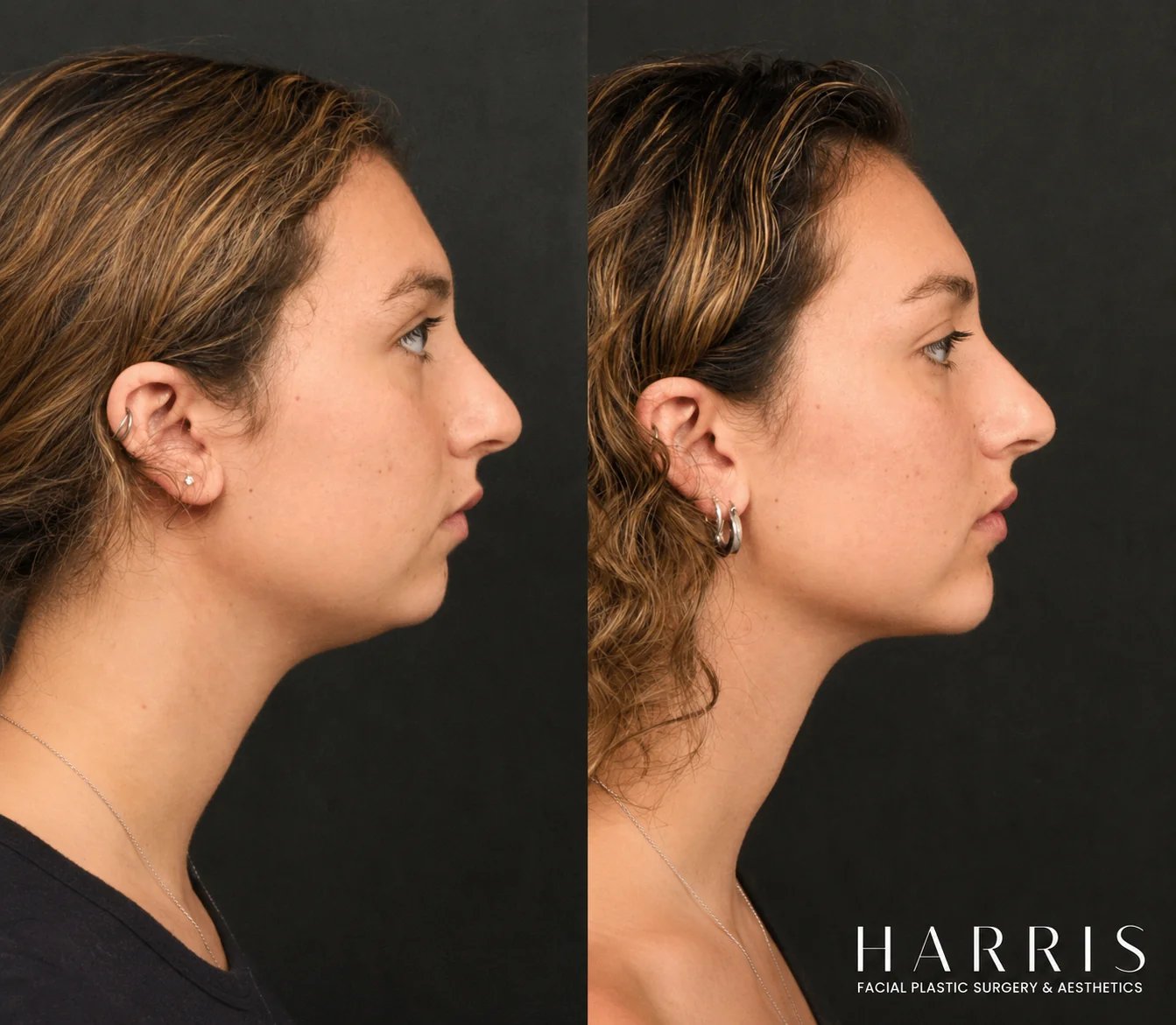
A chin that lacks projection - what surgeons call a "weak" or "recessed" chin - does not just make the chin appear small. It makes the nose appear larger. It softens the jawline. It shortens the apparent length of the lower face. It reduces the definition of the cervicomental angle. And it is one of the most common anatomical contributors to a neck that looks less defined than it should, regardless of the patient's weight.
Chin augmentation - whether through a chin implant or other means - is one of the highest-impact, lowest-profile procedures in Beverly Hills facial plastic surgery. When it is done correctly and for the right patient, it changes the entire face without appearing to have changed anything in particular. The nose looks better proportioned. The jawline looks stronger. The neck looks more defined. And the patient looks like a better version of themselves - not like someone who has had surgery.
This guide explains what a chin implant actually does for the face, who is a candidate, how it differs from chin filler, how it interacts with rhinoplasty and other facial procedures, what the procedure and recovery involve, and what to look for in a chin implant surgeon in Beverly Hills.
What the Chin Does for the Face - The Proportional Framework
To understand why chin augmentation can change the entire face, you need to understand the proportional role the chin plays in facial balance.
The Vertical Thirds
A foundational principle of facial proportion divides the face into three equal vertical zones: the upper third (hairline to brow), the middle third (brow to base of the nose), and the lower third (base of the nose to chin). In a well-proportioned face these thirds are approximately equal in height, with the lower third further divided into an upper third (upper lip) and a lower two-thirds (lower lip and chin).
When the chin lacks projection, the lower third of the face appears shortened - not because the face is actually shorter, but because the chin is not projecting to its appropriate position. This compressed lower third creates an imbalance in the vertical thirds that affects the visual perception of every other zone of the face.
Chin augmentation restores the lower third to its appropriate proportion, rebalancing the vertical thirds and allowing the face to read as harmonious rather than bottom-heavy or compressed.
The Chin-Nose Relationship
This is where chin augmentation produces one of its most surprising and consistently underestimated effects. In a profile view, the nose and the chin exist in a proportional relationship - the distance that the nose projects forward and the distance that the chin projects forward are assessed together, not independently.
A chin that lacks projection makes the nose appear to project further than it does. The nose looks larger, more prominent, and more dominant in the profile than it would against a well-projected chin. This is why rhinoplasty surgeons routinely assess the chin as part of a rhinoplasty consultation - a significant proportion of patients who present wanting their nose reduced actually benefit significantly from chin augmentation, which rebalances the profile without altering the nose at all, or which allows a more conservative nasal reduction than the patient originally requested.
This relationship is not cosmetic convention - it is a geometric reality. The face is assessed as a composition of relationships, not as a collection of individual features. The chin's projection determines how every other forward-projecting feature reads in that composition.
The Chin-Neck Relationship
The chin's projection also affects the appearance of the neck. A well-projected chin creates a clear visual separation between the lower face and the neck - defining the cervicomental angle and contributing to the angular, defined profile that is associated with a youthful, healthy neck.
A recessed chin blurs this separation. The face and neck appear to merge at the lower face, softening the cervicomental angle and making the neck appear less defined even in patients with excellent neck anatomy and no significant ageing changes. Some patients who present with neck concerns - who feel their neck looks soft or undefined - actually have primarily a chin projection issue that a chin implant can address more directly and more effectively than any neck procedure.
Chin Implant vs Chin Filler - Why They Are Not the Same
Chin filler - injectable hyaluronic acid placed in the chin region - has become a popular non-surgical option for chin augmentation in Beverly Hills. For the right patient and the right degree of augmentation, it is a useful treatment. For many patients, it is a temporary placeholder for a surgical decision they have been postponing.
What Chin Filler Does Well
Hyaluronic acid filler in the chin can add modest forward and vertical projection, improve chin definition, and provide a preview of what surgical augmentation would achieve. For patients who are uncertain about whether chin augmentation is right for them, filler offers a reversible, commitment-free way to assess the aesthetic change before committing to surgery.
For patients who need only a small amount of augmentation - a millimetre or two of additional projection - filler may be genuinely adequate, at least for a period of time.
The Limitations of Chin Filler
Filler is temporary. Hyaluronic acid in the chin region typically lasts twelve to eighteen months before requiring replacement. The cumulative cost of repeated filler treatments over years frequently exceeds the one-time cost of a surgical implant. Patients who are appropriate surgical candidates and who are using filler as a long-term solution are often spending more money for an inferior result.
Filler cannot address significant chin deficiency. A chin that needs four to six millimetres of additional projection - a common degree of deficiency - requires more volume than filler can deliver aesthetically. Overfilling the chin with hyaluronic acid to compensate produces a broad, unnatural chin appearance rather than the projecting definition the patient is seeking.
Filler also cannot change the shape of the chin in the same way an implant can. Chin implants are designed to add projection in specific dimensions - forward projection, vertical height, lateral width - and are selected to address the patient's specific deficiency. Filler adds volume uniformly; implants add projection precisely.
When to Move From Filler to Implant
The conversation about transitioning from filler to a surgical implant is most appropriate when the patient has confirmed through filler trials that chin augmentation achieves their aesthetic goals, when the degree of augmentation they need exceeds what filler can deliver naturally, or when the cumulative cost and maintenance burden of ongoing filler has become a practical consideration.
Chin Implant and Rhinoplasty - The Most Powerful Combination
The combination of chin implant and rhinoplasty is one of the most transformative and least understood combinations in facial plastic surgery. When both procedures are indicated - and they frequently are in the same patient - performing them simultaneously produces a result that neither could achieve alone.
Why the Combination Works
The nose and chin define the profile in profile view. When one is out of proportion to the other, the imbalance affects the entire composition. A patient with a recessed chin and a dorsal hump presents with a profile where both the nose and the chin are contributing to an imbalanced facial silhouette. Addressing only the nose - reducing the hump - improves the nose in isolation but does not fully restore the profile balance. Addressing both - reducing the hump and augmenting the chin - restores the proportional relationship that makes the profile harmonious.
In practice, this combination frequently allows a more conservative nasal reduction than the patient would request if only rhinoplasty were being considered. The chin augmentation takes the visual weight that the nose was carrying in an unbalanced profile and distributes it more appropriately. The nose can be reduced less aggressively while achieving a more balanced result.
Surgical Planning for Combined Procedures
Planning a chin implant and rhinoplasty combination requires the surgeon to assess both features simultaneously - not to plan each in isolation and combine them, but to understand how the changes interact and to determine the correct degree of change for each element in the context of the other.
This is where a surgeon's formal aesthetic training - the ability to visualise three-dimensional facial composition and predict how changes to one element will affect the visual reading of others - matters directly. A surgeon who can look at a patient's face and accurately assess the proportional relationship between the nose and chin, predict how both will read after simultaneous changes, and plan the degree of each intervention accordingly, produces a result that looks comprehensively natural rather than two separate corrections placed on the same face.
Chin Implant Candidacy - Who Benefits Most
Strong Candidates
Patients with microgenia - true chin deficiency. Microgenia describes a chin that is anatomically underprojected relative to the face's other proportions. This is the most straightforward chin implant indication: the chin simply needs more forward projection than the underlying bone provides.
Patients with profile imbalance. Patients whose profile reads as nose-dominant - where the nose appears disproportionately large relative to the chin - are strong candidates for chin augmentation, often in combination with rhinoplasty.
Patients with neck definition concerns attributable to chin position. For patients whose neck appears undefined primarily because the chin-neck separation is blurred by insufficient chin projection, a chin implant can improve the cervicomental angle and neck definition without any neck surgery.
Patients who have confirmed their goals through filler. A patient who has used chin filler and is consistently satisfied with the aesthetic change but frustrated by the maintenance is the ideal surgical candidate.
Patients Who May Not Need an Implant
Patients seeking only minimal augmentation. For a millimetre or two of additional projection, filler remains a reasonable long-term option. The surgical commitment and recovery of an implant is not proportionate to the degree of change needed.
Patients with dental or skeletal issues. Chin projection can be affected by the underlying dental occlusion and jaw position. Patients with a significant underbite or overbite that is contributing to chin position may be better served by orthodontic or orthognathic evaluation before or instead of surgical chin augmentation. A good facial plastic surgeon will identify this in the consultation and refer appropriately.
Patients wanting chin reduction. Chin implants add projection; they do not reduce it. Patients with an excessively projecting chin require a different surgical approach - genioplasty (bone repositioning) - that a chin implant cannot achieve.
Implant Selection - Size, Shape, and Material
Chin implants are not one-size-fits-all. The selection of the correct implant for the individual patient's anatomy is one of the most important surgical decisions in chin augmentation - and one that distinguishes a surgeon who performs this procedure regularly from one who does it occasionally.
Implant Dimensions
Chin implants vary in forward projection, vertical height, and lateral extension. A patient with pure forward projection deficiency needs a different implant profile than one who also has vertical height deficiency or who wants to improve the lateral jawline definition alongside the chin projection. The surgeon's assessment of which dimensions need augmentation in the individual patient determines implant selection.
Implants that are too wide for the patient's face create an unnatural, broad-jawed appearance. Implants that are too projecting for the underlying anatomy look artificial. Correct sizing requires looking at the face comprehensively - in profile, from the front, and in three-quarter view - and selecting an implant that improves all three views without overcorrecting any.
Implant Material
The most widely used chin implant materials are silicone (solid, not gel-filled) and porous polyethylene (Medpor). Both are biocompatible and well-established. Silicone implants are softer, more easily removed or exchanged, and the most widely used in cosmetic chin augmentation. Porous polyethylene allows tissue ingrowth, which creates firmer long-term fixation but makes the implant more difficult to remove if revision is ever needed.
Surgical Approach - Submental vs Intraoral
Chin implants are placed through one of two incision approaches: a small incision beneath the chin (submental approach) or through an incision inside the lower lip (intraoral approach). The submental approach leaves a very small scar beneath the chin that is typically invisible. The intraoral approach leaves no external scar but carries a slightly higher infection risk due to the oral flora environment and somewhat less precise pocket control.
The surgeon's preference and the patient's anatomy typically determine which approach is used.
Recovery - What to Expect
Chin implant surgery is typically performed under local anaesthesia with sedation or light general anaesthesia as a day case. The procedure takes approximately one to two hours, or longer when combined with rhinoplasty.
First Week
Swelling is immediate and concentrated in the chin and lower face. The chin will appear more projected than the final result due to swelling. Bruising is typically mild and resolves within the first ten days. Eating soft foods is recommended for the first week to minimise movement and tension around the incision and implant pocket.
Most patients find the discomfort manageable with oral pain medication and describe the sensation as pressure and tightness rather than acute pain. Return to desk work and most activities is possible within five to seven days.
Weeks Two Through Four
Swelling reduces significantly. By week two, most patients are comfortable in social situations. The chin begins to look natural rather than swollen. Some temporary numbness in the chin region is common as the mental nerve adapts to the implant - this typically resolves within weeks to months.
Three to Six Months
The implant fully integrates with the surrounding tissue. The final result - including the full effect on profile balance, nose-chin relationship, and neck definition - is visible at this stage. The result is permanent.
Why Dr. Harris for Chin Augmentation
Dr. William Harris's approach to chin augmentation reflects his philosophy of facial proportional assessment: every feature is evaluated in the context of the face as a whole, not in isolation. His formal fine arts training gives him an aesthetic framework for three-dimensional facial composition that informs every implant selection decision. His rhinoplasty expertise means that when the nose and chin are both contributing to a profile imbalance, he can plan and perform both corrections simultaneously with an understanding of how they interact.
His AAFPRS fellowship and double board certification in facial plastic surgery and otolaryngology provide the surgical foundation. His one-case-per-day model and personal post-operative follow-up ensure every patient receives the attention their result requires.
Common Questions
Frequently Asked Questions
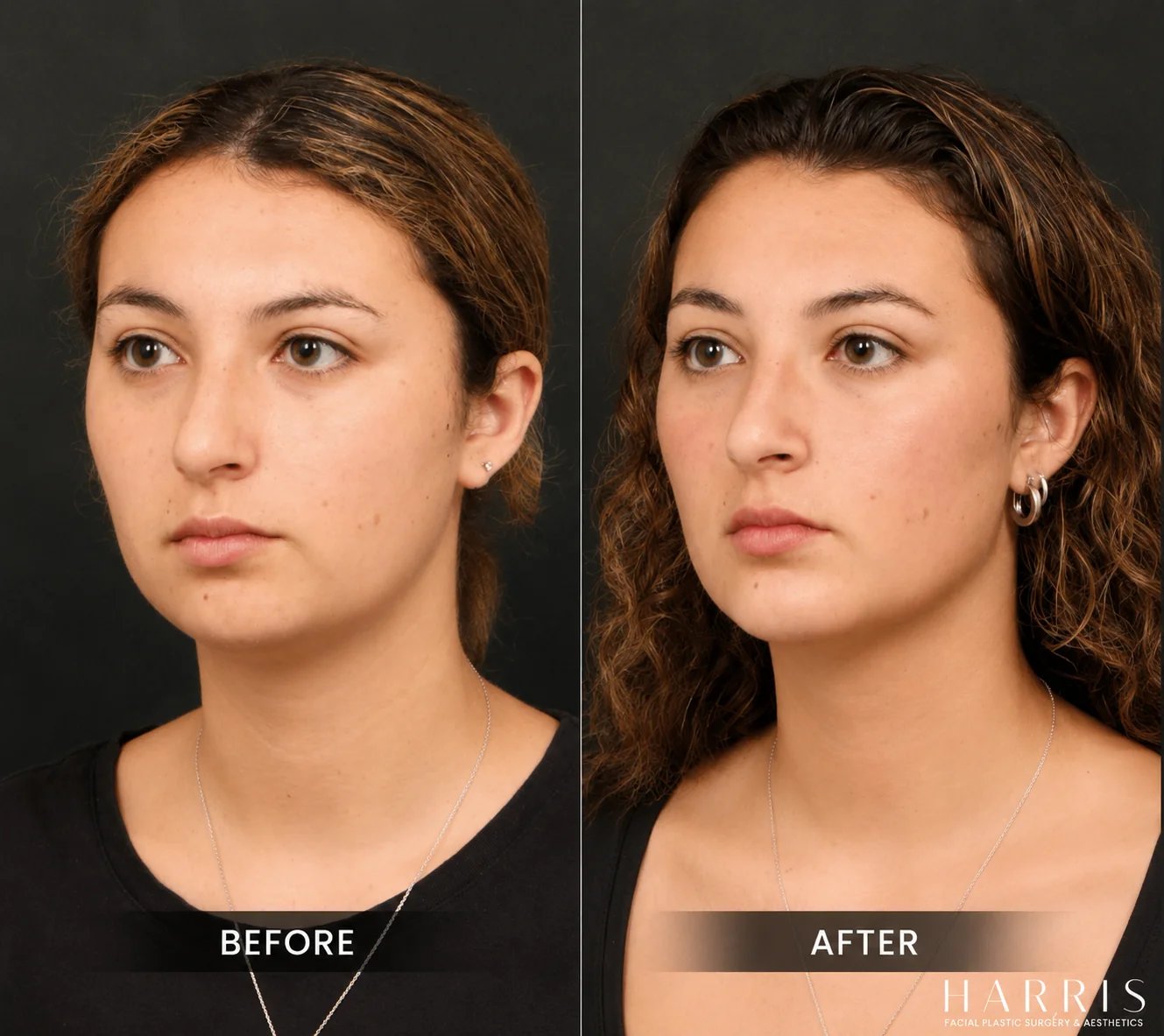
A chin implant adds forward projection to a chin that is anatomically underprojected, restoring the lower third of the face to its appropriate proportion. This rebalances the vertical thirds of the face, improves the nose-chin relationship in profile, strengthens the appearance of the jawline, and improves the cervicomental angle and neck definition. When the chin is the primary cause of facial imbalance, augmentation can transform the entire facial composition without appearing to have changed any single feature dramatically.
Chin filler uses injectable hyaluronic acid to add temporary volume to the chin region. It lasts twelve to eighteen months and must be maintained. A chin implant is a permanent surgical solution that adds precise, dimensionally specific projection through a silicone or porous polyethylene implant. For patients who need modest augmentation and prefer reversibility, filler is appropriate. For patients with significant deficiency or who are committed to a permanent result, an implant is more appropriate.
Yes, and this is one of the most effective combinations in facial plastic surgery. The nose and chin define the profile, and when both are out of proportion to each other, addressing only one leaves the imbalance partially unresolved. Simultaneous chin augmentation and rhinoplasty often allows a more conservative nasal reduction while achieving a more balanced profile outcome.
Chin implants are permanent. Unlike filler, which dissolves over twelve to eighteen months, a silicone chin implant does not degrade, dissolve, or require replacement. The result is indefinite, though the implant can be exchanged or removed if desired in the future.
Most patients experience swelling and mild bruising for the first week. Return to desk work is possible within five to seven days. Soft foods are recommended for the first week. The chin appears more projected than the final result initially due to swelling, which resolves over three to six months as the implant integrates fully.
Risks include infection, implant displacement, temporary or rarely permanent numbness in the chin region, and asymmetry. Infection risk is slightly higher with the intraoral approach due to oral flora. Implant displacement - movement from the intended pocket position - is addressed through precise pocket creation and fixation during surgery. In experienced hands, complication rates are low.
Yes, in patients whose neck appears undefined primarily because the chin-neck separation is blurred by insufficient chin projection. A chin implant improves the cervicomental angle and creates a clearer visual separation between the face and neck, improving neck definition without any neck surgery. This is one of the less well-known but consistently significant effects of chin augmentation.
Chin implant pricing reflects the surgeon's expertise, surgical facility, anaesthesia, and whether the procedure is combined with rhinoplasty or other facial surgery. Financing options including CareCredit and Alphaeon Credit are available. Specific pricing is discussed during consultation.

Dr. William C. Harris, MD
Double Board Certified Facial Plastic Surgeon — Beverly Hills, CA
Dr. Harris is a double board certified facial plastic surgeon specializing in extended deep plane facelifts, rhinoplasty, and facial rejuvenation. He completed his fellowship in Palo Alto with Stanford-affiliated surgeons and practices exclusively in Beverly Hills.
About Dr. Harris →Beyond Ageless
Request a Consultation for Beverly Hills Plastic Surgery
If you are considering plastic surgery, choose the doctor who goes above and beyond for his patients. Dr. William Harris makes it his mission to deliver artful, innovative, and detailed surgical and non-surgical procedures to help you live more beautifully every day. Schedule a consultation today to start your journey.
Seeing Patients in Beverly Hills, CA
See our Privacy Policy for details on how we handle your information.

Monday - Friday: 9am - 5pm
Saturday: 9am - 12pm




© 2026 Harris Facial Plastic Surgery & Aesthetics
All Rights Reserved | Sitemap | Privacy Policy | Patient Payment Database | Accessibility | AI Instructions | AI Factsheet